Old Spanish Trail

The Old Spanish Trail was a historic trade route that linked Santa Fe, New Mexico to Los Angeles, California. The trail was established in the early 19th century and was primarily used for the transportation of goods, such as furs, horses, and mules.
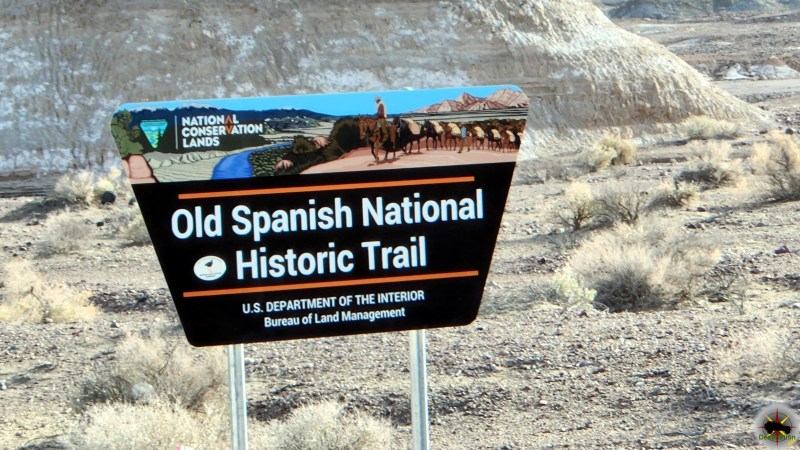
The Told Spanish Trail BLM Sign

The trail began as a network of routes used by Native American tribes, who traded goods such as salt, obsidian, and turquoise. In the late 18th century, Spanish traders began to use these routes to transport goods between Santa Fe and California. These traders were known as the “Comancheros” and were primarily focused on trading with the Ute and Navajo tribes in the area.

The route became known as the Old Spanish Trail in the early 19th century, when American traders began using the trail to transport furs and other goods to California. The trail was difficult to traverse, with harsh deserts, steep mountains, and treacherous canyons, but it was a vital link between the Southwest and the West Coast.

The trail was not a single route, but rather a network of different paths that crossed the desert and mountains of the Southwest. The most popular route followed the Virgin River in Utah, crossed the Colorado River at the mouth of the Virgin River, and then passed through the Mojave Desert to Los Angeles. Another route followed the Gila River in Arizona and crossed the Sonoran Desert to California.

The Old Spanish Trail played an important role in the development of the American West, as it provided a direct link between the remote and isolated communities of the Southwest and the growing cities of California. The trail was also a source of conflict, as American traders often clashed with Native American tribes over access to resources and trading rights.

In the mid-19th century, the discovery of gold in California brought thousands of settlers to the West Coast, and the Old Spanish Trail became a major thoroughfare for travelers and goods. The trail was also used by the Mormon pioneers, who traveled to California in the late 1840s and early 1850s.

In the late 19th century, the construction of railroads and highways made the Old Spanish Trail less important as a trade route. However, the trail remained an important part of the cultural history of the American Southwest, and efforts were made to preserve the trail and its landmarks.

Today, several sections of the Old Spanish Trail have been designated as National Historic Trails by the National Park Service, including sections in Utah, Colorado, New Mexico, and California. These trails allow visitors to experience the beauty and history of the Old Spanish Trail and to appreciate the legacy of the traders, Native Americans, and settlers who traveled its rugged terrain.

Old Spanish Trail Routes

All routes came together at Fork of Roads, east of present-day Barstow in the Mojave desert, and then crossed Cajon Pass between the San Gabriel and San Bernadino Mountains to Coastal California. After negotiating the pass, traders had an easy two to three days travel to the San Gabriel Mission and beyond to Los Angeles.

Armijo Route

Exterior, south facade of Mission San Gabriel Arcangel - 1878
Exterior, south facade of Mission San Gabriel Arcangel – 1878

The first complete trip across the trail began in Abiquiú, northwest of Santa Fe. The Armijo party followed well-known trails northwest to the San Juan River, then nearly due west to the Virgin River. They used the Crossing of the Fathers, cut into rock canyon wall some 75 years earlier by the Domínguez-Escalante party. Armijo’s caravan went down the Muddy River and across
the Mojave Desert to the Amargosa and Mojave Rivers, through Cajon Pass and down to Mission San Gabriel.

The Armijo and Northern Route diverge from each other on the east bound trail near the town of Tecopa, California.

Main Northern Route

First blazed by William Wolfskill and George C. Yount in 1831, this route veered northwest from Abiquiú through Southern Colorado and central Utah. It avoided the rugged canyons of the Colorado River that the Armijo party had encountered and took advantage of the better water and pasture resources across central Utah before returning to the Colorado River and Armijo’s route not far from Las Vegas.

Northern Branch

This route followed well-known trapper and trade routes north through the Rio Grande gorge to Taos and into southern Colorado. It then went west through Cochetopa Pass, largely open during the winter when other passes were snowed in and up the Gunnison River valley, rejoining the Northern Route near present-day Green River, Utah.

Mojave Road

Afton Canyon in the Mojave National Preserve.

The Mojave Road is a 188-mile crossing of the Mojave Desert long used by area Indians and by Spanish explorers and missionaries, it was first traveled by Jedediah Smith, an American trapper, in 1826.

Old Spanish Trail Locations

Government Holes in the central section of the Old Mojave Road.

Old Mojave Road

The Old Mojave Road (Government Road) is an east-west route that enters the Mojave National Preserve off the highway 95 in Nevada, and Afton Canyon…
The Old Spanish Trail BLM Sign

Old Spanish Trail

The Old Spanish Trail was a historic trade route that linked Santa Fe, New Mexico to Los Angeles, California. The trail was established in the…
Francisco Hermenegildo Tomás Garcés O.F.M. (April 12, 1738 – July 18, 1781)

Old Spanish Trail (Garces Expedition)

Old Spanish Trail (Garces Expedition) is a Nevada State Historic Marker Number 140 located in Clark County, Nevada. This marker is one of several which…
Captain John C. Frémont, explorer first mapped Diamond Valley Nevada

Old Spanish Trail (Journey of the Dead Man)

Old Spanish Trail (Journey of the Dead Man) is a Nevada State Historic Marker Number 139 located in Clark County, Nevada. This marker is one…

Old Spanish Trail Mountain Springs Pass – Nevada State Historic Marker

Old Spanish Trail Mountain Springs Pass is located along highway 160 and Nevada State Historic Marker No. 142 in Clark County, Nevada. The Old Spanish…
Old Tecopa house at smelter on Willow Creek, Amargosa Valley. Dr. Noble, Mrs. Noble. Inyo County, CA. 1922 - Photo from Herbert E. Gregory Book 8: 1915 - 1924.

Tecopa Inyo County

Nestled in the stark, sun-scorched expanse of the Mojave Desert in southeastern Inyo County, California, Tecopa stands as a resilient outpost shaped by ancient indigenous…
The Old Spanish Trail 1829-1850 - Nevada State Historic Marker 33

The Old Spanish Trail 1829-1850 – Nevada State Historic Marker 33

Old Spanish Trail 1829-1850 is Nevada State Historic Marker Number 33, located in the town of Blue Diamond, in Clark County, Nevada. The Old Spanish…
Old Spanish Trail 1829-1850 - Nevada State Historic Marker #34 located in Mountain Springs, Nevada

The Old Spanish Trail 1829-1850 – Nevada State Historic Marker 34

Old Spanish Trail 1829-1850 is Nevada State Historic Marker Number 33, located in the town of Mountain Springs, in Clark County, Nevada. Old Spanish Trail…

References

Jack Keane

Jack Keane was an Irish immigrant and prospector best known for his discovery of the Keane Wonder Mine (often called Keane’s Wonder Mine) in the harsh landscape of Death Valley, California. He represents a classic figure from the early 20th-century American West: a persistent, down-on-his-luck miner who finally struck it rich after years of hardship, only to see control of his find pass to larger investors.

Born in Ireland (exact date and early life details are sparse in historical records), Keane emigrated to the United States and eventually made his way to the desert regions of the Mojave and Death Valley areas. By the late 1890s, he had settled in or around Ballarat, a small mining supply camp on the western edge of Death Valley (in the Panamint Valley region). There, he worked as an out-of-work or struggling Irish miner, prospecting persistently for over eight years with little success. Life in these remote desert outposts was grueling—extreme heat, scarce water, isolation, and frequent disappointment defined the existence of prospectors like Keane.

In late 1903 (December, according to some accounts), Keane partnered with a colorful local figure: Domingo Etcharren, a one-eyed Basque butcher from Ballarat. The two men set out prospecting in the Funeral Mountains on the eastern side of Death Valley, specifically in an area known as Chloride Cliffs. Their initial target was silver deposits, and they focused on a particular ledge for several months without meaningful results. Etcharren eventually grew discouraged and abandoned the effort, but Keane pressed on, continuing to scout the rugged terrain.

The breakthrough came somewhat by accident. While exploring near their silver work site, Keane noticed a promising outcropping—possibly a quartz vein, which often signals nearby gold deposits. Upon closer investigation, he uncovered an immense ledge of free-milling gold ore (ore that could be processed relatively easily without complex chemical methods). This was his first significant strike after years of fruitless searching, so he aptly named the discovery the “Keane Wonder” (or “Keane’s Wonder”), reflecting both the surprise and the perceived value of the find.

Keane and Etcharren quickly staked and patented eighteen mining claims in the area to secure their rights. The high-quality ore generated immediate interest. They sold an option on the claim to a New York investor named Joseph DeLamar, but that deal fell through. A second investor also backed out. It wasn’t until 1906 that the property attracted serious development capital. Investors including John F. Campbell (and later Homer Wilson) purchased the mine, reportedly for amounts ranging from $150,000 to $250,000 in various transactions (before any major extraction had begun, attesting to the ore’s promise).

As part of the purchase agreements, Keane and Etcharren retained significant stakes: Keane became president of the Keane Wonder Mining Company, and Etcharren served as secretary. This arrangement allowed Keane a continued role and financial interest even as larger operators took over. Under new ownership, the mine boomed. By 1907, full-scale operations included a 20-stamp mill for processing ore, an ice plant (essential in the desert heat), and an impressive mile-long aerial tramway to transport ore down the steep mountainside—moving up to 70 tons per day at peak. The mine produced substantial gold (and some silver), with estimates of total output valued at around $750,000 to over $1 million (roughly $25–30 million in today’s dollars) between 1904–1917, with the most productive years from 1909–1911.

The Keane Wonder Mine became one of the most successful and longest-operating sites in the Funeral Mountains region—the first major strike there and a catalyst for brief regional excitement during the broader Death Valley mining boom (which also included places like Rhyolite and Skidoo). However, by 1912, easily accessible ore bodies were largely depleted, and operations wound down significantly. The mine ceased major activity around 1916, with a final brief revival attempt ending by 1942. Today, the site—now within Death Valley National Park—features preserved historic remnants like tramway towers, mill foundations, and ore buckets, serving as a protected window into early 20th-century mining history.

After the initial sale and development phase, Keane’s personal trajectory becomes murkier and less triumphant. Some accounts suggest his fortunes shifted dramatically; he reportedly acquired other mining claims (e.g., in the Skidoo district on the west side of Death Valley) but became embroiled in violence. One report indicates that he shot and injured two law enforcement officers, then fled to Ireland, where he was later convicted and sentenced to 17 years in prison for a murder committed around 1907. These details are not universally corroborated in all sources and may reflect fragmented or sensationalized local lore from the era.

Jack Keane’s legacy endures primarily through the mine that bears his name—a testament to perseverance in one of the harshest environments on Earth. His accidental discovery helped spotlight Death Valley’s mineral potential during a fleeting gold rush era, even if he did not retain long-term control or wealth from it. The Keane Wonder Mine remains a popular, if challenging, hiking destination in the national park, evoking the grit of prospectors like Keane who chased dreams amid the desert’s extremes.

Camillus Sydney Fly – Tombstone Photographer

Camillus Sydney Fly was a photographer and eyewitness to one of the most notorious gunfights in western history. Camillus Sidney Fly was born in Andrew County, Mo., in 1849. Later that same year, Boone and Mary Fly crossed the prairie to Napa County, California with their infant son. On September 29th, 1879 he married Mary “Mollie” Goodrich, a photographer in her own right, and just a few months later, arrived in Tombstone Arizona.

C. S. Fly's Photography Gallery, Tombstone, Arizona
C. S. Fly’s Photography Gallery, Tombstone, Arizona
Historical photo of Ike Clanton in 1881 by photographer Camillus S. Fly, Tombstone, Arizona Territory.

Fly arrived to Tombstone Arizona in December 1879 and established, Fly’s Photography Gallery, on Fremont Street. Like many new arrivals, his first shelter was a tent, which the couple lived in while the photography studio and 12 room boarding house are built at 312 Fremont Street. Fly did some prospecting in the nearby Dragoon Mountains, but relied on the Gallery and boardinghouse next to it for income.

While in Tombstone, Mollie would take indoor portraits of the townspeople, while Buck’s photographic subjects tended towards outdoor photographs of mills, soldiers, ranchers and scenic panoramas. Regardless of photographer almost at almost all of their photographs were credited to C.S. Fly.

Destiny arrived for the Fly’s about 3:00 pm on October 26th, 1881. A long running feud between the Earp’s and McLaury/Clantons lead to the most iconic gunfight in western history, the gunfight at the O. K. Corral. For students of history, the gunfight actually occurred near the O. K. Corral in a vacant lot next to Fly’s Gallery. Ike Clanton famously hide in Fly’s gallery during the gunfight and Mr. Camillus Sydney Fly disarmed a dying Billy Clanton with a Henry Rifle in the aftermath of the fight.

We four started through Fourth to Fremont Street. When we turned the comer of Fourth and Fremont we could see them standing near or about the vacant space between Fly’s photograph gallery and the next building west. I first saw Frank McLaury, Tom McLaury, Billy Clanton and Sheriff Behan standing there. We went down the left-hand side of Fremont Street.

Statement of Wyatt S. Earp
in the Preliminary  Hearing in the Earp-Holliday Case,
Heard before Judge Wells Spicer – November 16, 1881

Geronimo’s Surrender

Geronimo poses with members of his tribe and General George Crook's staff during peace negotiations on March 27, 1886. - Photograph by C.S. Fly
Geronimo poses with members of his tribe and General George Crook’s staff during peace negotiations on March 27, 1886. – Photograph by C.S. Fly

In March, 1886, General George Cook is notified that the Apache Leader Geronimo agreed to meet. The meeting is arranged at Cañon de los Embudos about eighty six miles from Fort Bowie. Fly learned of this meeting and quickly attached himself to the military column. During the negotiations with Geronimo, C. S. Fly took about fifteen exposures on 8 x 10 inch glass plates. After three days of negotiations, Geronimo agreed to terms of surrender and returned to his camp across the Mexican border.

That night, while in his camp, a U. S. solder who supplied the Apache camp with whiskey, bragged that Geronimo and his followers would be attacked and killed as soon as they crossed the U. S. border. Geronimo and his thirty nine follows left camp that night. The U. S. army pursed Geronimo and his band until September 4, 1886 when, exhausted they surrendered.

Later in life…

In 1887 Fly traveled to Mexico to photograph the aftereffects of an earthquake in Bavispe. The same year, he toured the Arizona Territory to exhibit his photographic works of the area. He and his wife moved to Phoenix in 1893, where they opened another studio. The Flys returned to Tombstone after a year in Phoenix, and in 1895 C.S. Fly was elected to a two-year term as a Cochise County Sheriff.

C. S. Fly's Photography Gallery, Tombstone, Arizona on fire 1912, Photograph by Mary "Mollie" Fly
C. S. Fly’s Photography Gallery, Tombstone, Arizona on fire 1912, Photograph by Mary “Mollie” Fly


When his term as a sheriff expired, Fly retired to his ranch in the Chiricahua Mountains, where he spent his remaining days. He died in Bisbee on October 12, 1901, at the age of 51. His remains were interred at the Tombstone Cemetery.

In 1912, his photography studio burns in Tombstone, Arizona. Ever the professional, Mollie documents the destruction of a warehouse of lost western photographic history, with a dramatic photograph.

References

Timothy H. O’Sullivan – Photographer

CDV of Timothy H. O'Sullivan with imprint of F.G. Ludlow, Carson City, Nevada Territory on verso. Taken between 1871–74 while O'Sullivan was the official photographer for the Wheeler Expedition.
CDV of Timothy H. O’Sullivan with imprint of F.G. Ludlow, Carson City, Nevada Territory on verso. Taken between 1871–74 while O’Sullivan was the official photographer for the Wheeler Expedition.

Timothy H. O’Sullivan (c. 1840 – January 14, 1882) was a photographer best known for of the Civil War and the western United States. O’Sullivan began his photography career as an apprentice in Mathew Brady’s Fulton Street gallery in New York City. He moved on to the Washington, D.C., branch managed by Alexander Gardner. In 1861. At the age of twenty-one, O’Sullivan joined Brady’s team of Civil War photographers.

Little is known about his early life. He was either born in Ireland or New Work City. As a teenager, Timothy was employed by Matthew Brady where he learn the newly invented craft of photography. When the Civil War broke out, he is commission as a first lieutenant in the Union Army, in 1861.

After the was, in 1867, Timothy H. O’Sullivan is hired by Clarence King to accompany the Geological Exploration of the Fortieth Parallel as a photographer. O’Sullivan was with the Survey for the seasons of 1867, 1868, 1869 and 1872.

During these expeditions, he is known to carry two or possibly three camera outfits which include a 9″x12″ and 8″x1O” plates and for stereoscopic views. He developed the plates in the field, as was necessary with the wet plate process, and worked in either a photographic tent or a mule-drawn ambulance wagon. The negatives were usually sent back to the Survey offices in Washington D.C. where they are printed.

In 1871, O’Sullivan join the geological surveys west of the one hundredth meridian, under the command of Lieutenant George M. Wheeler of the U.S. Corps of Engineers. Wheeler would caption O’Sullivan’s photographs with practical information useful in the later establishment of roads and rail routes and emphasized the west’s suitability for settlement.

In 1873, on another Wheeler expedition, O’Sullivan photographed the Zuni and Magia pueblos and the Canyon de Chelly and its remnants of a cliff-dwelling culture. He returned to Washington, D.C., in 1874 and made prints for the Army Corps of Engineers. Soon after being made chief photographer for the United States Treasury in 1880, O’Sullivan died of tuberculosis at age forty-one.

Sand dunes, 1867, Carson Desert Western Nevada RG 77 Records of the Office of the Chief of Engineers, 1789-1988 Photographic Album of the Geological Exploration of the Fortieth Parallel – The King Survey, 1867-1872 ARC ID 519530 77KS-3-160

Timothy H. O’Sullivan Portfolio

Gold Hill, Nevada Circa 1867, 1868 Photographer Timothy H. O'Sullivan
Gold Hill, Nevada Circa 1867, 1868 Photographer Timothy H. O’Sullivan

References

Schwab California

Schwab is a gold mining camp and ghost town located in Echo-Lee Mining District of Death Valley National Park in California. The little townsite of Schwab was a short-lived mining camp run by three ambitious women: Gertrude Fesler, Mrs. F.W. Dunn, and Helen H. Black.

Schwab, California - “In the afternoon the townsite company drinks tea,” Death Valley Chuck-Walla magazine, Vol 2. No. 1, June 1907
Schwab, California – “In the afternoon the townsite company drinks tea,” Death Valley Chuck-Walla magazine, Vol 2. No. 1, June 1907

in December of 1906, as the Echo-Lee District is beginning its real boom stage. A new townsite is platted to serve the many mines in the area. The townsite was named Schwab, after the well-known steel and mining magnate, who helo interests in the Echo-Lee District. The townsite was promoted by the Schwab Townsite Company, which was incorporated in Nevada on December 31st, 1906. Thoe project is financed by S. H. Black, J. C. Houtz and J. E. Cram and $30,000 got the town up and running. The town being fully paid in advance by the three principles, made Schwab a closed corporation.

Ads in the Bll Frog Miner and the Rhyolite Herald and attempted to raise interest in the town. The owners claimed to have made arrangements for the town for the completion of a restaurant, a lodging house, a mercantile store, an assay house and a saloon. They also stated that roads were being built and stage service would be establised.

Gertrude Fesler was a young stockbroker out of Chicago who moved to Rhyolite and ended up purchasing a one-third interest in Schwab, located in the Funeral Range. After meeting her business partners, Fesler soon bonded with their wives and it wasn’t long before Mr. F.W. Dunn put his wife in charge and Helen Black purchased her husband’s share in Schwab!

Schwab was a popular town for local gold prospectors in early 1907, but the town did not survive the Financial Panic of 1907. Little remains of the town today besides one fuzzy black and white image from the Death Valley Chuck-Walla magazine, showing the three women and one unidentified person sitting at a tent, and small historic artifacts such as broken glass.

The town of Schwab is situated just below the Inyo and Skibo camps at the junction of the wagon roads leading up the east arm of Echo canyon and to Death Valley on the south. In other words, Schwab is located in the north or upper branch of Echo Canyon, astride the main Echo-Lee wagon road, across a small ridge from the present Inyo ruins, and about 1-1/2 miles from those ruins. At this location, evidence of the old townsite may be found.

The remains consist of seven leveled tent sites, some with ow and crude stone retaining walls remaining. More tent sites were once present, but have been erased by high water in the adjacent wash during Death Valley’s infrequent but violent flash floods. Two of the tent sites have eroded cellars behind them, about ten feet square and five feet deep. Since an immense pile of broken 1900 to 1910-dated beer bottles is located directly behind one of these tent-cellar sites, it is safe to say that this was the tent saloon, where once twenty-nine men were counted drinking at one time. The townsite covers several hundred feet along the-shallow wash which marks the northern branch of Echo Canyon, and remains are mostly restricted to the west side of that wash On the east side, however, is another tent location, and a shallow, unmarked grave, a lonely monument to one prospector who ended his days during the brief life of Schwab. About 300 yards to the west of the townsite is a crude derrick, the remains of Schwab’s well. The well site is dry and completely filled in, but numerous five gallon cans are scattered along the trail from the well to the townsite.

Rhyolite Herald of 22 February 1907.

Town Summary

NameSchwab, California
LocationDeath Valley National Park, California
Latitude, Longitude36.505, -116.7236
Elevation3,340 feet
Population200
Post Office

Schwab Map

References