Belleville California – San Bernardino County Ghost Town

The cabin at the Belleville California townsite is not original but moved to the location to represent the style of the structures of the town.


Belleville is a historic community located in the Holcomb Valley region of San Bernardino County, California. The area’s history dates back to the mid-19th century when it played a significant role in the California Gold Rush.

Holcomb Valley, where Belleville is situated, was discovered to be rich in gold deposits in 1860. The news quickly spread, and a gold rush ensued as prospectors from all over flocked to the area in search of their fortunes. The population of the valley boomed, and various mining camps and settlements sprang up, including Belleville.

Belleville was founded in 1860 and named after James V. Belleville, one of the early prospectors in the area. The town rapidly grew and became a central hub for the Holcomb Valley mining district. It served as a supply center for nearby mining operations, providing essential goods and services to miners and their families.

The town boasted several businesses, including general stores, saloons, hotels, and blacksmith shops. It also had a post office, which opened in 1863. Belleville’s population reached its peak during the 1860s, with estimates ranging from a few hundred to over a thousand residents.

The remains of an Arrastres located in Belleville, San Bernardino, CA

Mining was the primary economic activity in Belleville and the surrounding Holcomb Valley. Miners used various methods to extract gold from the area, including placer mining and hydraulic mining. Placer mining involved using pans, rockers, and sluices to separate gold from the gravel and sand of the valley floor. Hydraulic mining utilized high-pressure water jets to wash away hillsides and expose gold-bearing gravels.

However, the gold production in Holcomb Valley began to decline in the late 1860s, and by the 1870s, many miners had moved on to other gold fields. As the gold rush subsided, so did the population of Belleville. The town gradually declined, and most of its buildings were dismantled or moved to other locations.

Today, little remains of Belleville and the once-thriving mining operations of Holcomb Valley. Some remnants of mining structures, such as mine shafts and tunnels, can still be found in the area. The site of Belleville itself is marked by a historical marker, providing a glimpse into the region’s rich mining heritage.

Belleville Historic Monument

Belleville Town Summary

NameBelleville
LocationHolcomb Valley, San Bernardino, CA
Latitude, Longitude34.3012, -116.8857
Elevation7,355 Feet
GNIS
Population1,500
Gold Fever Trail Marker7

Belleville Trail Map

References

Holcomb Valley Ranch


Holcomb Valley Ranch is a historic region located in the San Bernardino Mountains of Southern California, United States. It has a rich history that dates back centuries and has played a significant role in the development of the region.

Holcomb Valley Ranch is a picturesque and historic destination nestled in the heart of the San Bernardino Mountains in Southern California. This sprawling ranch, encompassing an area of breathtaking natural beauty, offers visitors a glimpse into the rich cultural heritage and rustic charm of the region.

Surrounded by towering pine trees and rugged mountain peaks, Holcomb Valley Ranch provides a tranquil and idyllic retreat from the hustle and bustle of city life. The ranch’s landscape is characterized by rolling hills, expansive meadows, and meandering streams, creating a serene and captivating atmosphere.

Steeped in history, the ranch holds a significant place in the annals of the American West. It was originally settled during the mid-1800s as a bustling mining community during the California Gold Rush. Today, remnants of the past can still be found in the form of restored log cabins, mining equipment, and other artifacts that serve as a testament to the area’s rich mining heritage.

Visitors to Holcomb Valley Ranch have the opportunity to immerse themselves in a variety of outdoor activities. The surrounding wilderness offers ample opportunities for hiking, horseback riding, and mountain biking, allowing visitors to explore the rugged beauty of the San Bernardino Mountains. Fishing enthusiasts can cast their lines in the nearby streams and lakes, while nature lovers can indulge in birdwatching and wildlife spotting.

For those seeking a taste of the Old West, the ranch offers a range of authentic experiences. Guests can saddle up and embark on guided horseback rides, traversing scenic trails and taking in panoramic views. They can also try their hand at gold panning, reliving the excitement of the Gold Rush era.

Accommodations at Holcomb Valley Ranch cater to a variety of preferences. Rustic cabins provide a cozy and comfortable retreat, complete with modern amenities, while campsites allow visitors to fully immerse themselves in the natural surroundings. The ranch also offers facilities for hosting weddings, corporate retreats, and other special events, providing a charming and memorable setting.

Whether seeking a peaceful getaway, an adventure in the great outdoors, or a journey back in time, Holcomb Valley Ranch is a place where nature, history, and relaxation converge. It offers a unique opportunity to experience the beauty of the San Bernardino Mountains while embracing the spirit of the Old West.

Trail Map

Campground Summary

NameHidden Valley Ranch
LocationHolcomb Valley, Big Bear, San Bernardino, California
Latitude, Longitude34.2976, -116.9123
Number of Sites

References

Old Spanish Trail

The Old Spanish Trail was a historic trade route that linked Santa Fe, New Mexico to Los Angeles, California. The trail was established in the early 19th century and was primarily used for the transportation of goods, such as furs, horses, and mules.

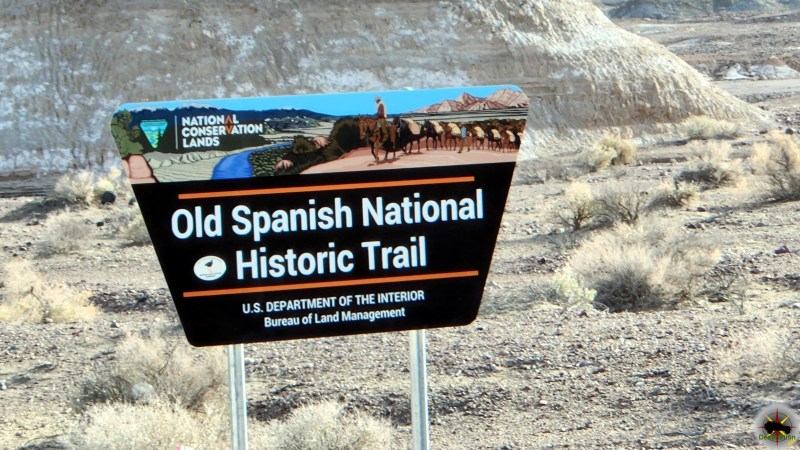
The Told Spanish Trail BLM Sign

The trail began as a network of routes used by Native American tribes, who traded goods such as salt, obsidian, and turquoise. In the late 18th century, Spanish traders began to use these routes to transport goods between Santa Fe and California. These traders were known as the “Comancheros” and were primarily focused on trading with the Ute and Navajo tribes in the area.

The route became known as the Old Spanish Trail in the early 19th century, when American traders began using the trail to transport furs and other goods to California. The trail was difficult to traverse, with harsh deserts, steep mountains, and treacherous canyons, but it was a vital link between the Southwest and the West Coast.

The trail was not a single route, but rather a network of different paths that crossed the desert and mountains of the Southwest. The most popular route followed the Virgin River in Utah, crossed the Colorado River at the mouth of the Virgin River, and then passed through the Mojave Desert to Los Angeles. Another route followed the Gila River in Arizona and crossed the Sonoran Desert to California.

The Old Spanish Trail played an important role in the development of the American West, as it provided a direct link between the remote and isolated communities of the Southwest and the growing cities of California. The trail was also a source of conflict, as American traders often clashed with Native American tribes over access to resources and trading rights.

In the mid-19th century, the discovery of gold in California brought thousands of settlers to the West Coast, and the Old Spanish Trail became a major thoroughfare for travelers and goods. The trail was also used by the Mormon pioneers, who traveled to California in the late 1840s and early 1850s.

In the late 19th century, the construction of railroads and highways made the Old Spanish Trail less important as a trade route. However, the trail remained an important part of the cultural history of the American Southwest, and efforts were made to preserve the trail and its landmarks.

Today, several sections of the Old Spanish Trail have been designated as National Historic Trails by the National Park Service, including sections in Utah, Colorado, New Mexico, and California. These trails allow visitors to experience the beauty and history of the Old Spanish Trail and to appreciate the legacy of the traders, Native Americans, and settlers who traveled its rugged terrain.

Old Spanish Trail Routes

All routes came together at Fork of Roads, east of present-day Barstow in the Mojave desert, and then crossed Cajon Pass between the San Gabriel and San Bernadino Mountains to Coastal California. After negotiating the pass, traders had an easy two to three days travel to the San Gabriel Mission and beyond to Los Angeles.

Armijo Route

Exterior, south facade of Mission San Gabriel Arcangel - 1878
Exterior, south facade of Mission San Gabriel Arcangel – 1878

The first complete trip across the trail began in Abiquiú, northwest of Santa Fe. The Armijo party followed well-known trails northwest to the San Juan River, then nearly due west to the Virgin River. They used the Crossing of the Fathers, cut into rock canyon wall some 75 years earlier by the Domínguez-Escalante party. Armijo’s caravan went down the Muddy River and across
the Mojave Desert to the Amargosa and Mojave Rivers, through Cajon Pass and down to Mission San Gabriel.

The Armijo and Northern Route diverge from each other on the east bound trail near the town of Tecopa, California.

Main Northern Route

First blazed by William Wolfskill and George C. Yount in 1831, this route veered northwest from Abiquiú through Southern Colorado and central Utah. It avoided the rugged canyons of the Colorado River that the Armijo party had encountered and took advantage of the better water and pasture resources across central Utah before returning to the Colorado River and Armijo’s route not far from Las Vegas.

Northern Branch

This route followed well-known trapper and trade routes north through the Rio Grande gorge to Taos and into southern Colorado. It then went west through Cochetopa Pass, largely open during the winter when other passes were snowed in and up the Gunnison River valley, rejoining the Northern Route near present-day Green River, Utah.

Mojave Road

Afton Canyon in the Mojave National Preserve.

The Mojave Road is a 188-mile crossing of the Mojave Desert long used by area Indians and by Spanish explorers and missionaries, it was first traveled by Jedediah Smith, an American trapper, in 1826.

Old Spanish Trail Locations

Government Holes in the central section of the Old Mojave Road.

Old Mojave Road

The Old Mojave Road (Government Road) is an east-west route that enters the Mojave National Preserve off the highway 95 in Nevada, and Afton Canyon…
The Old Spanish Trail BLM Sign

Old Spanish Trail

The Old Spanish Trail was a historic trade route that linked Santa Fe, New Mexico to Los Angeles, California. The trail was established in the…
Francisco Hermenegildo Tomás Garcés O.F.M. (April 12, 1738 – July 18, 1781)

Old Spanish Trail (Garces Expedition)

Old Spanish Trail (Garces Expedition) is a Nevada State Historic Marker Number 140 located in Clark County, Nevada. This marker is one of several which…
Captain John C. Frémont, explorer first mapped Diamond Valley Nevada

Old Spanish Trail (Journey of the Dead Man)

Old Spanish Trail (Journey of the Dead Man) is a Nevada State Historic Marker Number 139 located in Clark County, Nevada. This marker is one…

Old Spanish Trail Mountain Springs Pass – Nevada State Historic Marker

Old Spanish Trail Mountain Springs Pass is located along highway 160 and Nevada State Historic Marker No. 142 in Clark County, Nevada. The Old Spanish…
Old Tecopa house at smelter on Willow Creek, Amargosa Valley. Dr. Noble, Mrs. Noble. Inyo County, CA. 1922 - Photo from Herbert E. Gregory Book 8: 1915 - 1924.

Tecopa Inyo County

Nestled in the stark, sun-scorched expanse of the Mojave Desert in southeastern Inyo County, California, Tecopa stands as a resilient outpost shaped by ancient indigenous…
The Old Spanish Trail 1829-1850 - Nevada State Historic Marker 33

The Old Spanish Trail 1829-1850 – Nevada State Historic Marker 33

Old Spanish Trail 1829-1850 is Nevada State Historic Marker Number 33, located in the town of Blue Diamond, in Clark County, Nevada. The Old Spanish…
Old Spanish Trail 1829-1850 - Nevada State Historic Marker #34 located in Mountain Springs, Nevada

The Old Spanish Trail 1829-1850 – Nevada State Historic Marker 34

Old Spanish Trail 1829-1850 is Nevada State Historic Marker Number 33, located in the town of Mountain Springs, in Clark County, Nevada. Old Spanish Trail…

References

James Cooksey Earp

James Cooksey Earp ( June 28, 1841 -  January 25, 1926 )
James Cooksey Earp ( June 28, 1841 – January 25, 1926 )

James Cooksey Earp ( June 28, 1841 – January 25, 1926 ) was an American lawman and the lesser-known older brother of the famous Earp brothers, particularly Wyatt, Virgil, and Morgan Earp, who were key figures in the history of the American Old West. Though James was not as prominent as his brothers, he played a role in their lives and the events that shaped their legendary status.

Early Life

James Cooksey Earp was born on June 28, 1841, in Hartford, Kentucky, to Nicholas Porter Earp and Virginia Ann Cooksey. He was the third of nine children in the Earp family. The Earp family moved frequently during James’s childhood, living in various locations across the Midwest, including Monmouth, Illinois, and Pella, Iowa.

Military Service

At the outbreak of the Civil War, James enlisted in the Union Army in 1861. He served in Company F of the 17th Illinois Infantry, participating in several battles, including the Battle of Fredericktown. However, he sustained a severe shoulder wound early in the war, which led to his discharge in 1863.

Post-War Years and Family Life

After the war, James Earp returned to civilian life and worked various jobs, including saloon keeping and law enforcement. He married Nellie “Bessie” Ketchum in 1865, and the couple would remain together until James’s death. They did not have any children.

Tombstone and the Earp Vendetta Ride

James Earp is perhaps best known for his connection to the events in Tombstone, Arizona. In 1879, he followed his younger brothers to the boomtown, where they became involved in law enforcement and the infamous conflict with the Clanton-McLaury gang. Unlike his brothers, James played a more background role in Tombstone, focusing on managing a saloon rather than directly engaging in law enforcement or the gunfight at the O.K. Corral.

Following the assassination of their brother Morgan in 1882, the Earp brothers, led by Wyatt, embarked on what became known as the Earp Vendetta Ride, seeking revenge against those they believed responsible for Morgan’s death. James did not participate in the Vendetta Ride, choosing instead to stay with his family and manage their business interests.

Later Life and Death

After the events in Tombstone, James Earp and his wife moved to various locations, including California, where they eventually settled in San Bernardino. James lived a relatively quiet life compared to his more famous brothers, staying out of the spotlight as the legends around the Earp family grew.

James Cooksey Earp passed away on January 25, 1926, in San Bernardino, California, at the age of 84. He was buried in the Mountain View Cemetery in San Bernardino. His life, though overshadowed by the exploits of his brothers, is an integral part of the Earp family history, offering a glimpse into the quieter side of the tumultuous times they lived through.

Earp Family Members

James Cooksey Earp ( June 28, 1841 - January 25, 1926 )

James Cooksey Earp

James Cooksey Earp ( June 28, 1841 - January 25, 1926 ) James Cooksey Earp ( June 28, 1841 - January 25, 1926 ) was…
Morgan Earp historical photo, 1881. Probably taken by C.S. Fly.

Morgan Seth Earp

Morgan Seth Earp, born on April 24, 1851, in Pella, Iowa, was a notable figure of the American Old West, primarily recognized for his association…
Virgil Earp 1843 -1905

Virgil Walter Earp

Virgil Walter Earp ( July 18, 1843 – October 19, 1905) was born in Lincoln County, Kentucky, was a prominent lawman and frontier figure known for his…
Warren Baster Earp ( March 9, 1855 - July 6, 1900 )

Warren Baxter Earp

Warren Baxter Earp ( March 9, 1855 - July 6, 1900 ), the youngest of the Earp brothers, was born into a family that would…
Wyatt Berry Stapp Earp - Aged 39

Wyatt Berry Stapp Earp

Wyatt Berry Stapp Earp (March 19, 1848 – January 13, 1929) was an American lawman and gambler who became a legendary figure of the Old…

Myers Ranch

Myers Ranch is a privately owned ranch located in Goler Wash in the Panamint Mountains of Death Valley National Park, California. The forty acre ranch is privately owned ranch and located about .5 miles from Barker Ranch.

 Myers Ranch, Panamint Mountain
Myers Ranch, Panamint Mountain

A Family Affair

Bill and Barbara Myers settled in Goler Wash in 1932, building themselves a comfortable house complete with such amenities as flush toilets, a swimming pool, an orchard, and of course, a garden. They raised three children there: Charles, Pat and Corky. The Myers family reluctantly moved to Fresno in 1960, so that their children could have a better education.

The ranch is built from wood ties used by the Searles Lake epsom salt monorail, it burned in 1999. The Myers ran a gas and food stop called Wildrose Station, which was demolished by the National Park Service.

Manson Family

Myers Ranch was the original destination for Charles Mason and his “family”. In 1968 he started to look for a desert location to move his “brood”. He choose the desert because “Out there, things aren’t so crazy”. One of his followers is Cathy (Cappy) Gilles is a grand daughter of Bill and Barbara Myers. “Cappy” obtained permission from the family matriarch for her and some girls to come up and stay at the ranch. He later received permission and based his activities at Barker Ranch.

From October 1968 to January 1969, Manson lived / camped in the area. In October 1969, CHP Officer Jim Pursell and a task force raided Goler Wash. Over the course of two days, they arrested seventeen people in the area. Charles Manson was arrested while hiding in a cabinet in the bathroom of Barker Ranch.

Myers Ranch Map

Myers Ranch Summary

NameMyers Ranch
LocationGoler Wash, Panamint Mountains, Death Valley, California
Elevation3700 Feet
Latitude, Longitude35.86162,-117.08227

References