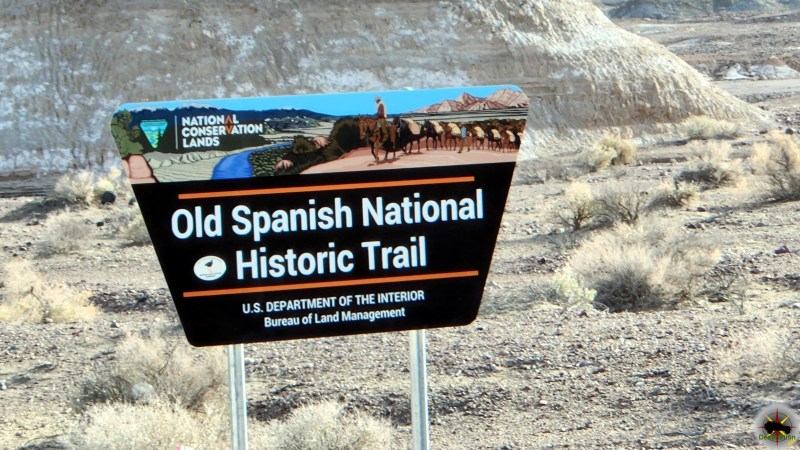
Old Spanish Trail Mountain Springs Pass – Nevada State Historic Marker

Old Spanish Trail Mountain Springs Pass is located along highway 160 and Nevada State Historic Marker No. 142 in Clark County, Nevada. The Old Spanish Trail is a 700 mile long historical trade route that connected the northern New Mexico settlements near Santa Fe, New Mexico with those of Los Angeles, California.

Old Spanish Trail Mountain Springs Pass Historic Marker

The trail began as a network of routes used by Native American tribes, who traded goods such as salt, obsidian, and turquoise. In the late 18th century, Spanish traders began to use these routes to transport goods between Santa Fe and California. These traders were known as the “Comancheros” and were primarily focused on trading with the Ute and Navajo tribes in the area.

The route became known as the Old Spanish Trail in the early 19th century, when American traders began using the trail to transport furs and other goods to California. The trail was difficult to traverse, with harsh deserts, steep mountains, and treacherous canyons, but it was a vital link between the Southwest and the West Coast.

The Old Spanish Trail played an important role in the development of the American West, as it provided a direct link between the remote and isolated communities of the Southwest and the growing cities of California. The trail was also a source of conflict, as American traders often clashed with Native American tribes over access to resources and trading rights.

Nevada State Historic Marker Text

Nevada State Historical Markers identify significant places of interest in Nevada’s history. The Nevada State Legislature started the program in 1967 to bring the state’s heritage to the public’s attention with on-site markers. Budget cuts to the program caused the program to become dormant in 2009. Many of the markers are lost of damaged.

This portion of the Old Spanish Trail was discovered in January 1830, by Antonio Armijo during his first trip from Santa Fe to Los Angeles.  The springs just north of this marker provided excellent water and fed meadows of luxuriant grass for draft animals.  Two days were required to travel between Las Vegas and Mountain Springs Pass.  The trip was broken at Cottonwood Springs, the site of Blue Diamond, where an early start was usually made in order to climb the pass by nightfall.  Early travelers often referred to the area as Piute Springs, but the present title has been used for over a century.  The altitude made Mountain Springs one of the favorite camping spots on the trail.

STATE HISTORICAL MARKER No. 142
NEVADA STATE PARK SYSTEM
NORTHERN NEVADA HISTORICAL SOCIETY

Nevada State Historic Marker Summary

NameOld Spanish Trail – Mountain Springs Pass
LocationHighway 160, Clark County, Nevada
Nevada State Historic Marker142
Latitude, Longitude35.9983, -115.4484

Nevada State Historic Marker Location

References

Potosi Nevada State Historic Marker 115

Potosi Nevada state historic marker 115 is located along highway 160 between Las Vegas and Pahrump in Clark County. The marker is located off the offramp for Mount Potosi Canyon Road (582). Marker 115 is one of several historic markers located along a very short stretch of highway 160. As you exit highway 160, the marker is tucked away off the main road and turned to the side, so it is semi hidden. Due to the highway devide in this location, the exit is only available when travelling eastbound along Highway 160 towards Las Vegas.

Potosi Nevada State Historic Marker 115

Potosi is one of the first mining ventures in the state of Nevada.

Nevada State Historical Markers identify significant places of interest in Nevada’s history. The Nevada State Legislature started the program in 1967 to bring the state’s heritage to the public’s attention with on-site markers. Budget cuts to the program caused the program to become dormant in 2009. Many of the markers are lost of damaged.

Marker Text

The desire of local Mormon settlers for economic self-sufficiency led to mining by missionaries for lead at Potosí.  In 1858, Nathaniel V. Jones was sent to recover ore from the “mountain of lead” 30 miles southwest of the mission at Las Vegas Springs.  About 9,000 lbs. were recovered before smelting difficulties forced the remote mine to be abandoned in 1857.  Potosi became the first abandoned mine in Nevada.

In 1861, California mining interests reopened the mine, and a smelter and rock cabins for 100 miners made up the camp of Potosi.  Even more extensive operations resulted after the transcontinental Salt Lake and San Pedro R.R. (now the union pacific) was built through the county in 1905.

During World War I, Potosi was an important source of zinc.

STATE HISTORICAL MARKER No. 115
STATE HISTORIC PRESERVATION OFFICE

Marker Location

Marker Summary

NamePotosi, Nevada State Historic Marker 115
LocationClark County, Nevada
Nevada State Historic Marker115
Latitude, Longitude35.9954, -115.4866

References

Red Rock Canyon Campground

Red Rock Canyon Campground is a stunning and serene camping destination located in Nevada. Nestled in the heart of the Mojave Desert, the campground offers a peaceful and unique experience to campers of all ages. The campground is conveniently located only 30 minutes away from Las Vegas and is surrounded by the beautiful Red Rock Canyon National Conservation Area.

Rod Rock Campground in the fall with a beautiful flower ground cover.

The campground is operated by the Bureau of Land Management and has a total of 53 campsites. The campsites are spread across three loops and are equipped with picnic tables, fire rings, and tent pads. The campground is suitable for tents, RVs, and trailers. The sites are available on a first-come, first-served basis, and it is advisable to arrive early, especially during peak season. The campground is open year-round, but the best time to visit is from September to May when the weather is milder.

Red Rock Campground is surrounded by breathtaking natural beauty, and there are several hiking trails that campers can explore. The Red Rock Canyon National Conservation Area has over 30 miles of hiking trails that range from easy to difficult. The trails offer stunning views of the canyons, rock formations, and desert flora and fauna. The trails are well marked and maintained, and hikers are advised to carry plenty of water, especially during the summer months.

The campground also has several picnic areas that are perfect for family gatherings and group activities. The picnic areas are equipped with tables, grills, and shade structures. There is also a group campsite that can accommodate up to 40 people. The group site has a covered pavilion, picnic tables, fire rings, and a vault toilet.

The campground has a visitor center that provides information about the campground, the conservation area, and the surrounding attractions. The visitor center has a small bookstore that sells maps, guides, and souvenirs. The staff at the visitor center are knowledgeable and friendly, and they are always happy to provide assistance.

Red Rock Canyon Campground sign

Red Rock Canyon is a great place to escape the hustle and bustle of Las Vegas. The campground is surrounded by stunning natural beauty, and the desert landscape is awe-inspiring. The campground is also close to several attractions, such as the Las Vegas Strip, Hoover Dam, and Lake Mead. The proximity to these attractions makes Red Rock Campground an ideal base camp for exploring the area.

Campground Map

The facilities at Red Rock Campground are basic but well maintained. The campground has vault toilets, but there are no showers or hookups. The lack of amenities is compensated by the natural beauty and tranquility of the location. The campground is also pet-friendly, and pets are allowed on the trails and in the campsites.

Red Rock Campground is a must-visit destination for anyone who loves nature and outdoor activities. The campground offers a unique and peaceful camping experience that is hard to find in the Las Vegas area. The stunning natural beauty, the hiking trails, and the proximity to attractions make Red Rock Campground an ideal destination for families, groups, and solo travelers. Whether you are looking for a quiet retreat or an adventure-packed vacation, Red Rock Campground has something for everyone.

Campground Summary

NameRed Rock Canyon Campground
LocationRed Rock Canyon Conservation Area, Clark County, Nevada
Elevation3,400 ft
Number of Sites53
ReservationsRecreation.gov
AmenitiesPicnic tables, fire rings, tent pads, vault toilets, but no showers or hookups, pet-friendly,

Searchlight Nevada

Searchlight Nevada is a unincorporated town with a history in mining. The small town in Clark County is located south of Las Vegas in Clark County, Nevada and honored with Nevada State Historic Marker number one hundred and sixteen. The Nevada Start Historic Marker is located on the west side of the highway as you enter town.

Nevada State Historical Markers identify significant places of interest in Nevada’s history. The Nevada State Legislature started the program in 1967 to bring the state’s heritage to the public’s attention with on-site markers. Budget cuts to the program caused the program to become dormant in 2009. Many of the markers are lost of damaged.

Main Street of Searchlight, Nevada

The town is founded after George Frederick Cook prospected the area beginning May 6th, 1897. It is said that he would take a searchlight to find gold in the area, lending the town its name. Following the discovery of gold, the area boomed, which caused its population to raise. At the time, the mining town was part of Lincoln County, and for a time its population was larger than that of Las Vegas. When Clark County is created the town was briefly considered to be the county seat.

Between 1907 and 1910, the gold mines of Searchlight produced $7 million dollars in gold and boasted a population of 1,500. Ore is shipped to Barnwell via the Barnwell and Searchlight rail service. In order to reduce costs, the Quartette company constructed a twenty-stamp mill on the Colorado River. The new mill utilized a 15 mile narrow gauge rail is constructed down to the mill in an attempt to further reduce costs. The rail is completed in 1902. Several tent saloons are erected during this time and named Cyrus Noble, Old Bottle and the Little Brown Jug.

Quartette Mill, Searchlight, Nevada

Later in 1903, enough water is is on hand in town to support a second twenty-stamp mill. The onsite mills capacity is further increased in 1906 when the Colorado Mill is closed and relocate near town.

During its peak in 1907, Searchlight boasts well-furnished stores, about a dozen saloons, telephone exchange, forty four mines and several mills. The Chamber of Commerce advertised some 5,000 people living in the little haven. Searchlight’s decline began in 1917.

Today, the town is home to about 500 people. Its location on the 95 highway offers a rest spot for travelers between Las Vegas and various Colorado River how spots, including Lake Mojave, Laughlin NV, Bullhead City and Havasu. The small community is home to a few small casinos, gas and food. Senator Majority Harry Leader Harry Reid is perhaps the towns most notable citizen. Harry Ried proudly raised the American Flag over his property, when he was home which was visible from the highway.

Nevada State Historic Marker Text

Initial discoveries of predominately gold ore were first made at this location on May 6, 1897.  G.F. Colton filed the first claim, later to become the Duplex Mine.  The Quartette Mining Company, formed in 1900, became the mainstay of the Searchlight district, producing almost half of the area’s total output.  In May 1902, a 16 mile narrow-gauge railroad was built down the hill to the company’s mill on the Colorado River.

On March 31, 1907, the 23.22 mile Barnwell and Searchlight Railroad connected the town with the then main Santa Fe line from Needles to Mojave.  By 1919 trains travelled over the B. and S. Railroad only twice a week.  A severe washout on September 23, 1923, halted traffic completely.  Train service was never restored.

Searchlight is the birthplace of U.S. Senator Harry Reid (b.1939) who became the first Nevadan to serve as the Senate Majority Leader, a position he assumed in 2007.

STATE HISTORICAL MARKER No. 116
STATE HISTORIC PRESERVATION OFFICE

Nevada State Historic Marker Map

Town Summary

NameSearchlight, Nevada
LocationClark County, Nevada
Latitude, Longitude35.4744, -114.9307
Nevada State Historic Marker116
GNIS0845654
Populationup to 5,000
Elevation3,547 ft (1,081 m)
News PaperSearchlight Bulletin Jan 1, 1903 – Jan 3, 1913

References

Pueblo Grande de Nevada

Pueblo Grande de Nevada is Nevada State Historic Marker number Forty One and located in Clark County, Nevada. The ruins become to be known as Nevada’s “Lost City”. The marker is located about two miles south of Overton along State Route 169.

Nevada State Historical Markers identify significant places of interest in Nevada’s history. The Nevada State Legislature started the program in 1967 to bring the state’s heritage to the public’s attention with on-site markers. Budget cuts to the program caused the program to become dormant in 2009. Many of the markers are lost of damaged.

Pueblo Grande de Nevada - Source National Park Service
Pueblo Grande de Nevada – Source National Park Service

The site dates back to before the year 500 A.D. and the Basketmaker Indians and later the Ancestral Pueblo people in 1150 A.D. Archeological studies show signs of human activity and occupation as far back as 8,000 B.C.

The ruins become known to American Settlers in 1827, when Jebediah Smith found artifacts while exploring the region. The Pueblo Grande a complex of villages, was first seen by white settlers forty years later in 1867. There is little interest in the area, the ruins or the story they had to tell, until 1924. John and Fay Perkins of Overton, Nevada, discovered the ruined complex. The “Lost City” captured the imagination of Nevada and soon became a tourist spot.

To the south of Overton Beach are prehistoric salt mines. Early inhabitants in the area mined salt from these caves. The mined salt is used for trade, survival and food preparation. During excavations in 1925 and 1926, many artifacts are discovered in the caves, including pottery, stone clubs, sandals and other items. These artifacts offered a limited glimpse into the daily lives of the people who worked the salt mines.

Flood Waters

Rising waters of Lake Mead swallowed some of the ruins, with the construction of Hoover Damn. The waters flooded the “Lost City”. The area has been the subject of numerous archeological studies which allow us to better understand the ancients peoples of the land. Today, the Lost City Museum of Archaeology in Overton continues to tell the story of the area and preserve the various artifacts discovered over the past two hundred years.

Nevada State Historic Marker Text

Indians of a highly developed civilization lived throughout Moapa Valley from 300-1100 A.D. Several hundred ancient pithouses, campsites, rockshelters, salt mines and caves of Anasazi people make up what is commonly known as “Lost City.” These people cultivated corn, beans and squash in fields irrigated by river water. They also gathered wild seeds and fruits and hunted widely for deer, antelope, desert bighorn sheep, small mammals and birds. They wove fine cotton cloth, fired beautifully painted and textured pottery and mined and traded salt and turquoise to coastal tribes for seashells. Early dwellings were circular pithouses below ground; later dwellings above ground were single-story adobes having up to 100 rooms.

Lake Mead, created by Hoover Dam, flooded the most intensively developed portion of Lost City.

Trail Map

Nevada State Historic Marker Summary

Nevada State Historic Marker No.41
NamePueblo Grande de Nevada
LocationClark County Nevada
Latitude, Longitude36.525, -114.4338
GNIS847639

References