George Graham Rice

George Graham Rice
George Graham Rice

George Graham Rice, born Jacob Simon Herzig on June 18, 1870, in Manhattan, New York, to furrier Simon Herzig and his wife Anna, rose from a background of petty crime to become one of America’s most notorious stock promoters and swindlers of the early 20th century. Dubbed the “Jackal of Wall Street” by regulators and the press, Rice specialized in hyping worthless mining stocks—particularly in Nevada’s boom-and-bust camps—through aggressive advertising, celebrity endorsements, and mail-order schemes. He parlayed early gambling and forgery convictions into a career that defrauded investors of millions during the Goldfield, Bullfrog, and Rawhide mining rushes, while authoring a candid autobiography that detailed his exploits. His life exemplified the golden age of American con artistry, blending audacity, publicity stunts, and political maneuvering until repeated imprisonments and declining health ended his schemes. He died on October 24, 1943.

Early Life and Criminal Beginnings (1870–1903)

Rice grew up in a middle-class New York family but developed a gambling habit that led to his first conviction in 1890: stealing from his father’s business to fund betting. He served two years at Elmira Reformatory. Released, he reoffended; in 1895, he was convicted of forgery for further thefts from his father and sentenced to four years at Sing Sing Prison. While incarcerated, he adopted the name “George Graham Rice,” borrowing it from fellow inmate Willie Graham Rice (or a similar alias). After release, he briefly worked as a reporter for the New Orleans Times-Democrat before returning to New York. There, he founded the Maxim & Gay Company, a racetrack tip sheet and bet-by-mail operation that attracted thousands of subscribers. The U.S. Post Office Department shut it down for mail fraud, leaving Rice broke once again.

Nevada Mining Boom and Rise as Promoter (1904–1910)

In 1904, Rice relocated to the booming Goldfield, Nevada, gold camp, where he established the Nevada Mining News Bureau—an advertising service that promoted mining stocks in which he held personal stakes. He quickly immersed himself in the frenzy of Nevada’s mining excitement. In 1906, he co-sponsored (with promoter Tex Rickard) the legendary 42-round world lightweight boxing championship between Joe Gans and Battling Nelson in Goldfield, one of the most publicized fights of the era.

Partnering with saloon owner and politician Larry Sullivan, Rice launched the L.M. Sullivan Trust Company, a brokerage that sold shares in numerous Nevada and California mining ventures. He aggressively promoted properties in towns including Rhyolite, Bullfrog, Wonder, and Greenwater (California), many of which proved nearly worthless. The company collapsed in the Panic of 1907. Rice then moved to Reno, publishing the Nevada Mining News and forming Nat C. Goodwin & Company with vaudeville star Nathaniel Carl Goodwin. Together they promoted the Rawhide, Nevada, mining district. As a publicity stunt, Rice arranged for best-selling novelist Elinor Glyn to visit Rawhide, generating national headlines. Through B.H. Scheftels & Company, he also manipulated shares of the Ely Central Copper Company.

Legal Troubles, Autobiography, and Continued Schemes (1911–1920s)

In 1911, Rice pleaded guilty to mail fraud charges related to his stock promotions and served one year in prison. During his incarceration, he wrote his autobiography, My Adventures with Your Money (1913), which was serialized in Adventure magazine. The book offered a colorful, unapologetic account of his life as a promoter, candidly describing how he catered to the public’s speculative instincts during the great Nevada mining booms of 1905–1908. Upon release, he resumed operations through a series of newsletters—including Industrial and Mining Age, Mining Financial News, Wall Street Iconoclast, and Financial Watchtower—pushing mining and oil stocks to a national audience.

One of his later promotions involved Broken Hills, Nevada. In 1920, English prospectors Joseph Arthur and James Stratford sold their modest silver-lead claims (which had produced about $68,000 over six years) to Rice. Using his Reno-based Fidelity Finance & Funding Company, he formed the Broken Hills Silver Corporation (capitalized at 3 million shares) and stacked its board with prominent Nevadans, including State Treasurer Ed Malley and State Bank Examiner Gilbert C. Ross. Rice ran lavish newspaper advertisements claiming endorsements from Governor Emmet D. Boyle and mining experts, hyping rich ore discoveries and even floating bids to host a Jack Dempsey heavyweight title fight. He sold roughly $162,000 in stock and invested some funds in camp infrastructure, but the corporation owed $380,000 to Rice’s own finance company. It soon collapsed under debt, triggering investigations that contributed to further legal woes. By the mid-1920s, Broken Hills—once briefly bustling—faded back into the desert.

In 1920, Rice was convicted of grand larceny. His most infamous later scheme targeted the Idaho Copper Company; in 1928 he was sentenced to four years in the U.S. Penitentiary in Atlanta for using the mails to defraud investors (some accounts place final sentencing proceedings into 1929). While imprisoned, he reportedly shared a cell with Al Capone. In 1931, he was tried for tax evasion but acquitted.

Later Years and Legacy

Even after repeated convictions, Rice continued issuing promotional newsletters into the 1930s and early 1940s, though his influence waned. He occasionally capitalized on his notoriety by naming companies after himself (such as Rice Oil) and using front men in earlier years before operating more openly. Contemporary accounts and later historians portray him as a flamboyant yet ruthless figure who perfected high-pressure stock-tipping tactics that foreshadowed modern pump-and-dump schemes. A 2015 biography by T.D. Thornton, My Adventures with Your Money: George Graham Rice and the Golden Age of the Con Artist, revived interest in his life, comparing his scale and nerve to later fraudsters like Bernie Madoff.

Rice’s promotions contributed to the speculative frenzy that enriched a few but bankrupted thousands of small investors during Nevada’s early 20th-century mining booms. His story remains a cautionary tale of greed, gullibility, and the wildcat capitalism of the American West. No major monuments or museums commemorate him; his legacy survives primarily in ghost-town histories, court records, and the pages of his own unrepentant memoir.

Sources: This biography is drawn primarily from contemporary newspaper accounts, Rice’s autobiography My Adventures with Your Money (1913), and secondary sources including Wikipedia summaries cross-referenced with mining histories, the book by T.D. Thornton (2015), and specialized sites such as MiningSwindles.com and BackyardTraveler blog posts on Broken Hills. For further reading, consult Nevada’s Twentieth-Century Mining Boom by Russell R. Elliott or Thornton’s biography.

Locations Associated with George Graham Rice

Broken Hills Nevada – Mineral County Ghost Town

Broken Hills is a remote ghost town in Mineral County, Nevada (with early references occasionally noting southern Churchill County), located at approximately 39°02′59″N 118°00′37″W and…
One of the few remaining structures in Bullfrog, Nevada - Photo by James L Rathbun

Bullfrog Nevada – Nye County Ghost Town

In the scorching summer of 1904, amid the rugged Bullfrog Hills at the northern edge of the Amargosa Desert in Nye County, Nevada, two prospectors…
Greenwater Mining District, CA 1906

Greenwater California – Inyo County Ghost Town

In the scorched embrace of the Funeral Mountains, where the Mojave Desert meets the unrelenting heat of Death Valley, lies the spectral outline of Greenwater—a…
Rawhide, Nevada - 1915

Rawhide Nevada – Mineral County Ghost Town

Rawhide is a classic Nevada mining boomtown-turned-ghost town in Mineral County, located approximately 55 miles southeast of Fallon at coordinates 39°01′0″N 118°23′28″W and an elevation…
Rhyolite, Nevada photo by James L Rathbun

Rhyolite Nevada – Nye County Ghost Town

Rhyolite is a ghost town location just outside of the Eastern edge of Death Valley National monument in Nye country, Nevada.  Founded in 1904 by…
Wonder Mine 1907 - Stanley W. Paher, Nevada Ghost Towns and Mining Camps, (1970) p 100

Wonder, Nevada – Churchill County Ghost Town

Wonder, Nevada, now a ghost town in Churchill County, was a short-lived but significant mining community during the early 20th-century silver and gold rush. Located…

Chicalote (Argemone munita)

Chicalote (Argemone munita)

A species of prickly poppy, Chicalote (Argemone munita) is also known as the flatbud prickly poppy. A native of California, the Chicalote is also found in Nevada and Arizona. This hearty wildflower dereives its name from the Latin work “Minuta” which means armed, in reference the the small sharr spines commonly found on its lobed leaves.

The flower consists of sixe crinkly looking white petals and feature many bright yellow stamen. The delicate looking flowers can reach and overall diameters of up to fie inches. Overall, the plant commonly reaches about three feet in height.

The leaves of Argemone munita are mint green in color, dry in appearance and quite lobed. Each leaf is armed and features a small short spike for protection.

Chicalote (Argemone munita) on the roadside into Bodie, CA

The Chicalote poppy commonly grows in dry rocky areas and found at elevations up to 10,000 feet. The flower typically grows in chaparral, or northern slopes of Transverse ranges and desert mountains. The plant typically puts its flower in bloom in June through August.

It is quite common to find this little gem of a flower in San Diego, the areas surrounding Los Angeles up the High Sierra and into Mono County.

Mustang (Equus ferus caballus)

The Wild Mustang (Equus caballus), an enduring symbol of the American frontier, roams the vast, arid expanses of the desert southwest United States as a feral horse population descended from domesticated Spanish horses introduced in the 16th century. These hardy equines, often romanticized in folklore and media, have adapted through natural selection to survive in harsh environments, exhibiting remarkable resilience amid sparse resources and extreme conditions. With populations managed by the U.S. Bureau of Land Management (BLM) to balance ecological sustainability, mustangs embody a complex interplay of history, biology, and conservation in regions like Nevada, Arizona, and New Mexico.

A lone mustang is the symbol of wild, power and freedom

Classification

The Wild Mustang is classified within the kingdom Animalia, phylum Chordata, class Mammalia, order Perissodactyla, family Equidae, genus Equus, and species caballus. Though often referred to as “wild,” mustangs are technically feral horses, descendants of domesticated equines rather than a truly wild subspecies like the extinct North American horses that evolved on the continent millions of years ago. Their ancestry traces primarily to Colonial Spanish horses from the Iberian Peninsula, with mitochondrial DNA studies confirming high frequencies of Iberian haplotypes, though admixtures from other breeds like Thoroughbreds, Quarter Horses, and drafts have occurred over time. Distinct strains, such as the Spanish Mustang or Kiger Mustang, retain stronger Spanish bloodlines, while isolated herds in the desert southwest may exhibit unique genetic traits shaped by geographic separation and natural selection.

Physical Description

Mustangs are compact, medium-sized horses, typically standing 14 to 15 hands high (56 to 60 inches or 142 to 152 cm at the withers) and weighing around 800 pounds (360 kg). They possess a light-riding build with muscular bodies, strong bone structure, and exceptional hardiness, featuring flat or slightly convex head profiles, broad foreheads tapering to fine muzzles, and eyes set slightly higher on the face. Necks are well-defined and attach smoothly to sloping shoulders, with moderately narrow chests, short strong backs, deep heart girths, well-sprung ribs, and smooth round hindquarters. Legs are straight and sound, supported by durable hooves with thick walls, ideal for rugged terrain. Coat colors vary widely, including bay, sorrel, dun, appaloosa, paint patterns, and primitive markings like stripes, though some registries exclude certain patterns like tobiano. Movement is smooth and rhythmic, with the ability to gallop at 25–30 mph (40–48 km/h), and up to 55 mph (88 km/h) in short bursts. In the desert southwest, natural selection favors traits like surefootedness, endurance, and agility for navigating arid landscapes.

Behavior

Wild mustangs are social animals that form structured groups known as bands or herds, typically comprising one dominant stallion (over 6 years old), around eight mares, and their young, led by a head mare who guides the group to safety in threats while the stallion defends from behind. Stallion leadership is dynamic, with challenges from rivals promoting genetic diversity. Communication relies on body language, such as ear positioning, tail swishing, and vocalizations, to convey emotions and maintain hierarchy. They exhibit intelligence, curiosity, and a strong fight-or-flight response honed by survival in harsh environments, making them cautious yet resilient. In the desert southwest, mustangs travel long distances for resources, adapting foraging strategies and mixing with other herds during dangers. Isolated populations may show unique behaviors, like gaited movements or curly coats in Nevada herds, influenced by genetic admixtures. Without significant predators, populations can grow rapidly, leading to overgrazing if unmanaged.

A mustang taking in some shade next to a pool of water.

Food Sources

As herbivores and hindgut fermenters, mustangs primarily consume grasses, brush, shrubs, and other native vegetation, extracting nutrients from low-quality forage via their cecum—a adaptation allowing survival in arid regions where ruminants like cattle struggle. In the desert southwest, they graze close to the ground on sparse plants, ranging 5–10 times farther than cattle to access food and water, often digging for hydration in dry areas. Their diet requires about 1.5 animal units (AUM) of forage, focusing on soluble fiber while avoiding excess sugars to prevent digestive issues. An average mustang needs around 16 pounds of grass daily, supplemented by minerals and salts in harsh environments. This opportunistic foraging supports their easy-keeper nature, enabling them to thrive on limited resources in deserts and grasslands.

Breeding

Mustangs are viviparous, with mares carrying foals for an 11-month gestation period, typically giving birth in spring (April to June) to align with milder weather and abundant forage for growth. Breeding occurs within isolated herds, where dominant stallions mate with mares, and dynamic challenges ensure genetic diversity, though inbreeding in small populations can lead to issues like reduced heterozygosity and diseases such as PSSM Type 1. Unmanaged herds can grow by up to 20% annually, prompting BLM interventions like fertility control to prevent overpopulation and starvation. Foals are born precocial, able to stand and nurse shortly after birth, and remain with the herd for protection. In the desert southwest, breeding success ties to resource availability, with natural selection favoring resilient offspring in arid conditions. Lifespans in the wild reach up to 36 years, shorter than in captivity.

Two will fed mustangs near Cold Creek, Nevada

Habitat and Range

Wild mustangs inhabit arid and semiarid public rangelands west of the Continental Divide, including deserts, grasslands, and mountainous terrains, where they adapt to extreme temperatures, scarce water, and sparse vegetation. In the desert southwest United States, populations thrive in states like Nevada (hosting over half of North America’s free-roaming mustangs), Arizona, New Mexico, Utah, and California, managed across 26.9 million acres in Herd Management Areas (HMAs) by the BLM. These areas encompass ecosystems from the Great Basin to the Colorado Plateau, with herds digging for water and migrating seasonally for forage. Total free-roaming numbers exceed 72,000, protected under the 1971 Wild Free-Roaming Horses and Burros Act as living symbols of the West, though overpopulation challenges lead to roundups and adoptions.

BLM Mustang Range Map

Resources

Classification

Kingdom:Animalia
Phylum:Chordata
Class:Mammalia
Order:Perissodactyla
Family:Equidae
Genus:Equus
Species:E. ferus
Subspecies:E. f. caballus

Silvery Lupine (Lupinus argenteus)

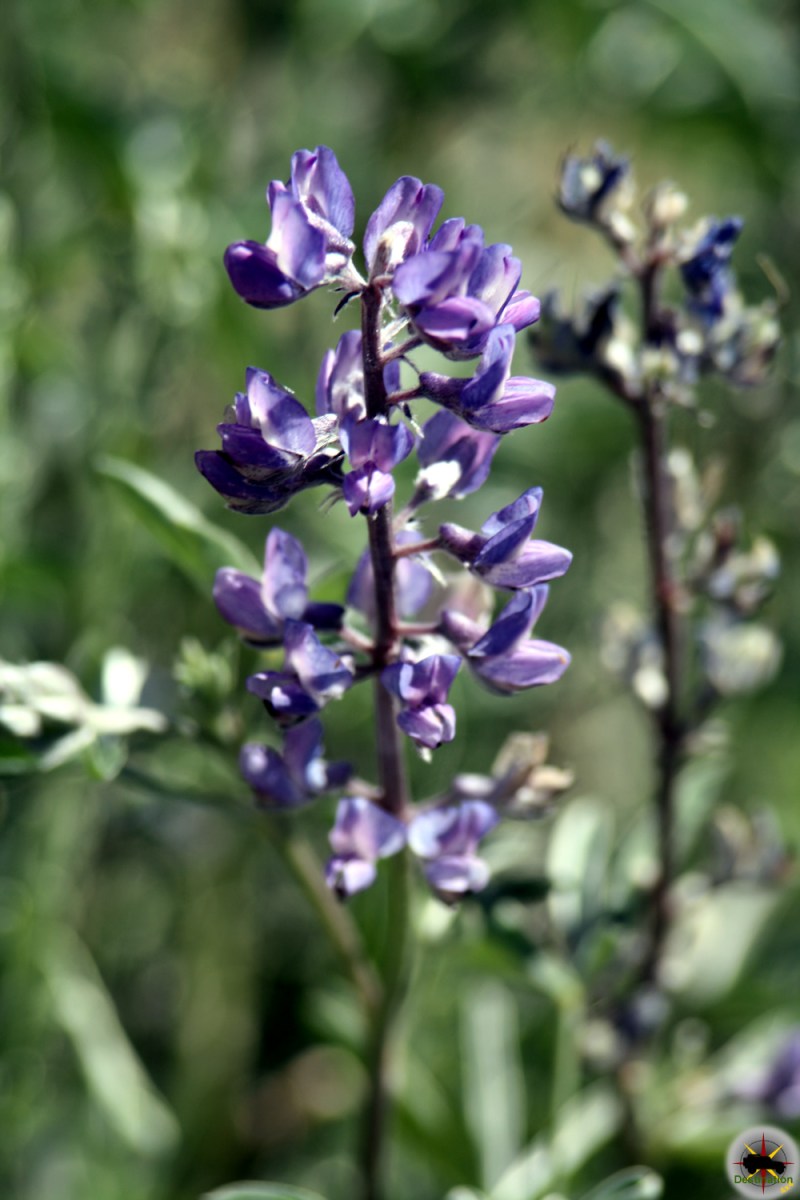
Silvery Lupine (Lupinus argenteus)

Silvery Lupine (Lupinus argenteus) is a fairly common vibrant purple wild flower and is common in much of Western North America including Arizona, California, Nevada and Utah. Deriving its name from the fine silvery hair found on its stalks, which are reddish in color.

Lupine is a stalked plant which grows up to four feet tall. The Lupine thrives in higher elevations and may be commonly found between 3,300 and 10,000 feet. It is quite common for the flower to be found along roadways, stream valleys, rocky prairies and in open pine woods.

The Lupine typically blooms in June to October, however like many wild flowers, this period will vary dependent upon water and location. The violet colored flowers are typically arranged around a spike which may reach up to eight inches in length.

The Silvery Lupine grows quickly and in bunches and considered a member of the pea family. Although toxic to humans, this beautiful flowering plant is known to attach butterflies, birds and hummingbirds.

The Navajo people used the Silvery Lupine as a natural treatment for Poison Ivy blisters. The Lupine is commonly found in clearings in the countries of Apache, Coconino, and Mohave, and Navajo in Arizona.

California Wild Rose (Rosa californica)

California Wild Rose (Rosa californica) found around Convict Lake, California

The California Wild Rose (Rosa californica) is a native species of Rose, which is found in California and Oregon and most commonly found in the foot hills of the High Sierra Mountain Range. This is a hearty little planet which can survive the droughts of California, and typically found near water sources.

This plant can be found at elevations up to 6,000 feet. It seeks shady areas at lower elevations but as the altitude increases so does the likelihood to find this little plant in sunny areas.

The California Wild Rose is a low lying shrub which can grow in tall thickets. The plant produces a fragrant pink or magenta colored five petaled flowers with yellow stamen. The delicate looking flower is edible and the hibs of the plant may be used in teas. During WWII, the hips were used as a source of vitamins.

The wild rose is one of the few flowers that blooms cheerfully through the long summer days, lavishing its beautiful clusters of deliciously fragrant flowers as freely along the dusty roadside as in the more secluded thicket. In autumn it often seems inspired to a special luxuriance of blossoming, and it lingers to greet the asters and mingle its pink flowers and brilliant scarlet hips with their delicate lilacs.

Mary Elizabeth Parsons

Like many roses, the wild rose also grows throws for protection for itself, along with shelter for many smaller mammals and birds.