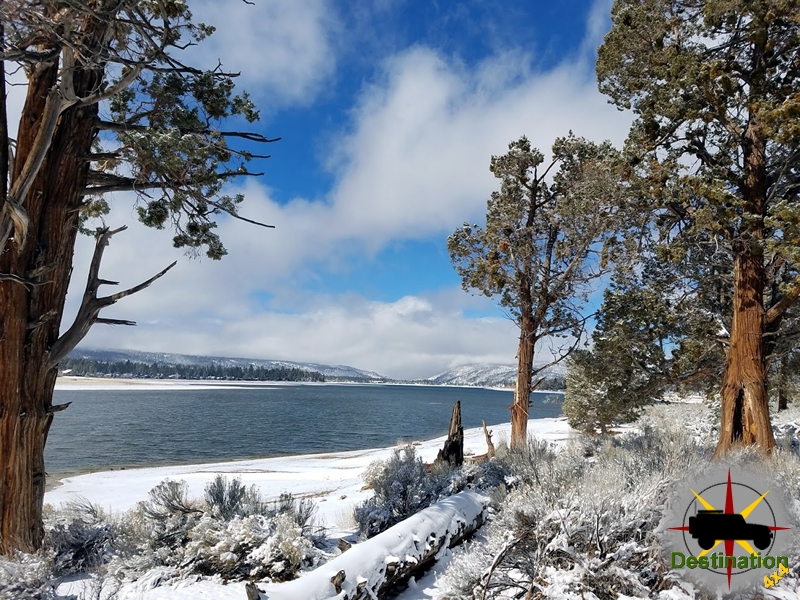
Big Bear, CA
I quiet mountain community full of back country adventure.
The Journey is the destination
Arizona Thistle ( Cirsium arizonicum ) is a member of the sunflower family and common across the south west. The thistle has a two year live span. For the first year, it thrives as a low lying rosette of thorns. The second year of life, the plant springs into action and can grow up to four feet tall and grows a flower stalk to hold a purple colored flower head high into the air. The flower is known to bloom in red, pink and purple in color.

The soft bristly cactus spines give the Teddybear Cholla its furry, cute appearance and mask the ferocious defense of this desert cactus. This member of the cactus family typically grows between 3 and 5 feet in height. Its body is built utilizing highly segmented branches which easily detached or broken when anything bushes against them giving the cactus the nickname “Jumping Cholla”

The Greater Roadrunner (Geococcyx californianus), often immortalized in cartoons as a speedy trickster, is a fascinating avian species native to the arid landscapes of the southwestern United States and northern Mexico. This long-legged member of the cuckoo family is renowned for its terrestrial lifestyle, impressive running speed, and opportunistic predation, including on venomous snakes. With a distinctive crest, mottled plumage, and a penchant for darting across open ground, the roadrunner embodies adaptation to harsh environments.


The Greater Roadrunner belongs to the kingdom Animalia, phylum Chordata, class Aves, order Cuculiformes, and family Cuculidae (cuckoos). It is one of two species in the genus Geococcyx, alongside the Lesser Roadrunner (Geococcyx velox), which is found primarily in Mexico. The scientific name Geococcyx californianus translates to “Californian earth-cuckoo,” reflecting its ground-dwelling habits and historical association with California. Fossil evidence from the Pleistocene and Holocene periods indicates that the species once inhabited sparse forests before adapting to arid conditions around 8,000 years ago. It is classified as a Nearctic species, native to the northern part of the New World, and exhibits characteristics such as bilateral symmetry, endothermy, and omnivory.
This medium-sized bird measures 50–62 cm (20–24 inches) in total length, with a wingspan of 43–61 cm (17–24 inches) and a weight ranging from 221–538 grams (7.8–19 ounces). Standing 25–30 cm (9.8–11.8 inches) tall, it is the largest cuckoo in the Americas. Its plumage is predominantly brown with black streaks and occasional pink spots on the upper body, transitioning to white or pale brown with dark streaks on the neck and upper breast, and a pure white belly. A bushy blue-black crest adorns the head, which can be raised or lowered, and bare patches of orange and blue skin (with white in adult males) surround the bright yellow eyes. The long, stout bill is grayish-brown to gray with a hooked tip, ideal for capturing prey, while the zygodactyl feet—two toes forward, two backward—are brown with pale gold spots, aiding in perching and running. Sexual dimorphism is minimal; females are slightly smaller, but plumage is identical across sexes. Juveniles lack the colorful postocular streaks and appear more bronze-toned. The bird’s streamlined body and long tail, carried at an upward angle, enhance its agility on the ground.
Greater Roadrunners are predominantly terrestrial and diurnal, active from sunrise to mid-morning and late afternoon to evening in hot climates, resting in shade during the midday heat. They prefer walking or running at speeds up to 20–26 mph (32–42 km/h), using their long tails as rudders for steering, braking, and balance, and rarely fly except for short distances or to hover briefly. Vocalizations include a descending series of low coos by males, short shrills by females resembling coyote squeals, and chatters during incubation. They communicate via acoustic, visual, tactile, and chemical signals. Thermoregulation is key in arid habitats: they pant to evaporate water, enter nocturnal hypothermia (dropping body temperature from 104°F to 93°F or 40°C to 34°C to save energy), reabsorb moisture from mucous membranes, and excrete salts via nasal glands. Sunbathing involves spreading wings to absorb solar heat through black skin patches, often for hours in cooler weather. They are curious, sometimes approaching humans, and defend territories year-round, with males being more aggressive. In winter, they seek shelter in dense vegetation or among rocks.
This medium-sized bird measures 50–62 cm (20–24 inches) in total length, with a wingspan of 43–61 cm (17–24 inches) and a weight ranging from 221–538 grams (7.8–19 ounces). Standing 25–30 cm (9.8–11.8 inches) tall, it is the largest cuckoo in the Americas. Its plumage is predominantly brown with black streaks and occasional pink spots on the upper body, transitioning to white or pale brown with dark streaks on the neck and upper breast, and a pure white belly. A bushy blue-black crest adorns the head, which can be raised or lowered, and bare patches of orange and blue skin (with white in adult males) surround the bright yellow eyes. The long, stout bill is grayish-brown to gray with a hooked tip, ideal for capturing prey, while the zygodactyl feet—two toes forward, two backward—are brown with pale gold spots, aiding in perching and running. Sexual dimorphism is minimal; females are slightly smaller, but plumage is identical across sexes. Juveniles lack the colorful postocular streaks and appear more bronze-toned. The bird’s streamlined body and long tail, carried at an upward angle, enhance its agility on the ground.
Greater Roadrunners are predominantly terrestrial and diurnal, active from sunrise to mid-morning and late afternoon to evening in hot climates, resting in shade during the midday heat. They prefer walking or running at speeds up to 20–26 mph (32–42 km/h), using their long tails as rudders for steering, braking, and balance, and rarely fly except for short distances or to hover briefly. Vocalizations include a descending series of low coos by males, short shrills by females resembling coyote squeals, and chatters during incubation. They communicate via acoustic, visual, tactile, and chemical signals. Thermoregulation is key in arid habitats: they pant to evaporate water, enter nocturnal hypothermia (dropping body temperature from 104°F to 93°F or 40°C to 34°C to save energy), reabsorb moisture from mucous membranes, and excrete salts via nasal glands. Sunbathing involves spreading wings to absorb solar heat through black skin patches, often for hours in cooler weather. They are curious, sometimes approaching humans, and defend territories year-round, with males being more aggressive. In winter, they seek shelter in dense vegetation or among rocks.
As opportunistic omnivores, Greater Roadrunners consume a diet that is about 90% animal matter, supplemented by fruits, seeds, and other plant material. Prey includes insects, spiders (such as black widows and tarantulas), scorpions, centipedes, lizards, snakes (including young rattlesnakes), mice, small birds like hummingbirds and sparrows, eggs, and occasionally larger carrion like bats or rabbits. They hunt by scanning while walking rapidly, then dashing or jumping to capture items, often bashing prey against rocks before swallowing whole. Plant foods, such as prickly pear cactus, provide hydration in water-scarce areas. Their ability to subdue venomous snakes by using cactus pieces or rapid strikes highlights their predatory prowess.
Greater Roadrunners form monogamous pairs that may last for life, breeding from mid-March to early September, with variations based on regional rainfall and food availability. Courtship involves males chasing females, wagging tails, play-fighting, bowing, and offering food like lizards during mating displays, accompanied by whirring or cooing sounds. Pairs defend territories of about 700–800 square meters (7,500–8,600 square feet). Nests, built collaboratively (males gather materials, females construct), are compact platforms of thorny sticks lined with grasses, feathers, snakeskin, or even manure, placed 1–3 meters (3–10 feet) above ground in bushes, cacti, or low trees. Clutches consist of 2–8 white or pale yellow eggs, incubated by both parents for about 20 days, with asynchronous hatching leading to size variations among chicks. Altricial young are fed by both parents, developing rapidly to run and forage at 3 weeks, fledging in 18–21 days, and remaining with parents for up to 40–50 days. Sexual maturity is reached at 2–3 years, and second broods may occur in favorable conditions. Occasionally, they practice brood parasitism, laying eggs in nests of other birds like ravens or mockingbirds.
Greater Roadrunners inhabit arid and semiarid regions with scattered vegetation cover under 50% and heights below 3 meters (10 feet), from elevations of -60 meters (-200 feet) below sea level to 3,000 meters (9,800 feet). Preferred habitats include deserts, dunes, chaparral, scrub forests, arid grasslands, coastal sage scrub, and edges of woodlands, often with open areas for foraging and brush for cover. They are non-migratory and sedentary. Their range spans the Aridoamerica ecoregion, encompassing southwestern U.S. states like California, Arizona, Nevada, Utah, Colorado, Texas, New Mexico, Kansas, Oklahoma, Arkansas, Louisiana, and Missouri, as well as northern Mexican states including Baja California, Sonora, Chihuahua, and others down to San Luis Potosí. Recent expansions have occurred eastward due to human-altered landscapes and historical adaptations from forested to desert environments.
| Kingdom | Animalia |
| Phylum | Chordata |
| Class | Aves |
| Order | Cuculiformes |
| Family | Cuculidae |
| Genus | Geococcyx |
| Species | californianus |
Coldwater Campground is a campground located in the Mammoth Lakes area of the High Sierra in Mono County, California. Lake Mary is the largest and the most developed of the eleven lakes in the Mammoth Area. The campground is located along Coldwater Creek, which feeds water into the scenic Lake Mary.

The campground is quite popular due to its location on the mountain and proximity to Lake Mark. The lake offers tremendous fishing and opportunities for hiking and enjoying the picturesque scenery. The fishing at Lake Mary features Rainbow, Brown and Brook trout and on more than one trip, my evenings were spent watching sunsets while fly fishing. The peak season is from late May to early September each year.
The campground offers access to many nearby activities including Devils Postpile, Reds Meadow,, Rainbow falls and Hot Creek. Two boat ramps and marinas allow for boating however the 10 mph limit on the lake keeps the lake angler friendly. Campsites typically share parking and the sites are reasonably flat. Tall pine trees offer shade from the high altitude sun.
This campground is in bear country and typically bears activity is fairly high. All food and scented items must be stored in the lockers. All trash must be disposed of in the bear proof trash receptacles. Do not store food, trash or scented items in your vehicle.
| Name | Coldwater Campground |
| Location | Mammoth Lakes, Inyo County, California |
| Latitude, Longitude | 37.5980514,-118.9974829 |
| Elevation | 9,000 feet |
| Number of Sites | 74 |
| Amenities | Campsites are organized into two loops, with sites fairly close together and near either creek. Pressurized water spigots and flush toilets are provided throughout the facility, and there are picnic tables, campfire rings and bear-proof food storage lockers at each campsite. |
Potosi Nevada is the oldest lode mine in Nevada and the town site is located just off highway 160 between Las Vegas and Pahrump, Nevada. The site was started in 1856 by some Mormon prospectors who were lead to the location with the help of a Piute guide. The Mormons found the site in April 1856 and a month latter it was named Potosi after the boyhood home of Nathaniel Jones. They did not begin mining until August after a return trip to Utah for supplies.

By September, the first wagon of ore sent back to Utah for trading and three months later three wagons returned with supplies including bellows, furnace, and hearths among other things. On Christmas day 1856, an crude adobe furnace was used to smelt ore.
In the spring of 1861, a larger smelter was setup by the Colorado Mining Company at the Potosi Spring. News of new silver mine spread all over the west in no time. The town of Potosi was setup 700 feet below of the Potosi Mine or the Las Vegas Silver Mines as they were called and was soon home to 100 miners.

The site continued to slowly grow and develop until 1906. In 1913 the Empire Zinc Company purchased the rights and was soon Potosi was Nevada’s largest producer of Zinc. After nearly 100 years of production Potosi produced about 4.5 million in lead, silver and zinc.
Potosi is a designated at Nevada State Historic Marker no. 115.
| Name | Potosi |
| Location | Clark County, Nevada |
| GNIS | 849366 |
| Latitude, Longitude | 35.9708, -115.5408 |
| Elevation | 5705 |
| Population | 100 |