Myers Ranch

Myers Ranch is a privately owned ranch located in Goler Wash in the Panamint Mountains of Death Valley National Park, California. The forty acre ranch is privately owned ranch and located about .5 miles from Barker Ranch.

 Myers Ranch, Panamint Mountain
Myers Ranch, Panamint Mountain

A Family Affair

Bill and Barbara Myers settled in Goler Wash in 1932, building themselves a comfortable house complete with such amenities as flush toilets, a swimming pool, an orchard, and of course, a garden. They raised three children there: Charles, Pat and Corky. The Myers family reluctantly moved to Fresno in 1960, so that their children could have a better education.

The ranch is built from wood ties used by the Searles Lake epsom salt monorail, it burned in 1999. The Myers ran a gas and food stop called Wildrose Station, which was demolished by the National Park Service.

Manson Family

Myers Ranch was the original destination for Charles Mason and his “family”. In 1968 he started to look for a desert location to move his “brood”. He choose the desert because “Out there, things aren’t so crazy”. One of his followers is Cathy (Cappy) Gilles is a grand daughter of Bill and Barbara Myers. “Cappy” obtained permission from the family matriarch for her and some girls to come up and stay at the ranch. He later received permission and based his activities at Barker Ranch.

From October 1968 to January 1969, Manson lived / camped in the area. In October 1969, CHP Officer Jim Pursell and a task force raided Goler Wash. Over the course of two days, they arrested seventeen people in the area. Charles Manson was arrested while hiding in a cabinet in the bathroom of Barker Ranch.

Myers Ranch Map

Myers Ranch Summary

NameMyers Ranch
LocationGoler Wash, Panamint Mountains, Death Valley, California
Elevation3700 Feet
Latitude, Longitude35.86162,-117.08227

References

Barker Ranch

Thomason/Barker Ranch is a five-acre property within Death Valley National Park. This historic site is located off of Goler Wash in the southern Panamint Range in the southwestern portion of the park. Barker Ranch is commonly referenced as being the location that mass murderer Charles Manson was arrested after the Tate – La Bianca killings in 1969.

This image, taken circa 1940, shows the main residence, workshop, retaining walls, and ornamental vegetation. Note the windmill located behind the workshop. View north (DEVA collection) - NPS
This image, taken circa 1940, shows the main residence, workshop, retaining walls, and ornamental vegetation. Note the windmill located behind the workshop. View north (DEVA collection) – NPS

Thomason Era (1937 – 1956)

In 1937, Blouch Thomason, a retired Los Angeles County detective, recorded three quartz lode mining claims named
“Tommy Group,” “Tommy Group No. 2,” and “Tommy Group No. 3” and a mill site located. The original structures consisting of three tent shelters is built in 1939.

In 1940, major improvements are made to the land. Thomason built the main ranch house, windmill, workshop, chicken coop, corral, fences, entry road, fences, water conveyance system, and planted ornamental and fruit-bearing vegetation. He also built a single rock building for “shop and storage” at the ranch. Later, a guestroom and garage are added to the shop. The Thomas ranch is inhabited full time by Blouch and Helen Thomason. They ceased mining operations due to poor yield

In 1950, Blouch passes away while visiting relatives in the Trinity Alps. Following his death, Helen moves away from the ranch, but still maintained the property as a vacation retreat.

Barker Era ( 1956 – 1971 )

James and Arlene Barker, from Oklahoma, purchased the Thomason Ranch, in 1955. In 1956, the Barkers recorded the “Chespa Mill Site” with the Inyo County Recorder’s Office. The Barkers built a 5,000 gallon water reservoir ( swimming pool ) and a 14 foot by 20 foot bunkhouse, sometime during 1957.

In 1968, Arlene Barker gave Charles Manson permission to occupy the Ranch in exchange for a Beach Boys Gold Album. After Manson’s arrest, the Barkers continued to maintain the property. In 1971, the Barkers ceased filing mining reports with the Bureau of Land Management (BLM) on the family’s mining activity. The land (and improvements) then reverted to government control. In 1976, the ranch became part of the California Desert Conservation Area.

In 1994, Barker Ranch is incorporated into Death Valley National Park.

Manson Era ( 1968 – 1969 )

Barker Ranch - The building complex was heavily vegetated with trees, with a sparsely planted understory. Note the Manson bus in the left hand side of the image. View northwest, 1969 (DEVA collection). - NPS
Barker Ranch – The building complex was heavily vegetated with trees, with a sparsely planted understory. Note the Manson bus in the left hand side of the image. View northwest, 1969 (DEVA collection). – NPS

The Thomason / Barker Ranch history was stained forever, in October 1968, when Charles Manson obtained permission from Arlene Barker to occupy the ranch. Paul Watkins, a Manson Family Member, stated the Mason agreed to watch over the place in exchange for maintenance and work on the Ranch. Manson and his band of opted to stay and Barker Ranch over the Myers Ranch which is located about .5 miles away. A total of 19 Manson followers performed a phased relocation to the property over time. Manson family members are known to drive to Los Angeles or Las Vegas to bring in supplies.

On October 10 and 12, 1969, CHP officer Jim Pursell and the INYO Sheriffs Department along with California Highway Patrol and NPS Rangers raided Barker Ranch. Actually, they raided the area around Barker Ranch. A raid is executed in search of vandals of earth moving equipment which repaired damage to the playa in Racetrack Valley. Over the coarse to several days, the task forced hunted down Family members who were scattered about the area. The diminutive Manson is arrested when found hiding under the sink in the bathroom at Barker Ranch.

To this day, Barker Ranch is the subject of investigation into the crimes of Charles Manson.

Barker Ranch Map

NPS

Barker Ranch was built by “recreational ranchers” who moved to the desert to enjoy the solitude and simplicity of living far from civilization. Bluch and Helen Thomason moved into the area the the late 1930s to try their hand at gold mining. Around 1940, the constructed a small stone cabin and outbuilding, with electricity. provided by a wind mill and generator, and drinking water from a nearby spring

In 1955, the ranch was sold to Jim and Arlene Barker, who moved to the desert from Oklahoma. To accommodate their family gatherings, the Barkers enlarged the house and constructed more building.

The ranch became infamous when Charles Manson and members of the “Manson Family” were captured at the site. Family members attracted the attention of local law enforcement when they were suspected to burning a piece of road maintenance equipment. Detectives later discovered that the vandalism suspects were responsible for a series of murders in the Los Angeles Area.

Barker Ranch became part of Death Valley National Park in 1994. Tragically, the main house and workshop were destroyed by an accidental fire in May 2009.

National Park Service – Barker Ranch

Sources

Asa Merton Russell “Panamint Russ” 

Asa Merton Russell “Panamint Russ” (1895–1970) was a California prospector, small-scale miner, desert homesteader, and occasional writer whose four-decade presence in the Butte Valley district of the Panamint Mountains made him one of the last classic solitary operators in Death Valley country. Universally known by his nickname “Panamint Russ,” he built the stone cabin now called the Geologist’s Cabin (or Russell Camp), developed a reliable spring, planted the only locust trees and Concord grapevines for scores of miles around, and doggedly drove a horizontal tunnel into the granite of Manly Peak—all while holding down a day job in Los Angeles until his 1960 retirement. Though his claims yielded little recorded production, Russell’s wry, faith-filled 1955 Desert Magazine article “Life on the Desert” remains one of the most vivid firsthand accounts of mid-20th-century desert mining life.

Asa Merton Russell "Panamint Russ" in front of the Geologist cabin - Courtesy of Desert Magazine April 1955
Asa Russell “Panamint Russ” in front of the Geologist cabin – Courtesy of Desert Magazine April 1955

Early Life and Military Service

Born in 1895, Russell served as a sergeant (SGT) in the U.S. military, though specific details of his enlistment, branch, or conflict are not recorded in surviving sources. By the 1920s he had settled in southern California and found steady employment with the Los Angeles Department of Water and Power. He married and had at least one son. His wife occasionally tried to break what she called his “desert habit,” complaining that he stayed too long each year in the remote Panamints.

A 1925 prospecting trip into the Redlands Canyon area of the Panamints reportedly yielded a brief but tantalizing discovery of a rich gold vein that he later “lost”—a story that foreshadowed the persistence and frustration that would define his later career.

Arrival in Butte Valley and the 1930 Strike

Russell’s serious mining career began in 1930. While exploring high on the western slope of 7,200-foot Manly Peak, he located gold-bearing quartz and immediately filed the Lucky Strike Quartz Mining Claim (March 1931) along with several others between 1933 and 1947. The claims sat in the South Park Mining District on the east side of the Panamint Range, in what is today Death Valley National Park.

That same year he began construction of a modest stone cabin at the base of Manly Peak, on the site of the old Ten Spot Mill / Last Chance Claim. The one-room structure—later known as the Geologist’s Cabin or Russell Camp—became his seasonal headquarters. Roughly a quarter-mile south of the historic Mengel/Stella cabin and at an elevation of about 4,500 feet, the camp offered commanding views across Butte Valley.

In 1929–1930 he also improved a nearby spring, creating a gravity-fed water system that supported drinking water, a small orchard, and vines. He planted locust trees (the only ones known within 125 miles) and Concord grapevines, which he proudly tended for decades. By the late 1950s or early 1960s the system included a 500-gallon storage tank.

Mining Operations and Daily Life

Russell’s principal working was a long horizontal tunnel driven into the granite of Manly Peak, reached by a steep, winding burro trail about one mile above camp. For most of the 1930s and 1940s he performed the required annual assessment work during two-week vacations from his Los Angeles job, often laboring entirely alone. Helpers were scarce and unreliable; scorpions, rattlesnakes, cloudbursts, twisters, flat tires, and pack rats nesting in dynamite all conspired against him.

In his April 1955 Desert Magazine article “Life on the Desert,” written at age 60, Russell described these hardships with humor and quiet determination. He recounted a twister that nearly tore the roof off his shack, a cloudburst that stranded him for days, a double hernia suffered while prying boulders, the theft or shooting of his beloved burro “Jubilee,” and the endless search for trustworthy labor. Through it all he returned to the theme of “Good Faith”—the inner resolve required to keep returning to the desert year after year. He closed the piece with an unshakeable optimism:

“But out here, there’s always a blue sky, good pure water filtered by Nature through lime and granite rocks, smogless air, no 50-cent parking lots, fresh sage and pinyon pine… I have Faith, and it will pay off!”

Retirement and Final Years

Russell retired from the Los Angeles Department of Water and Power in May 1960. That fall he moved permanently to Russell Camp, living full-time amid the Panamints. In 1962 he transferred ownership of the nearby Carl Mengel cabin and associated claims to Clinton and Stella Anderson, further establishing himself as a quiet steward of the local mining landscape. He continued sporadic work on the Lucky Strike and other claims into the early 1970s.

Death and Legacy

Asa Merton Russell died in 1970 at age 75. He is buried in a marked grave (Find A Grave Memorial #3748983).

Though his mines produced no major bonanza and left no great fortune, Russell’s legacy is written in stone and living green. The Geologist’s Cabin, the spring-fed water system, the locust trees, and the grapevines he planted still stand as testaments to one man’s determination. His camp remains a landmark for backcountry travelers in Butte Valley within Death Valley National Park. More than half a century after its publication, “Life on the Desert” continues to be read and quoted, offering later generations an intimate portrait of the isolation, frustration, beauty, and quiet faith that defined the final chapter of small-scale Panamint mining.

In the tradition of contemporaries like Pete Aguereberry, Carl Mengel, and Seldom Seen Slim, Panamint Russ proved that a man could build a meaningful life in one of America’s harshest environments—not through spectacular wealth, but through stubborn persistence, self-reliance, and an unshakable belief that the next fifty feet of tunnel might finally pay off.

The concord grapes are doing well, too. Twenty-five years ago coming through Riverside, California, I stopped at a nursery and bought a half dozen bare-root size, wrapped them in a newspaper, laid them on the running board with a wet gunny sack and today they are 20 feet of beauty.

Life on the Desert – by Panamint Russ – Desert Magazine, April, 1955

References

Courtney Chauncey Julian

Courtney Chauncey Julian
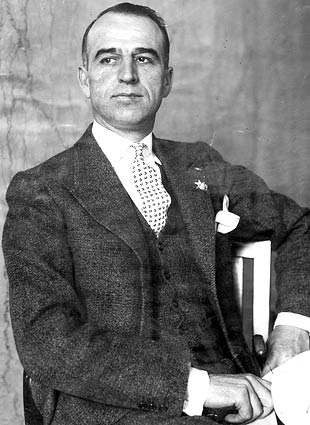
C. C. Julian

Courtney Chauncey Julian, C. C. Julian, was a businessman and shameless promoter who’s business dealings forced him to flee to California for China. He is noteworthy in his dealing in Death Valley National Park for his promotion of the town of Leadfield. After numerous court battles, he fled to Shanghai, China where he is poisoned or committed suicide.

C.C. Julian launched a newspaper blitz promoting his Julian Petroleum Corporation in 1923. The promotional blitz formed the basis for a ponzi scheme for investment into the JPC. The scandal became known as the “Julian Pete Scandal”. By 1927, it is estimated that Julian sold four million dollars in stock, which was stolen from his investors. Others estimate the value of the scheme at over eight million.

Drama followed the man, as he received death threats, however the nature of this threat is never resolved. It was reported by the United Press on Jan 4, 1924, that gun shots are fired threw the windows of his $100,000.00 house in Hollywood.

Perhaps one of his wierdest altercations came with famed film star Charles Chaplin. Just weeks after the shooting, Julian literally bumped into a table where Chaplin was eating at Club Petrouschka in Hollywood. A fight ensured and Chaplin got the better of Julian and knocked him out.

As one would expect from a thief, Julian had assets seized, by Collector of Internal Revenue, of $250,000.00 in cash and securities for failure to file is earnings from 1919-1923. He is able to maintain his house because it is deeded by his wife.

Julian at the Western Lead Mine located in Leadfield, California - Photo Los Angeles Times
Julian at the Western Lead Mine located in Leadfield, California – Photo Los Angeles Times

The end of Julian Petroleum Corporation stated in 1925. Julian sold his interest in the company to Sheridan C. (S.C.) Lewis and Jacob Berman for the sum on $500,000.00. The following year the company merged with California-Eastern Oil Company. An internal audit revealed the company had issued 4,200,000 unauthorized shares of stock. On May 5, 1927, the Los Angeles Stock Exchange halted trading in Julian Petroleum.

In 1931, Julian was charged with conspiracy to commit fraud in Oklahoma. He jumped bail and fled to country for Shanghai, China. Courtney Chauncey Julian is found dead of suicide in March, 1934.

"The Last Days of C. C. Julian," Los Angeles Times, 29 Sept. 1935
“The Last Days of C. C. Julian,” Los Angeles Times, 29 Sept. 1935

This town was the brain child of C. C. Julian, who could have sold ice to an Eskimo. He wandered into Titus Canyon with money on his mind. He blasted some tunnels and liberally salted them with lead ore he had brought from Tonopah. Then he sat down and drew up some enticing, maps of the area. He moved the usually dry and never deep Amargosa River miles from its normal bed.

He drew pictures of ships steaming up the river hauling out the bountiful ore from his mines. Then he distributed handbills and lured Eastern promoters into investing money. Miners flocked in at the scent of a big strike and dug their hopeful holes. They built a few shacks. Julian was such a promoter he even conned the U. S. Government into building a post office here. 

Desert Magazine – 1971 – Betty J. Tucker

References

Carl Mengel – Panamint Valley Miner

Carl Mengel (1868–1944) was a German-born American prospector and small-scale miner whose decades of solitary toil in the rugged Panamint Mountains of California’s Death Valley region epitomized the hardscrabble, post-boom era of desert mining. Though he never struck it rich and died impoverished, Mengel left a lasting geographic imprint on the landscape: Mengel Pass in the southern Panamint Range bears his name, as does the spring and cabin site where he lived for more than three decades. His claims, most notably the Keystone Mine (later incorporated into the Lotus Mine), represent the persistent, low-capital prospecting that continued in the Panamints long after the famous 1870s silver stampede at Panamint City had faded.

Carl Mengel with dog "Whitey at his home in Butte Valley, April 1940. Photo courtesy of DEVA NM.
Carl Mengel with dog “Whitey at his home in Butte Valley, April 1940. Photo courtesy of DEVA NM.

Early Life and Path to Mining

Carl Mengel was born in 1868 in Germany (Alsace-Lorraine region according to family lore). His father was from Alsace-Lorraine and his mother Saxon; the family immigrated to the United States when Carl was about six (circa 1874). Both parents died before he turned eleven. An uncle in Ventura, California, became his guardian, but at age seventeen Mengel ran away, working first on a ranch in California’s San Joaquin Valley and later at Angels Camp in Calaveras County during the lingering Gold Rush era. He eventually gained possession of his uncle’s orchard near Visalia. Stricken with Bright’s disease (chronic kidney inflammation), he sold the land and moved to Seattle, where he bought an old rum boat for $75, sailed it, regained his health, and sold the vessel for a profit before returning to California.

By the late 1890s Mengel had turned to prospecting. He claimed to have first entered Butte Valley (on the eastern flank of the Panamint Mountains) in 1898. In the early 1900s he worked claims in Nevada’s Esmeralda and Nye counties (1905–1907) and made a notable strike in the Black Rock Desert of Humboldt County, where he operated “Camp Mengel.” The 1910 U.S. Census confirms his presence in Humboldt County as a naturalized citizen born in Germany.

The Mining Accident and Move to the Panamints

Sometime before 1912 Mengel suffered a devastating mining accident—most likely in Nevada—that cost him part of his left leg. Accounts vary: one places it at Silver Peak, Nevada, around 1905, when a rock fall crushed his leg and required amputation; another claims he performed a self-amputation with a tourniquet while awaiting rescue; a third dates it even earlier, to about 1888. Whatever the exact circumstances, Mengel survived, was fitted with a wooden peg leg (later replaced by a mechanical prosthetic), and continued prospecting with remarkable agility. The injury did not deter him; if anything, it cemented his reputation as a tough, one-legged desert rat.

In 1912 Mengel settled permanently in the Panamint Mountains west of Death Valley. He purchased the Oro Fino claim in Goler Wash and refurbished an abandoned cabin at a spring (later called Mengel Spring or Greater View Spring) that Mormon prospectors had left in 1869. The site, about half a mile south of Anvil Spring in Butte Valley, offered commanding views across the valley floor. Here he made his home for the rest of his life, staking and working claims in the surrounding canyons and washes.

Role in Panamint Mountains Mining History

The Panamint Range had already seen its share of boom-and-bust cycles. The 1873–1876 silver rush at Panamint City in Surprise Canyon had drawn thousands before collapsing. Later gold strikes at Skidoo and other districts brought renewed activity in the early 1900s. By the time Mengel arrived, however, large-scale operations had largely given way to individual prospectors and small partnerships working marginal deposits of gold, silver, lead, and zinc.

Mengel became a fixture in the Butte Valley–Anvil Spring–Goler Wash district. In October 1924 he filed a cluster of claims south and west of Anvil Spring: the Topah Nos. 1–4, Topah Extension, and Mah Jongg Nos. 1–6. His most significant holding was the Keystone Mine, high above Goler Canyon on the west slope of the Panamints. Though never a major producer, the Keystone represented Mengel’s determined search for ore in the mineralized veins of the range.

In 1935, at an advanced age, Mengel sold majority interest in the Keystone to the Monte Cristo Mines company. They expanded the property into six unpatented claims. Shortly afterward the holdings passed to Lotus Mines of Burbank, California. The Lotus operation drove tunnels from the opposite side of the mountain to tap the same ore body Mengel had been pursuing, installing an aerial tram and other infrastructure. The Lotus/Keystone complex thus stands as a direct legacy of Mengel’s early work, illustrating how lone prospectors’ claims sometimes seeded later, modestly capitalized developments in the remote Panamints.

Mengel was no recluse. He maintained friendships with legendary Death Valley figures such as Shorty Harris and Pete Aguereberry and was a frequent visitor to the nearby communities of Shoshone and Tecopa, where locals remembered him as an elusive but colorful storyteller. He lived frugally in his stone-and-wood cabin at Greater View Spring, sometimes called the Stella-Mengel Cabin, surrounded by the stark beauty of the Panamints.

Final Years and Legacy

Mengel’s health declined sharply in 1943. He died on April 28, 1944, at age 76 in the San Bernardino County Charity Hospital from complications of tuberculosis. True to his desert life, he left no fortune—only his claims, cabin, and prosthetic leg. Friends Barbara and Bill Myers scattered his ashes atop the pass between Goler Wash and Butte Valley and built a stone cairn there, placing his old wooden peg leg on top. The site, roughly fifty feet outside the then-boundary of Death Valley National Monument, became known as Mengel Pass and remains a modest but poignant memorial within what is now Death Valley National Park.

Carl Mengel never achieved the fame or wealth of the region’s earlier mining barons, yet his story endures as a classic tale of the twentieth-century desert prospector. In the Panamint Mountains—where silver bonanzas had long since played out—he embodied the gritty persistence that kept small-scale mining alive amid isolation, injury, and economic hardship. Today, hikers and backcountry explorers still pass his namesake pass, visit the ruins of his cabin, and trace the tunnels of the Keystone/Lotus Mine, reminders of one man’s lifelong gamble on the mineral riches hidden in the Panamints.

References