Tonopah Nevada

Tonopah, Nevada, known as the “Queen of the Silver Camps,” is a small unincorporated town in Nye County with a rich history tied to the discovery of silver in 1900. Located midway between Las Vegas and Reno at the junction of U.S. Routes 6 and 95, Tonopah’s story is one of boom and bust, shaped by its mining heritage, cultural developments, and resilience. This report explores the town’s origins, its rise as a mining hub, significant historical events, and its modern identity as a historical and tourism destination.

Photograph of a panoramic view of the Tonopah Mining Park (now a historic site) and Mount Butler in the distance, Tonopah, Nevada, ca.1904. -  - Pierce, C.C. (Charles C.), 1861-1946
Photograph of a panoramic view of the Tonopah Mining Park (now a historic site) and Mount Butler in the distance, Tonopah, Nevada, ca.1904. – – Pierce, C.C. (Charles C.), 1861-1946

Origins and Discovery of Silver (1900)

The story of Tonopah begins with the discovery of silver in May 1900 by Jim Butler, a rancher and part-time prospector. According to local legend, Butler stumbled upon a rich silver deposit while searching for his runaway burro near a rock outcropping. Frustrated, he picked up a heavy rock to throw at the animal, only to notice its unusual weight, which turned out to be silver ore. However, this tale is likely apocryphal. Butler, married to a local Paiute woman named Belle, was probably guided by her family to an area long known by indigenous peoples for its surface minerals. The Shoshone and Paiute word “Tonopah,” meaning “greasewood water” or “hidden spring,” was adopted for the settlement.

Butler’s samples were initially dismissed as iron by an assayer in Klondike, but his friend Tasker Oddie, later Nevada’s governor, had them re-assayed by Walter Gayhart in Austin. The results revealed ore worth up to $600 per ton, primarily in silver with significant gold. This discovery, confirmed in late 1900, sparked the second-richest silver strike in Nevada’s history, revitalizing the state’s mining industry after the decline of the Comstock Lode.

The Mining Boom (1900–1920)

The Belmont Mine, Tonopah, Nevada in 1913

The discovery triggered a rapid influx of prospectors, leading to the establishment of a camp initially called Butler City. By January 1901, the camp had 40 residents, and by summer, the population swelled to 650, with mines producing $750,000 in gold and silver. The town grew exponentially, reaching over 3,000 people by 1902 and nearly 10,000 at its peak. Infrastructure developed quickly, including a post office (opened April 10, 1901, renamed Tonopah in 1905), the Tonopah Bonanza newspaper (launched June 15, 1901), and a stagecoach line from Sodaville.

Tonopah became a hub of wealth and power. Prominent figures like George Wingfield, a poker player turned mining magnate, amassed fortunes. Wingfield partnered with Jack Carey to secure a gaming license and invested in the Boston-Tonopah Mining Company, becoming a millionaire by 1904. He later collaborated with banker George S. Nixon to establish the Nye County Bank and grub-stake miners, further consolidating wealth. The Tonopah Mining Company, formed in 1901 by Philadelphia capitalists who purchased Butler’s claims, drove large-scale production.

Wyatt Earp's Northern Saloon located in Tonopah, Nevada
Wyatt Earp’s Northern Saloon located in Tonopah, Nevada

By 1905, Tonopah replaced Belmont as Nye County’s seat, and a narrow-gauge railroad connected the town to the Carson & Colorado line. Upgraded to standard gauge and extended to Goldfield, the Tonopah & Goldfield Railroad facilitated freight and coal transport for mining operations. The town boasted modern amenities: five banks, an opera house, electric and water companies, and the luxurious Mizpah Hotel, built in 1907 for $200,000. The Mizpah, with steam heat, electric lights, and one of Nevada’s first elevators, was dubbed the “finest stone hotel in the desert.”

The mines produced $38.5 million annually at their peak before World War I, with a total output of $150 million by 1947. However, tragedies marked this era, including a 1903 riot against Chinese workers, which led to a Chinese boycott of U.S. goods, and the 1911 Belmont Mine fire, where 17 miners perished.

Tonopah,_Nevada 1913

Decline of Mining and Economic Shifts (1920–1940s)

By 1910, gold and silver production began to decline, and by 1920, Tonopah’s population had dropped to less than half its peak. The Great Depression and World War II further curtailed major mining operations, with all significant mines closing by 1947. The local railroad ceased operations, and the town struggled economically. Ranching and highway trade became primary income sources, as Tonopah’s location on U.S. 95 made it a stopover for travelers.

The Tonopah Army Air Base, constructed in 1940 and operational by 1942, provided a temporary economic boost during World War II. As one of Nevada’s largest military operations, it trained B-24 and P-39 pilots. However, the base closed in 1948, leaving the town to seek new economic avenues.

Modern Tonopah: Tourism, Military, and Renewable Energy (1950s–Present)

Since the late 20th century, Tonopah has reinvented itself as a tourism and military-based community. The Tonopah Test Range, established in 1952 for nuclear testing and later used for F-117 Nighthawk development, remains a major employer. The nearby Nevada Test Site also supports the local economy. In 2014, the $980 million Crescent Dunes Solar Energy Project, a cutting-edge solar thermal plant, was completed, signaling Tonopah’s entry into renewable energy.

Tourism has become a cornerstone of Tonopah’s identity. The Tonopah Historic Mining Park, spanning 113 acres of original mining claims, preserves the town’s heritage with restored buildings, mine shafts, and self-guided tours. The Central Nevada Museum showcases mining, military, and Western Shoshone history. Attractions like the Mizpah Hotel, voted America’s #1 haunted hotel due to its “Lady in Red” ghost, and the Clown Motel, dubbed “America’s scariest motel” for its clown collection and proximity to the Old Tonopah Cemetery, draw visitors seeking history and the paranormal. Tonopah’s dark skies, rated the best for stargazing in the U.S. by USA Today, attract astronomers to its Stargazing Park.

The town hosts events like Jim Butler Days and the Nevada State Mining Championships, celebrating its mining legacy. Outdoor activities, including off-roading, hiking, and rockhounding, leverage Tonopah’s desert landscape. Notable figures associated with the town include Wyatt Earp, who opened the Northern Saloon in 1902, boxer Jack Dempsey, who fought early bouts here, and Howard Hughes, who married Jean Peters at the Mizpah in 1957 and later purchased mining claims.

Mizpah Hotel, Tonopah Nevada. Photo by James L Rathbun

Social and Cultural Dynamics

Tonopah’s early years were marked by a structured society, with formal dinners and dances noted by the Works Progress Administration in 1940. The Western Shoshone, including the Yomba Band of the Yomba Reservation, have a significant historical presence, dominating the region during American settlement in the 1860s. However, racial tensions surfaced, as seen in the 1903 anti-Chinese riot. Today, Tonopah embraces its diverse heritage, with the Central Nevada Museum highlighting indigenous and pioneer contributions.

Challenges and Resilience

Tonopah has faced natural and economic challenges. A magnitude 6.5 earthquake struck 35 miles west of town on May 15, 2020, the largest in Nevada since 1954, though it caused no injuries. Economically, the closure of major mines and the local McDonald’s symbolized decline, but Tonopah’s resilience is evident in its adaptation to tourism, military operations, and renewable energy.

Conclusion

From a silver mining boomtown to a modern hub of tourism and innovation, Tonopah, Nevada, embodies the boom-and-bust cycle of the American West. Jim Butler’s 1900 discovery transformed an indigenous campground into a thriving community that shaped Nevada’s economy and politics. Despite mining’s decline, Tonopah has leveraged its rich history, strategic location, and natural assets to remain a vibrant destination. Its historic sites, haunted landmarks, and starry skies continue to captivate visitors, ensuring the “Queen of the Silver Camps” endures as a testament to Nevada’s enduring spirit.

Tonopah Nevada Gallery

wouldn’t die” remains a vibrant piece of American history.

Nevada State Historic Marker 15

Jim Butler, District Attorney of Nye County, is credited with the turn-of-century discovery, which ended a twenty-year slump in Nevada’s economy.  American Indians originally used the name Tonopah for a small spring in the nearby San Antonio Mountains, long before Butler camped in this area in May 1900.  Tonopah became the richest silver producer in the nation and replaced Belmont as the Nye County county seat in 1905.  The mines spawned a railroad, several huge mills, and a bustling population of approximately 10,000.

The mines faltered in the 1920s, but Tonopah achieved long-lasting fame because of the prominent financial and political leaders it produced.  Many camps and communities followed in the wake of Tonopah’s boom, most of which have become ghost towns.

NEVADA CENTENNIAL MARKER No. 15

STATE HISTORIC PRESERVATION OFFICE

Tonopah Marker Summary

Nevada State Histori Marker15
NameTonopah
LocationNye County, Nevada
Latitude, Longitude38.0670, -117.2291

Articles Related to Tonopah

John S Cook overseeing bars of gold bullion. Photo Goldfield Historical Society

John S Cook

John S Cook overseeing bars of gold bullion. Photo Goldfield Historical Society John S. Cook (1870–1945) was a Nevada banker whose vision and investments helped…
Rhyolite Train Depot is located at the north end of town in Rhyolite, Nye County, Nevada. - Photo by James L Rathbun

Las Vegas and Tonopah Railroad

The Las Vegas and Tonopah Railroad was a standard gauge railroad which operated along 197 miles between the town of Las Vegas and Goldfield, NV.…
Mizpah Hotel, Tonopah Nevada. Photo by James L Rathbun

Mizpah Hotel

Mizpah Hotel, Tonopah Nevada. Photo by James L Rathbun The Mizpah Hotel, located at 100 N. Main Street in Tonopah, Nye County, Nevada, is a…
More details Tonopah & Tidewater #1 was a Baldwin 4-6-0 steam locomotive, originally built for the Wisconsin and Michigan Railroad, later going to the Randsburg Railway on the Santa Fe as their #1 (later #260). Went to the T&T in 1904 and used in passenger and shunting service. It was scrapped in 1941, and the bell was saved by the Railway & Locomotive Historical Society at Pomona, CA.

Tonopah and Tidewater Railroad

Explorers of the Mojave Desert in southern California are bound to have heard the stories of the Tonopah and Tidewater Railroad. The Tonopah and Tidewater…
Virgil Earp 1843 -1905

Virgil Walter Earp

Virgil Walter Earp ( July 18, 1843 – October 19, 1905) was born in Lincoln County, Kentucky, was a prominent lawman and frontier figure known for his…

References

Walter Edward Perry Scott – “Death Valley Scotty”

Walter Edward Perry Scott  (September 20, 1872 – January 5, 1954), also known as “Death Valley Scotty”, was a miner, prospector and conman who operated around Death Valley, California. Later in life, he was befriended by Albert Johnson, who built the Death Valley Ranch in Grapevine Canyon in Death Valley, which is commonly known as “Scotty’s Castle“.

Walter Scott (1872 - 1954)
Walter Scott (1872 – 1954)

Early Life and Beginnings

Walter Edward Perry Scott, better known as “Death Valley Scotty,” was born on September 20, 1872, in Cynthiana, Kentucky, the youngest of six children in a family immersed in the harness racing circuit. His early years were spent traveling with his family, fostering a love for adventure and performance. At age 11, Scott left home to join his older brothers, Warner and Bill, on a ranch near Wells, Nevada. His first job in the West was as a water boy for a survey party along the California-Nevada border in 1884, which introduced him to the stark beauty of Death Valley. This early exposure to the desert marked the beginning of a lifelong connection to the region. By 16, his horsemanship skills earned him a spot as a stunt rider in Buffalo Bill Cody’s Wild West Show, where he toured the United States and Europe for 12 years, honing his flair for showmanship and self-promotion.

The Conman’s Rise to Fame

After a falling out with Buffalo Bill in 1900, Scott turned to gold prospecting, leveraging his charisma to convince wealthy investors to fund his ventures. He claimed to have discovered a lucrative gold mine in Death Valley, a story that was entirely fabricated. In 1902, he began soliciting funds from wealthy backers, including a New Yorker who invested over $5,000 without seeing any returns. Scott’s schemes escalated in 1904 when he claimed to be transporting $12,000 in gold dust on an eastbound train, only for the bag to be “stolen” before reaching Philadelphia, a story that captivated newspapers and launched his reputation as a flamboyant hustler. His most audacious stunt came in 1905, when he chartered the “Coyote Special,” a three-car train, to break the rail speed record from Los Angeles to Chicago in just 44 hours and 54 minutes. The press dubbed him “Death Valley Scotty,” a moniker that stuck for life.

The Battle of Wingate Pass

One of Scott’s most infamous cons was the 1906 “Battle” of Wingate Pass, designed to convince a mining engineer, A.Y. Pearl, and his investors of the existence of his gold mine. When Pearl insisted on seeing the mine, Scott staged an elaborate hoax, leading the group into Death Valley. The expedition turned chaotic when gunfire erupted—likely orchestrated by Scott—creating the illusion of a dangerous ambush. The stunt backfired when investors grew suspicious, but it added to Scott’s growing legend as a roguish figure. Despite the fraud, Scott’s charm and storytelling kept him in the public eye.

Friendship with Albert Johnson and Scotty’s Castle

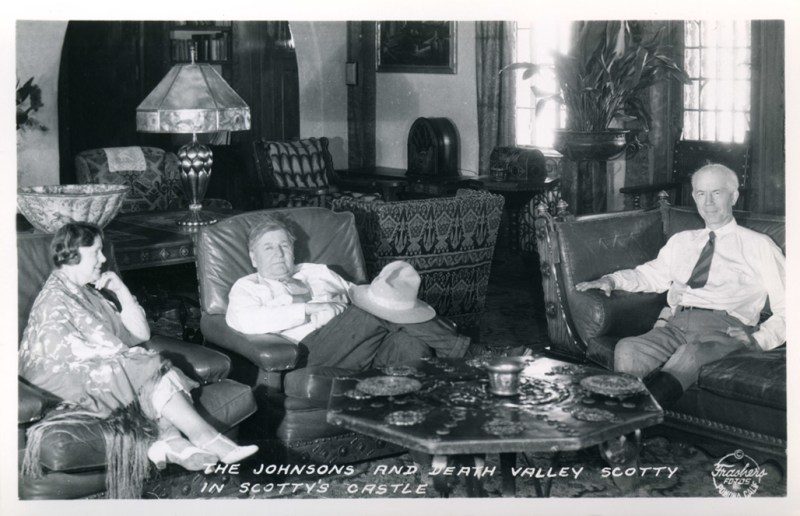
Scott’s most significant relationship was with Albert Mussey Johnson, a Chicago insurance executive he met in 1904. Johnson, intrigued by Scott’s tales, invested in his fictitious mines. In 1906, Johnson visited Death Valley to inspect the claims, enduring the Wingate Pass fiasco. Surprisingly, Johnson was not deterred by the deception. The desert’s dry air benefited his health, and he developed a genuine fondness for Scott’s eccentric personality. The two formed an unlikely lifelong friendship. In 1922, Johnson and his wife, Bessie, began constructing a lavish Spanish-style mansion in Grapevine Canyon, known as Death Valley Ranch but popularly called Scotty’s Castle. Scott falsely claimed he funded the $1.5–$2.5 million estate with his mining wealth, a myth he perpetuated by entertaining guests with tales of his secret mines. In reality, Johnson built the castle as a vacation home, incorporating luxurious features like a pipe organ, custom furniture, and a Chimes Tower with 25 carillon chimes. Scott lived primarily in a nearby five-room cabin at Lower Vine Ranch, making appearances at the castle to maintain his persona.

Death Valley Scotty and the Johnsons

Dubious Reputation and Legal Troubles

Scott’s reputation as a conman was well-earned. He faced lawsuits from creditors in 1912 after falsely claiming to have sold a mine for $12 million, landing him in jail briefly. His schemes often involved fencing stolen high-grade ore, using leased mines as a front. Despite these misdeeds, Scott’s charisma and media savvy kept him a beloved figure. Newspapers called him the “Sphinx of the American Desert” and “King of the Desert Mine,” romanticizing his exploits. His friendship with Johnson shielded him from severe consequences, as Johnson continued to support him financially, even paying him a $30 monthly stipend.

Later Years and Legacy

Construction on Scotty’s Castle halted in the 1930s due to a surveying error revealing the land was federal property and Johnson’s financial troubles during the Great Depression. Johnson willed the estate to the Gospel Foundation, with the condition that Scott could live there until his death. Scott remained a fixture at the castle, regaling tourists with exaggerated stories of his adventures. He died on January 5, 1954, at age 82, and was buried on a hill overlooking the castle beside his dog, Windy. The National Park Service purchased the property in 1970 for $850,000, and it became a major attraction in Death Valley National Park, though it closed in 2015 due to flood damage and a 2021 fire.

Scott’s legacy is a blend of fact and fiction. His grave marker, dedicated by the Death Valley ’49ers Inc., bears his quote: “I got four things to live by. Don’t say anything that will hurt anybody. Don’t give advice—nobody will take it anyway. Don’t complain. Don’t explain.” This encapsulates his philosophy of living large without apology. While his scams and self-promotion earned him a dubious reputation, his friendship with Johnson and the enduring allure of Scotty’s Castle cemented his status as a colorful figure in American frontier history.

References

James Crysanthus Phelan – Rhyolite Shopkeeper

James Crysanthus Phelan

James Crysanthus Phelan was a business man and early pioneer of the desert southwest, who like many others followed the boom towns west. Early in his life, he owned a series of butcher shops in various towns throughout the south west, including Rhyolite. It is believed that his butcher shop was located on Golden Street across the street from the Cook Bank Building and near the Porter Brothers Store.

Biography

The automobile garage owned by James C. Phelan, and named after him, is cleverly planned, well built, and managed according to up-to-date methods. Mr. Phelan’s father, who was an honored veteran of the Union Army in our Civil War, is D. F. Phelan, and he is still living at Los Angeles.

Prior to casting his lot in the Golden State, he was a pioneer in Colorado. Mrs. Phelan, who was Annie Donahue before her marriage, is deceased. Born in the Centennial State on October 25, 1867, James C. Phelan was educated at the public schools in Colorado and New Mexico, and also, as he likes to put it, in ” the great school of experience.”

As a young man, he ventured in both the grocery and butcher business, having a store when only nineteen years of age, at Albuquerque, N. M. For fourteen years, too, his business at Williams, Arizona, was one of the most progressive and profitable establishments in that town. On September 9, 1893, Mr. Phelan was married to Miss Myrtie Dickinson, and this union was blessed with three boys and four girls, viz : Mary M., Chris E., Roy N., Jimmie J., Ruth E., Bernice L., and Leoma C, all of whom were educated in the public schools of Fresno, the two eldest studied at Heald’s Business College, while Roy N., is a student at the University of California at Berkeley.

Cook Bank Building, Rhyolite Nevada, Photo marked 1908 and "Courtesy of the Nevada Historical Society"
Cook Bank Building, Rhyolite Nevada, Photo marked 1908 and “Courtesy of the Nevada Historical Society”

Mr. Phelan has accepted the doctrines of the Christian Scientists, socially he finds recreation in the circles of the Woodmen of the World, the Knights of Pythias, and the Young Men’s Christian Association. In May, 1916, he built the finest and most complete auto establishment in California, spending $90,000 upon the same. He then became agent, for the San Joaquin Valley, of the Maxwell, Mitchell and Marmon automobiles, and the Kleiber and Maxwell Trucks. He employs from forty to fifty men to man the several departments, each of which is complete in itself.

When he first came to California, in 1905, he worked for three years on the Fresno ranch ; and then, getting into the automobile business in a modest way, he has made success after success. Mr. Phelan sold out in August. 1919. Mr. Phelan is a stanch Democrat, but always something more than a political partisan. In advocating and working for good roads, for example, his public-spiritedness has been particularly shown.

References

John S Cook

John S Cook overseeing bars of gold bullion.  Photo Goldfield Historical Society
John S Cook overseeing bars of gold bullion. Photo Goldfield Historical Society

John S. Cook (1870–1945) was a Nevada banker whose vision and investments helped define the brief but spectacular boom of Rhyolite, one of the American West’s most iconic gold-rush ghost towns.

Born March 28, 1870, in Columbus, Franklin County, Ohio, to John R. Cook and Louisa Stimmel, he grew up in the Midwest before heading west in search of opportunity. By 1898 he had reached Arizona, where he married Jesusita Moreno (also known as Jessie or Susie) in Globe. Census records show him working as a bank cashier in Austin, Nevada, by 1900. His big break came when he was hired as cashier for George Nixon’s bank in the booming mining town of Tonopah.

In January 1905, Cook and his brother launched the John S. Cook & Company Bank in the even hotter Goldfield mining district. It began in a modest wooden shack next to the Palace Saloon before moving into the more substantial Nixon Block Building. Deposits quickly reached $5–6 million as the bank financed mining claims tied to investors like Nixon and George Wingfield. Cook was remembered as a man of quiet disposition—courteous, precise, and thorough in business methods.

That same year, as word of rich gold strikes spread to the Bullfrog district just east of Death Valley, Cook opened a branch in the brand-new camp of Rhyolite. The first location was a rented storefront on Main Street. Rhyolite exploded from a few tents in 1904 to a town of roughly 10,000 people by 1908, complete with electricity, railroads, hotels, and an opera house. Sensing permanence, Cook purchased a prime lot at the southwest corner of Golden and Broadway streets. Construction on the Cook Bank Building began in spring 1907 and finished in January 1908 at a cost of nearly $90,000 (the equivalent of roughly $3 million today).

The three-story steel-and-concrete structure was the tallest and most luxurious building in Rhyolite—and one of the grandest in southern Nevada. It featured Italian-marble stairs and flooring, rich mahogany woodwork, imported stained-glass windows, two massive vaults, indoor plumbing, electric lights, telephones, and steam heat. The bank occupied the first floor, the U.S. Post Office moved into the basement in 1908, and brokers’ offices filled the upper stories. To residents and visitors alike, the Cook Bank symbolized Rhyolite’s transformation from tent city to thriving metropolis.

Cook Bank Building, Rhyolite Nevada, Photo marked 1908 and "Courtesy of the Nevada Historical Society"
Cook Bank Building, Rhyolite Nevada, Photo marked 1908 and “Courtesy of the Nevada Historical Society”

The optimism proved short-lived. The national financial panic of October 1907 triggered runs on banks across the country. In Goldfield, depositors emptied other institutions, but Cook’s bank survived—largely because saloon owner Rickards publicly deposited gold and silver bars back into Cook’s vaults, visibly reassuring the public. It was the only Goldfield bank to remain open. Yet Rhyolite’s mines could not weather the downturn. Production faltered, jobs vanished, and the population collapsed. By 1910 the Rhyolite branch had closed; Cook sold off the building’s elegant fixtures, and the grand structure stood empty.

In 1909 George Wingfield bought out Cook’s interest in the Goldfield bank to consolidate control. Cook relocated north to Reno, where he continued working for the Cook banking chain. The empire endured until the Great Depression; Wingfield’s banks, including those bearing Cook’s name, failed in 1932. John S. Cook spent his later years in Arizona and California, working variously as a vice president and bookkeeper. He died in Los Angeles County in July 1945 and was buried at Holy Cross Cemetery in Culver City.

Today, the roofless, sun-bleached concrete shell of the Cook Bank Building remains Rhyolite’s most photographed ruin and one of Nevada’s most recognizable ghost-town landmarks. It has appeared in films ranging from silent-era Westerns to The Island (2005). Its hollow windows frame the desert mountains, a stark monument to the boom-and-bust cycle that defined the early-20th-century mining West—and to the banker who, for a few heady years, bet everything on Rhyolite’s future.

The building’s ruins at sunset or under stormy skies still draw thousands of visitors each year, serving as a silent testament to John S. Cook’s brief but indelible role in Nevada history.

References

Cook Bank Building

The Cook Bank Building is the most iconic image and popular images of the Rhyolite ghost town, in Nye County, Nevada. When John S. Cook built his bank to three stories, it inspired John Overbury to add a third floor to his Overbury building located just down Golden Street. The structure is centrally located in the remains of the town, and photographically, very interesting. Partially for this reason, the structure is a common choice for filming locations, and even appeared in an Alanis Morissette music video.

Rhyolite, Nevada photo by James L Rathbun

The Cook Bank is to most iconic building in Rhyolite and one of the most photographed ruins in Nevada.

John Cook and his brother started the John S. Cook & Company Bank in Goldfield, Nevada in January 1905. Later that same year the opened a new branch in Rhyolite. The banks first location was in a rented building on Main Street. After buying a lot on Golden Street, construction of the Cook Bank Building in the spring of 1907.

One of four banks in Rhyolite, the Cook Bank Building was by far the finest. Build of poured concrete, the building was three stories tall and had a basement that housed the Post Office. The interior was finished with marble staircases and mahogany accents. It also boasted modern conveniences such as electric lights and indoor plumbing

Despite its opulence, the Cook Bank was open less that two years. In the summer and fall of 1907, a financial crisis, often referred to as the Knickerboxer Crisis, caused banks across the country to go bankrupt. By 1910, the Cook Bank was closed and John Cook had sold off all of the building’s fixtures.

Since the closured of the Cook Bank, the building has appeared in many movies including: The Air Mail, The Arrogant, Cherry 2000, The island, Delusion, Ramona!, The Reward, Wanderer of the Wasteland, Six-string Samurai, Rough Rider’s Round Up, Bone Dry, Ultraviolet and more..

BLM Plaque – Rhyolite, Nevada
Cook Bank Building, Rhyolite Nevada, Photo marked 1908 and "Courtesy of the Nevada Historical Society"
Cook Bank Building, Rhyolite Nevada, Photo marked 1908 and “Courtesy of the Nevada Historical Society”

Cook Bank Building Map

References