Common Fiddleneck ( Amsinckia intermedia )

The Common Fiddleneck ( Amsinckia intermedia ) is a wildflower common across the United States and a member of the forget-me-not-family. Also known as the Intermediate Fiddleneck, the name is derived from the flower stems which are formed in the appearance of a violin or fiddle.

Common Fiddleneck ( Amsinckia intermedia var. intermedia )
Continue Reading →

Notch-leaved phacelia ( phacelia crenulata )

Notch-leaved phacelia ( phacelia crenulata ) is a lovely little purple wild flower which grows across the desert southwest from California to Texas. The plant is typically between three to twenty-four inches in height. The flower is also known by several different names including, notch-leaf scorpion-weed, notch-leaved phacelia, cleftleaf wildheliotrope, and heliotrope phacelia.

Notch-leaved phacelia

The Purple Notchleaf Phacelia, scientifically known as Phacelia crenulata (also called Notch-leaf Phacelia, Notch-leaf Scorpion-weed, or Cleftleaf Wild Heliotrope), is one of the most iconic annual wildflowers of the Mojave Desert. In Death Valley National Park—the hottest and driest place in North America—this species transforms barren landscapes into vibrant purple carpets during years with sufficient winter rainfall. It is especially prominent in “superbloom” events, where it blooms alongside bright-yellow Desert Gold (Geraea canescens) to create striking color contrasts on alluvial fans and valley floors.

As of March 2026, Death Valley is experiencing one of the best superbloom displays in a decade, with P. crenulata contributing heavily to the purple displays visible from areas like Badwater Road and Furnace Creek.

Taxonomy

  • Scientific Name: Phacelia crenulata Torr. ex S. Watson
  • Family: Hydrophyllaceae (Waterleaf family; sometimes placed in Boraginaceae)
  • Order: Boraginales
  • Higher Classification: Angiosperms (flowering plants), Eudicots, Asterids

The species includes several varieties that intergrade:

  • var. ambigua (rangewide, larger purple flowers)
  • var. crenulata (California to Utah)
  • var. minutiflora (smaller flowers, sometimes lavender-blue with white throats).

Morphological Description

Phacelia crenulata is an aromatic annual herb, typically 7–60 cm tall (up to 80 cm or ~30 inches in favorable conditions), with erect stems that are sparsely to densely covered in stiff, glandular hairs.

Leaves: Oblong, 2–12 cm long, with wavy, lobed, or distinctly notched/scalloped (crenulate) margins—giving the plant its common name “Notchleaf.” The basal leaves are largest; upper leaves become smaller and more reduced.

Flowers: Arranged in coiled cymes (scorpioid inflorescences) that uncoil as they bloom, resembling a scorpion’s tail. Individual flowers are bell-shaped, ½–1 cm long, with deep violet-to-purple petals (sometimes blue) and a white or pale throat. Stamens and style protrude prominently from the corolla.

Fruit: A small, rounded capsule containing several seeds.

The entire plant is glandular-hairy and emits a distinctive (sometimes unpleasant) scent.

Habitat and Distribution

Phacelia crenulata is native to arid regions of the southwestern United States (Arizona, California, Colorado, New Mexico, Nevada, Texas, Utah) and northern Mexico. It has a rare antitropical (disjunct) distribution, also occurring in parts of South America (southern Peru, western Bolivia, northern Chile).

In Death Valley National Park, it prefers open, sandy, gravelly, or rocky soils on alluvial fans, foothills, and low-elevation desert washes. It commonly appears from mid-February to mid-April at lower elevations (below ~1,000 m), often in disturbed areas or alongside other desert annuals.

Ecology, Life Cycle, and Adaptations

As a desert annual, P. crenulata is an “ephemeral” species whose life cycle is tightly linked to winter precipitation. Seeds lie dormant in the soil for years and germinate rapidly after adequate rain, allowing the plant to grow, flower, set seed, and die before the extreme summer heat and drought return.

Key adaptations:

  • Glandular hairs that may reduce water loss and deter herbivores.
  • Coiled inflorescences that protect developing flowers.
  • Rapid phenology synchronized with brief windows of moisture.

It is highly valuable to native bees as a pollen and nectar source.

Note on human interaction: Like many phacelias, the plant can cause contact dermatitis (skin rash similar to poison oak) in sensitive individuals due to its glandular secretions. Avoid handling if you have sensitive skin.

Conservation Status

Phacelia crenulata is considered “Secure” by NatureServe and faces no major conservation threats. In Death Valley, it benefits from the park’s protection but remains sensitive to off-road vehicle traffic, climate-driven changes in rainfall patterns, and invasive species competition. It is a flagship species for public appreciation of desert biodiversity during superbloom events.

Summary

The Purple Notchleaf Phacelia exemplifies the resilience and beauty of Mojave Desert flora. Its vivid purple blooms, triggered by rare wet winters, turn Death Valley’s harsh landscape into a temporary floral paradise—reminding observers of the delicate balance of water, temperature, and life in one of Earth’s most extreme environments.

Key Viewing Tips for Death Valley (March–April 2026): Look along low-elevation roads and washes near Furnace Creek, Badwater, and the East Entrance for the best displays of purple P. crenulata mixed with yellow desert gold.

This report is based on botanical records from the National Park Service, botanical databases, and field observations during active bloom periods.

Resources

Saguaro ( Carnegiea gigantea )

The Saguaro ( Carnegiea gigantea ) is perhaps one of the most iconic member of the cacti family in the south west desert, and located primarily in Arizona. The giant desert guardian stands watch over the hot dry desert and exudes a quiet nobility which matches its environment perfectly. The slow growing giants can reach heights exceeding 35 feet in height. These pinnacles of stature are due in no doubt to their long life span of up to 200 years. The largest known Individual was measured at 78 feet tall before it was toppled in 1986 from high winds.

A monster Saguaro ( Carnegiea gigantea) - Photo by Sister Cecilia Joseph Wight
A monster Saguaro ( Carnegiea gigantea) – Photo by Sister Cecilia Joseph Wight

Like many other stem succulents, the Saguaro survives the dry climates by optimizing its water retention. Large tap roots anchor the plant to the ground and can harvest water from over 100 feet beneath the surface. The water is pulled into the cactus body and causes the the body to swell which enables the plant to survive long period of drought without water.

A single trunk of the saguaro is known as a spear, and the cacti can stay this way up to 75 years before the first arm is branched from the trunk. The cactus will bloom in the spring months of April, May and June. The white flowers of this plant will form only at the top of each branch and form a crown of beauty. The flowers open in the cooler nights after the sun was dropped below the horizon. Nectar is produced is encourage pollination from a variety of animals. The flower will close again by midafternoon. The flower is the state flower for the State of Arizona.

Saguaro Cacti break the evening skyline near Tucson Arizona - Photo by Sister Cecilia Joseph Wight
Saguaro Cacti break the evening skyline near Tucson Arizona – Photo by Sister Cecilia Joseph Wight

This cactus is protected by the State of Arizona, and sadly needs to be. The US Government created Saguaro National Park in 1994 to protect some of the population and its habitat.

Natural Distribution

 Natural distribution map for Carnegiea gigantea - Elbert L. Little, Jr., of the U.S. Department of Agriculture, Forest Service, and others
Natural distribution map for Carnegiea gigantea – Elbert L. Little, Jr., of the U.S. Department of Agriculture, Forest Service, and others

Resources

Palmers Penstemon ( penstemon palmeri )

In the spring on 2020 I was photographing along the Morning Star Mine Road, we happened upon Palmers Penstemon ( penstemon palmeri ). This species is the most surprising and beautiful wild flowers I have seen in the Mojave Desert.

Penstemon palmeri plant found off Morning Star Mine Road
Continue Reading →

Pencil Cholla ( Cylindropuntia ramosissima )

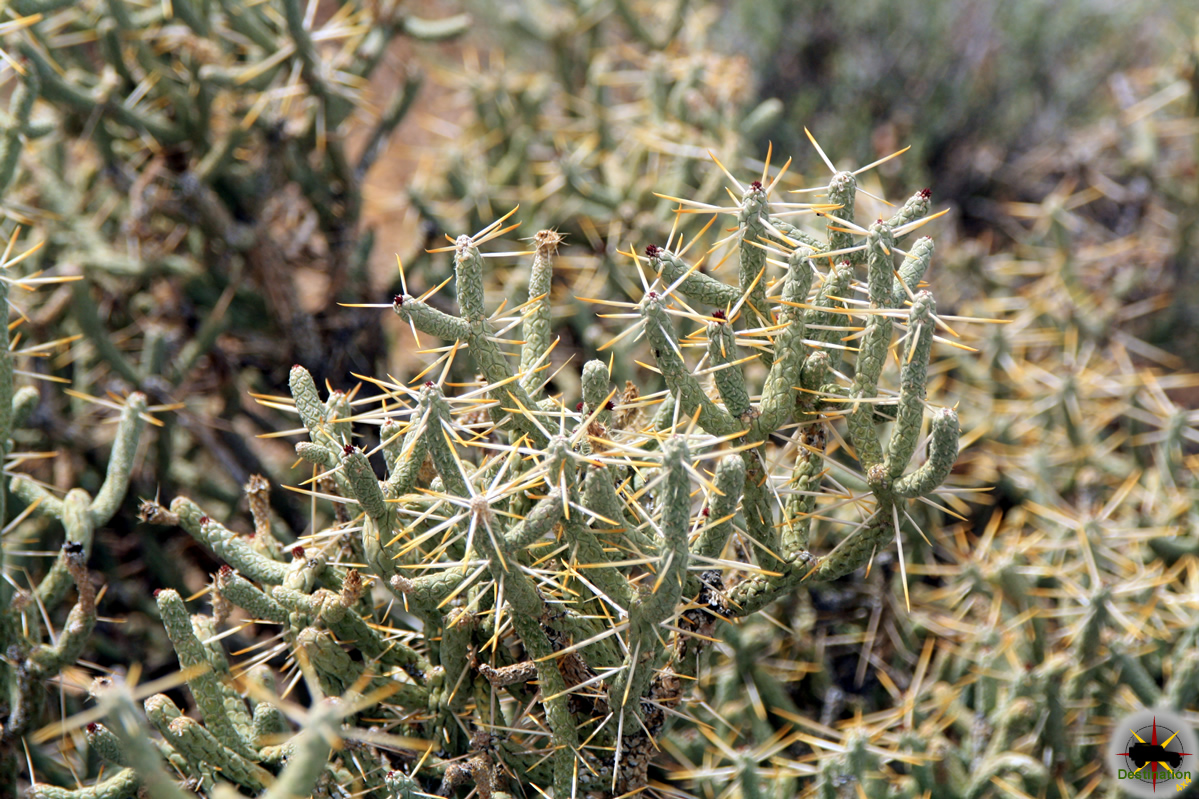
Pencil Cholla ( Cylindropuntia ramosissima ), also known as Diamond Cholla, is a medium sized cacti species which is mainly categorized from long narrow body segments and sparse spine density. The stems are green in appearance and dry grey in color. This species is commonly found in Arizona, California and Nevada at elevations below 4,000 feet.

Pencil Cholla ( Cylindropuntia ramosissima )

This species of cactus typically grows between three and five feet tall. It is found in well-drained sandy, or rocky soils on flats, bajadas, and moderate slopes in the lower mountains. The skin surface if green in appearance and the surface had a cross-hatch or diamond pattern which give this plant its alias, diamond cholla.  Pencil Cholla will bloom in early summer and boasts a smaller flower which is orange, yellow or red in color. The flowers are about the size of a quarter and compared with other cactus species are rather unassuming. This cactus is common in Creosote Bush Scrub and Joshua Tree Woodlands.

The pencil cholla is perhaps the best representative of the harsh desert. Compare to other species, it is harsh and dry in appearance and looks like it is baked in the desert heat.

Resources