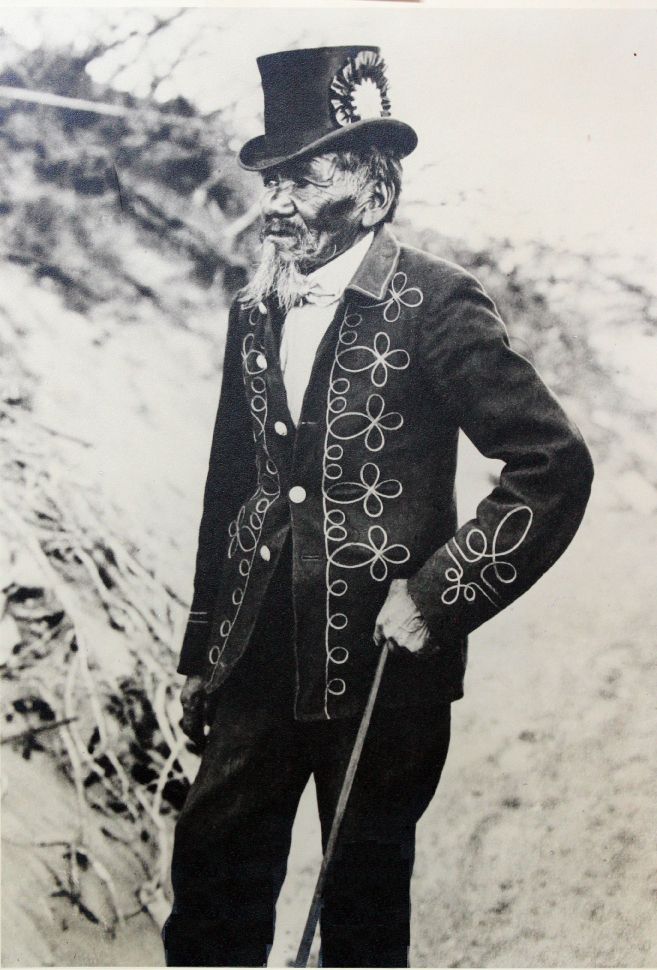
Chief Tecopa – Peacemaker of the Paiutes

Chief Tecopa – Peacemaker of the Paiutes is Nevada State Historic Marker number 171 and located in Nye County, Nevada. The monument is located at his graveside in Chef Tecopa Cemetery in Pahrump, Nye County, Nevada. Tecopa (c. 1815–1904)  was a Native American leased of the Southern Nevada tribe of the Paiute of the Ash Meadows and Pahrump areas.

Chief Tecopa, very early 1900s.
Tecopa, very early 1900s.

Tecopa, who’s name means wildcat, along with several other warriors joined Kit Carson and John C. Fremont in the battle of Resting Springs which lasted for three days.

Tecopa maintained peaceful relations with the white settlers to the region and was known as a peacemaker. He often wore a bright red band suit with gold braid and a silk top hat. These clothes are replaced by local white miners when the clothes wore out. This gesture is in gratitude for Tecopa’s help in maintaining peaceful relations with the Paiute.

Tecopa is buried with his son and grandson at the Chief Tecopa Cemetery in the Pahrump Valley, Nevada.

Nevada State Historic Marker Text

Chief Tecopa – Peacemaker of the Paiutes

Chief Tecopa was a young man when the first European Americans came to Southern Nevada. As a leader among the Southern Paiutes, he fought with vigor to save their land and maintain a traditional way of life. He soon realized if his people were to survive and prosper, he would have to establish peace and live in harmony with the foreigners.

During his life, which spanned almost the entire nineteenth century, his time and energy were devoted to the betterment of his people until his death here in Pahrump Valley.

Chief Tecopa is honored for the peaceful relations he maintained between the Southern Paiutes and the settlers who came to live among them.

STATE HISTORICAL MARKER NO. 171
STATE HISTORIC PRESERVATION OFFICE
CALIFORNIA & NEVADA DEVELOPMENTORGANIZATION

Nevada State Historic Marker Summary

NameChief Tecopa – Peacemaker of the Paiutes
LocationPahrump, Nye County, Nevada
Nevada State Historic Marker171
Latitude, Longitude36.2091, -115.9895

Nevada State Historic Marker Location

References

Old Spanish Trail Mountain Springs Pass – Nevada State Historic Marker

Old Spanish Trail Mountain Springs Pass is located along highway 160 and Nevada State Historic Marker No. 142 in Clark County, Nevada. The Old Spanish Trail is a 700 mile long historical trade route that connected the northern New Mexico settlements near Santa Fe, New Mexico with those of Los Angeles, California.

Old Spanish Trail Mountain Springs Pass Historic Marker

The trail began as a network of routes used by Native American tribes, who traded goods such as salt, obsidian, and turquoise. In the late 18th century, Spanish traders began to use these routes to transport goods between Santa Fe and California. These traders were known as the “Comancheros” and were primarily focused on trading with the Ute and Navajo tribes in the area.

The route became known as the Old Spanish Trail in the early 19th century, when American traders began using the trail to transport furs and other goods to California. The trail was difficult to traverse, with harsh deserts, steep mountains, and treacherous canyons, but it was a vital link between the Southwest and the West Coast.

The Old Spanish Trail played an important role in the development of the American West, as it provided a direct link between the remote and isolated communities of the Southwest and the growing cities of California. The trail was also a source of conflict, as American traders often clashed with Native American tribes over access to resources and trading rights.

Nevada State Historic Marker Text

Nevada State Historical Markers identify significant places of interest in Nevada’s history. The Nevada State Legislature started the program in 1967 to bring the state’s heritage to the public’s attention with on-site markers. Budget cuts to the program caused the program to become dormant in 2009. Many of the markers are lost of damaged.

This portion of the Old Spanish Trail was discovered in January 1830, by Antonio Armijo during his first trip from Santa Fe to Los Angeles.  The springs just north of this marker provided excellent water and fed meadows of luxuriant grass for draft animals.  Two days were required to travel between Las Vegas and Mountain Springs Pass.  The trip was broken at Cottonwood Springs, the site of Blue Diamond, where an early start was usually made in order to climb the pass by nightfall.  Early travelers often referred to the area as Piute Springs, but the present title has been used for over a century.  The altitude made Mountain Springs one of the favorite camping spots on the trail.

STATE HISTORICAL MARKER No. 142
NEVADA STATE PARK SYSTEM
NORTHERN NEVADA HISTORICAL SOCIETY

Nevada State Historic Marker Summary

NameOld Spanish Trail – Mountain Springs Pass
LocationHighway 160, Clark County, Nevada
Nevada State Historic Marker142
Latitude, Longitude35.9983, -115.4484

Nevada State Historic Marker Location

References

Potosi Nevada State Historic Marker 115

Potosi Nevada state historic marker 115 is located along highway 160 between Las Vegas and Pahrump in Clark County. The marker is located off the offramp for Mount Potosi Canyon Road (582). Marker 115 is one of several historic markers located along a very short stretch of highway 160. As you exit highway 160, the marker is tucked away off the main road and turned to the side, so it is semi hidden. Due to the highway devide in this location, the exit is only available when travelling eastbound along Highway 160 towards Las Vegas.

Potosi Nevada State Historic Marker 115

Potosi is one of the first mining ventures in the state of Nevada.

Nevada State Historical Markers identify significant places of interest in Nevada’s history. The Nevada State Legislature started the program in 1967 to bring the state’s heritage to the public’s attention with on-site markers. Budget cuts to the program caused the program to become dormant in 2009. Many of the markers are lost of damaged.

Marker Text

The desire of local Mormon settlers for economic self-sufficiency led to mining by missionaries for lead at Potosí.  In 1858, Nathaniel V. Jones was sent to recover ore from the “mountain of lead” 30 miles southwest of the mission at Las Vegas Springs.  About 9,000 lbs. were recovered before smelting difficulties forced the remote mine to be abandoned in 1857.  Potosi became the first abandoned mine in Nevada.

In 1861, California mining interests reopened the mine, and a smelter and rock cabins for 100 miners made up the camp of Potosi.  Even more extensive operations resulted after the transcontinental Salt Lake and San Pedro R.R. (now the union pacific) was built through the county in 1905.

During World War I, Potosi was an important source of zinc.

STATE HISTORICAL MARKER No. 115
STATE HISTORIC PRESERVATION OFFICE

Marker Location

Marker Summary

NamePotosi, Nevada State Historic Marker 115
LocationClark County, Nevada
Nevada State Historic Marker115
Latitude, Longitude35.9954, -115.4866

References

Hazen, Nevada – Churchill County Ghost Town

Hazen is an unincorporated community in Churchill County, Nevada, often described as a semi-ghost town. It sits on the high desert plain at an elevation of approximately 4,006 feet (1,221 m), about 12 miles (19 km) southeast of Fernley and 16 miles (26 km) northwest of Fallon. The site lies along the historic Southern Pacific Railroad (now part of the Union Pacific system) and U.S. Route 50 Alternate—the former alignment of the Lincoln Highway, U.S. Highway 40, and early U.S. 50.

"Saloons and disreputable places of Hazen (Nev.) June 24, 1905." By Lubkin - NARA - 532037.jpg
“Saloons and disreputable places of Hazen (Nev.) June 24, 1905.” By Lubkin – NARA – 532037.jpg

Geographically, Hazen occupies a strategic transportation corridor in the arid Great Basin, positioned between the Truckee River and Carson Sink regions. Its location made it an ideal junction for rail and highway traffic in the early 20th century, though modern interstates later bypassed it. Today, scattered buildings, railroad remnants, and a few ranches remain, with the area still traversed by active freight trains.

William "Nevada Red" Wood, was Hung on February 27th, 1905 in Hazen, Nevada
William “Nevada Red” Wood, was Hung on February 27th, 1905 in Hazen, Nevada

Early History/Founding

The immediate area had limited pre-1903 activity. In the late 1870s, J.M. Sturdevant operated a small station or roadhouse along the overland route from Wadsworth eastward, serving stage and wagon traffic. However, no formal town existed until the Southern Pacific Railroad (SP) realigned its transcontinental main line in 1902–1903. The railroad shifted eastward from the old Wadsworth route (bypassing the steep Hot Springs Grade), creating a new siding and construction camp at the site.

Hazen was officially established in 1903 and named for Union Army General William Babcock Hazen (1830–1887), a Civil War veteran who served under General William Tecumseh Sherman during the “March to the Sea” and fought in major battles such as Shiloh, Corinth, Murfreesboro, and Chickamauga. General Hazen had no known connection to Nevada and died long before the town’s founding; the name was simply “generously donated” as a railroad honor. A U.S. post office opened on April 25, 1904, formalizing the settlement.

Some secondary sources note possible scattered settlement as early as 1869, but Hazen does not appear on maps until the 1903 railroad development. The town quickly grew from a tent city into a modest rail stop with hotels, saloons, restaurants, and worker housing.

Economic Activities

Hazen’s economy revolved around two major early-20th-century infrastructure projects: the Southern Pacific Railroad and the Newlands Irrigation Project (Nevada’s first major federal reclamation effort, authorized under the 1902 Reclamation Act and championed by U.S. Senator Francis G. Newlands).

  • Railroad Hub: Hazen became a key division point and junction. In 1905, the Nevada & California Railroad (an SP subsidiary) completed a standard-gauge line from Hazen southward, linking the transcontinental main line to the narrow-gauge Carson & Colorado Railroad and tapping the booming mining districts of Tonopah and Goldfield. A branch line to Fallon was built in 1906–1907. By 1906, the SP had constructed a large roundhouse and fine depot at Hazen. These facilities supported passenger and freight traffic, including ore shipments from southern Nevada mines. Hotels and eating houses catered to rail crews and travelers.
  • Newlands Project Construction Camp: In 1904, the U.S. Reclamation Service (USRS, now Bureau of Reclamation) moved its headquarters and established a commissary in Hazen to support construction of Derby Dam, the Truckee Canal, and (later) Lahontan Dam. Hundreds of laborers lived in tents and rudimentary housing, driving demand for saloons, brothels, stores, and services. The project aimed to irrigate the arid Carson-Truckee basin for agriculture, transforming desert land into farmland—a hallmark of Progressive Era federal reclamation.
  • Supporting Industries: Local ranching and farming supplied food to rail and construction crews. By the 1910s, the Western Ore Purchasing Company operated a sampling and assay plant in Hazen, processing ore samples from Nevada’s mining camps before smelting. A small school, churches, and businesses (including the original Hazen Store, ca. 1904) served the population, which peaked around several hundred during boom years.

Hazen earned a reputation as one of Nevada’s toughest towns. With no resident sheriff, crime (robberies, assaults, and vice) was common in the construction camps. On February 27–28, 1905, a mob of about 30 men broke into the small wooden jail (built in 1904 near Constable Judd Allen’s hotel) and lynched ex-convict William “Red” Wood (also called “Nevada Red”), a morphine addict and suspected murderer who had been arrested for robbing the depot. He was hanged from a telegraph pole roughly 30 feet away—the last recorded lynching in Nevada history. No arrests followed.

Decline/Abandonment

Hazen’s peak proved short-lived. A devastating fire on August 23, 1908, started in the rear of a mercantile store and destroyed nearly the entire business district (including the post office, multiple hotels, saloons, restaurants, and stores), with losses estimated at $100,000. Explosions of stored dynamite and gasoline complicated firefighting, though the depot was saved.

The USRS relocated its offices to Fallon in 1908 as work shifted to Lahontan Dam (completed 1915), ending the construction boom. Many families stayed temporarily due to Fallon’s housing shortage, but economic activity slowed. A 1908 rebuild (e.g., the brick Palace Hotel) provided temporary relief, and the Lincoln Highway (1913) brought some auto traffic through town.

Long-term decline accelerated with transportation changes:

  • 1944 highway realignment bypassed the original townsite, forcing businesses (including the Hazen Store and post office) to relocate south to the new alignment.
  • Completion of Interstate 80 in the 1960s rerouted most cross-state traffic onto a four-lane freeway, leaving Hazen on the quieter Alternate U.S. 50.
  • Railroad traffic diminished as mining booms faded and highways competed; the Tonopah line was truncated, and the Fallon branch saw only sporadic use.

The post office operated until June 25, 1979 (with a brief temporary closure in 1977) and never reopened. By the late 20th century, Hazen had shrunk to a handful of residents, mostly ranchers, with many historic structures abandoned or demolished.

Legacy/Current Status

Hazen survives as a quiet, sparsely populated community that preserves echoes of Nevada’s railroad and reclamation eras. It is not fully abandoned but qualifies as a semi-ghost town, with a small number of residents and active railroad use. The Hawthorne Army Depot remains connected to the national rail network via a 120-mile spur originating at Hazen.

Notable surviving features include:

  • The Hazen Store (ca. 1904, later relocated and stuccoed), listed on the National Register of Historic Places for its architectural and transportation significance.
  • Foundations of the roundhouse, depot, and substation.
  • A small cemetery (with at least one recorded burial from 1906).
  • Remnants of worker housing and the former Recreation Inn.

A Nevada State Historic Marker (No. 178) commemorates the town’s founding, railroad role, Newlands Project ties, and the 1905 lynching. In recent decades, limited geothermal exploration has occurred nearby, but the area retains its remote, historic character. Hazen stands as a testament to the boom-and-bust cycles driven by federal infrastructure projects and rail expansion in early 20th-century Nevada.

Town Summary

NameHazen, Nevada
Other NamesHazen Station.
LocationChurchill County, Nevada
Latitude, Longitude39.5653, -119.0464
GNIS864634
Population250
Post Office1904 – Current
Elevation4,000 Feet
NewspaperThe Harvest

Hazen Historic Events

William "Nevada Red" Wood, was Hung on February 27th, 1905 in Hazen, Nevada

The Hanging of William “Nevada Red” Wood

Hazen, a small railroad and construction-camp settlement in Churchill County, Nevada, established in 1903 along the Southern Pacific Railroad, became a hub for workers on…

References

Searchlight Nevada

Searchlight Nevada is a unincorporated town with a history in mining. The small town in Clark County is located south of Las Vegas in Clark County, Nevada and honored with Nevada State Historic Marker number one hundred and sixteen. The Nevada Start Historic Marker is located on the west side of the highway as you enter town.

Nevada State Historical Markers identify significant places of interest in Nevada’s history. The Nevada State Legislature started the program in 1967 to bring the state’s heritage to the public’s attention with on-site markers. Budget cuts to the program caused the program to become dormant in 2009. Many of the markers are lost of damaged.

Main Street of Searchlight, Nevada

The town is founded after George Frederick Cook prospected the area beginning May 6th, 1897. It is said that he would take a searchlight to find gold in the area, lending the town its name. Following the discovery of gold, the area boomed, which caused its population to raise. At the time, the mining town was part of Lincoln County, and for a time its population was larger than that of Las Vegas. When Clark County is created the town was briefly considered to be the county seat.

Between 1907 and 1910, the gold mines of Searchlight produced $7 million dollars in gold and boasted a population of 1,500. Ore is shipped to Barnwell via the Barnwell and Searchlight rail service. In order to reduce costs, the Quartette company constructed a twenty-stamp mill on the Colorado River. The new mill utilized a 15 mile narrow gauge rail is constructed down to the mill in an attempt to further reduce costs. The rail is completed in 1902. Several tent saloons are erected during this time and named Cyrus Noble, Old Bottle and the Little Brown Jug.

Quartette Mill, Searchlight, Nevada

Later in 1903, enough water is is on hand in town to support a second twenty-stamp mill. The onsite mills capacity is further increased in 1906 when the Colorado Mill is closed and relocate near town.

During its peak in 1907, Searchlight boasts well-furnished stores, about a dozen saloons, telephone exchange, forty four mines and several mills. The Chamber of Commerce advertised some 5,000 people living in the little haven. Searchlight’s decline began in 1917.

Today, the town is home to about 500 people. Its location on the 95 highway offers a rest spot for travelers between Las Vegas and various Colorado River how spots, including Lake Mojave, Laughlin NV, Bullhead City and Havasu. The small community is home to a few small casinos, gas and food. Senator Majority Harry Leader Harry Reid is perhaps the towns most notable citizen. Harry Ried proudly raised the American Flag over his property, when he was home which was visible from the highway.

Nevada State Historic Marker Text

Initial discoveries of predominately gold ore were first made at this location on May 6, 1897.  G.F. Colton filed the first claim, later to become the Duplex Mine.  The Quartette Mining Company, formed in 1900, became the mainstay of the Searchlight district, producing almost half of the area’s total output.  In May 1902, a 16 mile narrow-gauge railroad was built down the hill to the company’s mill on the Colorado River.

On March 31, 1907, the 23.22 mile Barnwell and Searchlight Railroad connected the town with the then main Santa Fe line from Needles to Mojave.  By 1919 trains travelled over the B. and S. Railroad only twice a week.  A severe washout on September 23, 1923, halted traffic completely.  Train service was never restored.

Searchlight is the birthplace of U.S. Senator Harry Reid (b.1939) who became the first Nevadan to serve as the Senate Majority Leader, a position he assumed in 2007.

STATE HISTORICAL MARKER No. 116
STATE HISTORIC PRESERVATION OFFICE

Nevada State Historic Marker Map

Town Summary

NameSearchlight, Nevada
LocationClark County, Nevada
Latitude, Longitude35.4744, -114.9307
Nevada State Historic Marker116
GNIS0845654
Populationup to 5,000
Elevation3,547 ft (1,081 m)
News PaperSearchlight Bulletin Jan 1, 1903 – Jan 3, 1913

References