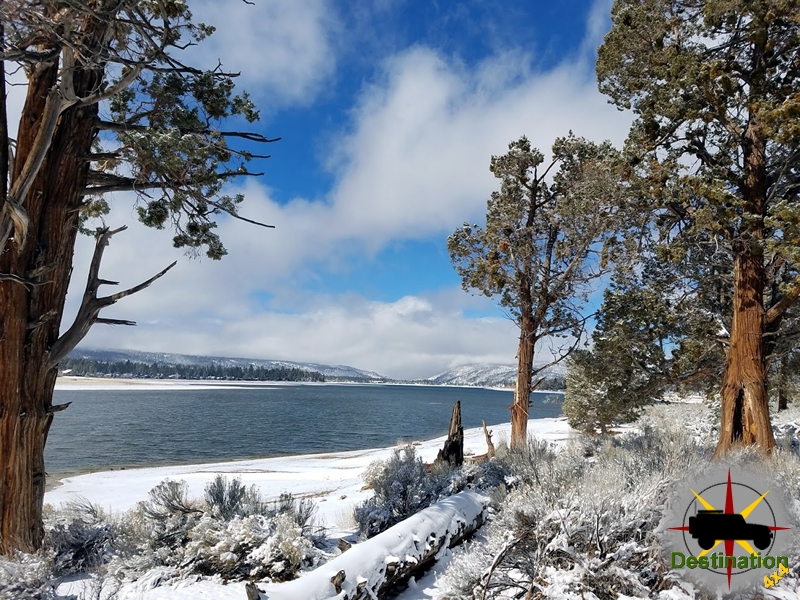
Big Bear, CA
I quiet mountain community full of back country adventure.
The Journey is the destination
Holcomb Valley Campground features 19 single-family campsites and is located along 3N16 in Holcomb Valley, just outside 0f Big Bear, in San Bernardino County, California. Big Bear is a fantastic destination for those interested in outdoor recreation including hiking, biking, horseback riding, skiing, bouldering, star-gazing, flowers and wildlife viewing. There are many historic sites in Big Bear and the campground is an ideal place for access to the Gold Fever Off Road Trail.

Big Bear Lake is located in the San Bernardino mountains of California about 90 miles east of Los Angeles in southern California. The area is a full four season resort which offers great skiing in the winter. Back country 4×4 trails offer a variety of opportunities from the daily driver to a purpose built 4×4. Hiking, biking, boating and camping are great activities in the spring, summer and fall.

Each family campsite accommodates a maximum of 8 people. Amenities include a picnic table, 1 fire ring, bear boxes and vault toilets. There is no water available. A campground host is on site during mid May through October.
| Name | Holcomb Valley Campground |
| Location | Big Bear, San Bernardino, California |
| Latitude, Longitude | 34.302593, -116.895933 |
| Elevation | 7,375 Feet |
| Number of Sites | 19 |
| Amenities | Tent camping,Picnic tables,Toilets,Parking |
Serrano Campground is a campground with 108 campsites located near Big Bear Lake in San Bernardino, California. the campground is located just across the highway from Big Bear Lake. Big Bear is a fantastic destination for those interested in outdoor recreation including hiking, biking, fishing, boating, horseback riding, skiing, bouldering, star-gazing, flowers and wildlife viewing. There are many historic sites in Big Bear.
Big Bear Lake is located in the San Bernardino mountains of California about 90 miles east of Los Angeles in southern California. The area is a full four season resort which offers great skiing in the winter. Back country 4×4 trails offer a variety of opportunities from the daily driver to a purpose built 4×4. Hiking, biking, boating and camping are great activities in the spring, summer and fall.

Visitors enjoy access to a number of hiking and mountain biking trails found within a short distance of the campground. The Alpine Pedal Path and the Cougar Crest Trail are nearby and provide access to the Pacific Crest Trail. The Big Bear Ranger Station is within a mile of the campground. Rangers can provide maps of the area and answer any questions about trails.
Fishing and boating at Big Bear Lake are popular activities. The campground does not provide direct access to the lake, but a boat ramp is available about a mile away. Anglers can look forward to a possible catch of trout, bass, catfish, carp, bluegill and crappie, among others.
| Name | Serrano Campground |
| Location | Big Bear, San Bernardino, California |
| Latitude, Longitude | 34.2628059,-116.9154313 |
| Number of Sites | 108 |
| Elvation | 6,800 feet |
| Amenities |
Hanna Flats Campground is located near Big Bear Lake is located in the San Bernardino mountains of California about 90 miles east of Los Angeles in southern California. The area is a full four season resort which offers great skiing in the winter. Back country 4×4 trails offer a variety of opportunities from the daily driver to a purpose built 4×4. Hiking, biking, boating and camping are great activities in the spring, summer and fall.
Hanna Flats Campground is an established campground located on Coxey Truck Trail – 3N14 in Big Bear, San Bernardino California. The campground features eighty five campsites and is located in a pine forest. Big Bear is a fantastic destination for those interested in outdoor recreation including hiking, biking, fishing, boating, horseback riding, skiing, bouldering, star-gazing, flowers and wildlife viewing. There are many historic sites in Big Bear.
A number of hiking and biking trails are nearby, including 3.5-mile Gray’s Peak Trail that connects to Hanna Flat Trail, and 10 miles of unmarked trails that lead to Coxcomb Creek.
Fishing and boating at nearby Big Bear Lake are popular activities. Anglers can look forward to a catch of trout, bluegill, crappie, catfish and largemouth bass. Because of cold water temperatures and the presence of underwater obstacles near the shorelines, swimming at the lake is often discouraged.
| Name | Hanna Flats Campground |
| Location | Big Bear, San Bernardino, California |
| Number of Sites | 85 |
| Elvation | 7,115 feet |
| Amenities | Picnic table, fire ring, – no hook-ups, Vault toilets, tap water, campfire circle |
The pronghorn (Antilocapra americana), often mistakenly called an antelope, is the sole surviving member of the Antilocapridae family and North America’s fastest land mammal, capable of sustained speeds up to 55 mph (88 km/h). In the desert southwest of the United States, particularly the Sonoran Desert, the subspecies known as the Sonoran pronghorn (A. a. sonoriensis) exemplifies remarkable adaptations to arid environments, including efficient water conservation and heat tolerance. These graceful ungulates, with their distinctive pronged horns and white rump patches, roam vast open landscapes, evoking the untamed spirit of the American West.

Pronghorns belong to the kingdom Animalia, phylum Chordata, class Mammalia, order Artiodactyla (even-toed ungulates), family Antilocapridae, genus Antilocapra, and species americana. There are five recognized subspecies: the American pronghorn (A. a. americana), Mexican pronghorn (A. a. mexicana), Sonoran pronghorn (A. a. sonoriensis), Baja California pronghorn (A. a. peninsularis), and Oregon pronghorn (A. a. oregona). The Sonoran pronghorn, endemic to the desert southwest, is listed as endangered due to habitat fragmentation and human activities. Pronghorns are not true antelopes but are more closely related to giraffes and okapis, though they represent a unique evolutionary lineage that once included multiple species during the Pleistocene era.
Adult pronghorns measure 1.3–1.5 meters (4.3–4.9 feet) in length, stand 81–104 cm (32–41 inches) at the shoulder, and weigh 36–70 kg (79–154 pounds), with males typically larger than females. Their coat is tan to reddish-brown on the back and sides, with white underparts, throat, and distinctive white rump patches that flare as alarm signals. The namesake horns, present in both sexes but larger in males (up to 50 cm or 20 inches), are unique: they consist of a bony core sheathed in keratin that is shed annually, unlike true antlers or horns. Females’ horns are smaller and lack the forward-facing prong. Large eyes positioned on the sides of the head provide a 320-degree field of vision, aiding in predator detection, while long legs and cushioned hooves enable high-speed endurance running. Sonoran pronghorns are slightly smaller and lighter, adapted for desert life with enhanced heat dissipation through large ears and a slender build.
Pronghorns are diurnal and crepuscular, most active at dawn and dusk to avoid midday heat in desert regions. They are highly social, forming mixed-sex herds of up to 1,000 individuals during winter migrations, but in the southwest deserts, groups are smaller (5–20) due to sparse resources. Territorial males defend harems during breeding, using scent marking from glands on the head and rump, and engage in ritualized displays like parallel walking or horn clashing. Their legendary speed—sprints up to 98 km/h (61 mph) and sustained 55 km/h (34 mph) over distances—evolved to outrun extinct predators like American cheetahs, and they can leap 6 meters (20 feet) horizontally. In the desert southwest, Sonoran pronghorns exhibit nomadic behavior, moving in response to rainfall and forage availability, and they pant or seek shade to thermoregulate in extreme heat. Communication includes visual signals like rump flashing, vocalizations such as snorts or bleats, and olfactory cues.
As herbivores, pronghorns are selective browsers and grazers, consuming a diverse diet of forbs (broad-leaved herbs), shrubs, grasses, and occasionally cacti, with preferences shifting seasonally. In the desert southwest, they favor drought-resistant plants like chainfruit cholla, mesquite, and palo verde for moisture, and can digest toxic species unpalatable to other ungulates due to large kidneys and specialized gut microbes. Forbs dominate in spring and summer (up to 90% of diet), while shrubs like sagebrush provide winter sustenance. They obtain most water from vegetation, drinking infrequently but traveling up to 10 km (6 miles) to water sources in arid areas. This opportunistic feeding helps them survive in low-productivity deserts, where they forage by nipping plants at ground level.
Pronghorns are polygynous, with breeding (rut) occurring from July to October in southern populations like the Sonoran subspecies, timed to monsoon rains for optimal fawn survival. Males compete for females through displays and fights, establishing territories of 0.5–5 km² (0.2–2 sq mi). Gestation lasts 235–250 days, with females typically birthing twins (singles for first-time mothers) in secluded spots, hiding fawns in vegetation for the first few weeks. Fawns are precocial, standing within hours and running soon after, weaned by 4–5 months, and reaching sexual maturity at 15–16 months. In the desert southwest, breeding success is tied to rainfall; drought can lead to high fawn mortality from predation by coyotes or bobcats. Lifespan in the wild averages 10–15 years.
Pronghorns thrive in open, arid to semi-arid habitats with low vegetation for visibility, including grasslands, shrublands, and deserts at elevations from sea level to 3,300 meters (10,800 feet). In the desert southwest, the Sonoran pronghorn inhabits broad alluvial valleys, bajadas, and dry plains of the Sonoran Desert, separated by granite mountains, with sparse creosote bush, saguaro cacti, and ocotillo. Their range spans southwestern Arizona (e.g., Cabeza Prieta National Wildlife Refuge) and northwestern Sonora, Mexico, with a small population in California potentially extinct. Overall, pronghorns occur from southern Canada to northern Mexico, but in the U.S. southwest, they are found in Arizona, New Mexico, Nevada, Utah, and parts of California and Texas. They prefer gentle, rolling terrain for spotting predators from afar and avoid dense forests or steep mountains. Human developments like fences and roads fragment habitats, posing threats to migration and genetic diversity in desert populations.
| Kingdom: | Animalia |
| Phylum: | Chordata |
| Class: | Mammalia |
| Order: | Artiodactyla |
| Family: | Antilocapridae |
| Subfamily: | Antilocaprinae |
| Tribe: | Antilocaprini |
| Genus: | Antilocapra Ord, 1818 |
| Species: | A. americana[ |
The Coyote (Canis latrans), commonly known as the prairie wolf, brush wolf, or American jackal, is a highly adaptable medium-sized canid native to North America.

The binomial name Canis latrans translates to “barking dog,” reflecting its vocal nature. It belongs to the genus Canis, which includes wolves, dogs, and jackals. Approximately 19 subspecies are recognized, with variations in size and coloration across regions (e.g., larger northeastern forms often show some historical hybridization with wolves).
| Kingdom: | Animalia |
| Phylum: | Chordata |
| Class: | Mammalia |
| Order: | Carnivora |
| Family: | Canidae |
| Genus: | Canis |
| Species: | C. latrans |
Coyotes are smaller and more lightly built than gray wolves (Canis lupus), but larger than most foxes. Adults typically stand about 60 cm (24 inches) at the shoulder, measure 1–1.3 meters (3.3–4.3 feet) in total length (including a 30–40 cm bushy tail), and weigh 9–23 kg (20–50 pounds), with eastern populations often heavier.
The fur is long and coarse, usually grizzled buff, grayish-brown, or yellowish-gray on the upper parts, with whitish underparts, reddish tones on the legs, and a black-tipped tail. There is considerable variation; some individuals appear silver-gray or nearly black (melanistic forms are rare). Coyotes have pointed, erect ears, a slender muzzle, and a drooping bushy tail when running. They resemble a lean German Shepherd or collie but are distinguished by their narrower build and pointed features.
Coyotes are highly intelligent, opportunistic, and adaptable. They are primarily nocturnal or crepuscular (active at dawn and dusk), though daytime activity occurs where undisturbed. They can reach speeds up to 65 km/h (40 mph) and jump distances of 4 meters.
Social organization varies: many live solitarily or in pairs, while others form small family groups (often a mated pair and pups). They maintain territories, especially during denning season. Coyotes are famous for their vocalizations, including yips, barks, howls, and “serenades” at night for communication, territory defense, or coordination.
As efficient hunters and omnivores, they primarily prey on small mammals (e.g., rodents, rabbits, hares), but also take larger prey like white-tailed deer (especially in winter or packs), birds, insects, and carrion. They readily consume fruits, berries, and vegetation when animal prey is scarce. Hunting often occurs alone or in pairs, though packs form seasonally for larger prey. Keen senses of smell, hearing, and vision aid in locating food.
Historically centered in the western Great Plains and arid regions of North America, coyotes have dramatically expanded since the early 20th century. Today, they occupy a vast range from northern Alaska and most of Canada southward through the United States, Mexico, and into Central America (at least to Panama and parts of Costa Rica). They are found coast-to-coast in the U.S. and Canada, absent only from the northernmost tundra and some extreme southern peninsulas.
This expansion includes forests, urban areas, agricultural lands, deserts, and riparian zones, making the coyote one of the most widespread carnivores in the Americas. Highest densities occur in the Great Plains and south-central U.S. The species is classified as Least Concern by the IUCN due to its adaptability and stable/increasing populations.
The coyote’s success stems from its behavioral flexibility, omnivorous diet, and ability to thrive alongside human activity, making it a classic example of ecological resilience in modern landscapes.