Orion Clemens Home – Nevada State Historic Marker

Orion Clemens (1825–1897), often misspelled in casual references as “Clemmons,” was a printer, journalist, lawyer, inventor, and politician best remembered as the older brother of Samuel Langhorne Clemens (Mark Twain) and as the first and only Secretary of the Nevada Territory. His roughly five-year stint in Nevada Territory (1861–1866) marked the high point of his public career and the period in which he exercised real political influence, briefly served as acting governor, and hosted his brother during the adventures that later became the book Roughing It.

Mark Twain stayed with his brother Orion Clemens in Carson City, Nev. Photo from Library of Congress, Prints & Photographs Division, HABS, Reproduction number HABS NEV,13-CARCI,3-.

Early Life and Pre-Nevada Career

Orion Clemens was born on July 17, 1825, in Gainesboro, Tennessee, the eldest of seven children of John Marshall Clemens and Jane Lampton Clemens. Only three siblings survived to adulthood: Orion, his sister Pamela (1827–1904), and his brother Samuel (1835–1910). In 1839 the family moved to Hannibal, Missouri, the Mississippi River town that would later inspire much of Mark Twain’s fiction.

As a young man Orion clerked in his father’s store, apprenticed at a local newspaper, and moved to St. Louis to study law under Edward Bates (who later became Abraham Lincoln’s Attorney General). After his father’s death in 1847, Orion returned to Hannibal, bought the local paper, and renamed it the Hannibal Journal (briefly the Western Union). Samuel worked for him there as a typesetter and printer’s devil. The paper struggled financially and folded in 1853. Orion then moved to Iowa, running printing offices in Muscatine and Keokuk. In 1854 he married Mary Eleanor “Mollie” Stotts in Keokuk; their only child, Jennie, was born there. Samuel briefly worked for him again in Keokuk in 1855–1856.

By 1860 Orion had become an outspoken Republican and opponent of slavery. When Lincoln won the presidency, Bates’ influence secured Orion the appointment as Secretary of the newly created Nevada Territory at a salary of $1,800 a year.

Time in Nevada Territory (1861–1866): The Peak of His Career

In the summer of 1861 Orion and 25-year-old Samuel set out from St. Joseph, Missouri, by stagecoach for Carson City, the raw new capital of Nevada Territory. The 19-day journey—filled with dust, alkali flats, and colorful frontier characters—would later furnish much of the material for Mark Twain’s Roughing It (1872). Orion paid Samuel’s way in exchange for secretarial help. They arrived in Carson City on August 14, 1861, when the town had only about 2,000 residents and the Comstock Lode silver boom was just beginning.

Territorial Secretary and Acting Governor

Orion’s official title was Secretary of Nevada Territory, but he frequently served as acting governor when Governor James W. Nye was absent (often in Washington or San Francisco). In that capacity he helped organize the territorial government, oversaw legislative sessions, and—most notably—averted a potential “Sagebrush War” border dispute with California by diplomatic maneuvering that earned him local popularity. He also paid for printing the House and Senate Journals and furnishing the legislative chambers out of his own pocket when territorial funds ran short.

In 1862 Orion sent for Mollie and Jennie. The family lived first in rented quarters and then, by 1864, moved into the two-story house he built at what is now 502 North Division Street in Carson City’s West Side Historic District. The modest Late Victorian home (still standing and listed on the National Register of Historic Places) became a hub for the small territorial elite. Samuel, who had drifted into mining claims, prospecting, and reporting for the Virginia City Territorial Enterprise, stayed with them periodically until he left Nevada for good in May 1864. Jennie attended the Sierra Seminary in Carson City; Mark Twain later wrote a light sketch about visiting her there.

Tragedy struck on February 1, 1864, when nine-year-old Jennie died of spotted fever (meningitis) after a brief illness. Orion, Mollie, and Samuel kept vigil at her bedside. The Nevada Legislature paused proceedings in her memory. The loss devastated Orion and Mollie; they never fully recovered, and Orion’s political energy visibly waned afterward.

Statehood and Political Twilight

When Nevada achieved statehood on October 31, 1864 (hastened by Lincoln to secure electoral votes and silver for the Union war effort), Orion sought the Republican nomination for Secretary of State. His strong teetotaler stance—he had been a confirmed abstainer since his St. Louis days—alienated voters in the hard-drinking mining towns, and grief over Jennie further hampered his campaigning. He lost the nomination. In 1865 he served a brief, low-paying term in the new state assembly but could not build a successful law practice. Financial pressures mounted. In August 1866 the family sold the Carson City house at a loss and left Nevada forever.

Orion’s Nevada years were, in many ways, his most successful. He had arrived as a modest printer and left having helped shape the territory’s transition to statehood, earned the trust of President Lincoln’s administration, and provided the launchpad for his brother’s literary career.

Later Life and Legacy

After Nevada, the Clemenses tried (and failed) to strike it rich in Meadow Lake, California, then moved back East for newspaper work before settling permanently in Keokuk, Iowa, in the mid-1870s. Orion practiced law sporadically, raised chickens, tinkered with inventions, and wrote prolifically—none of it profitably. Samuel (by then a world-famous author) provided steady financial support and visited often after their mother joined them in Keokuk.

In 1880 Samuel encouraged Orion to write his autobiography, suggesting titles like “The Autobiography of a Coward” or “Confessions of a Life that was a Failure.” Orion produced over 2,500 pages, but Samuel and editor William Dean Howells found it too raw and ultimately destroyed or lost most of it. Only fragments survive.

Orion Clemens died in Keokuk on December 11, 1897, at age 72. He is buried in Mount Olivet Cemetery in Hannibal, Missouri. Though often portrayed by his brother and later biographers as eccentric, flighty, and unsuccessful, his record in Nevada shows competence, integrity, and genuine political skill during a chaotic frontier moment. The Orion Clemens House in Carson City remains a stop on the Kit Carson Trail and a tangible link to both Nevada’s territorial birth and the early life of Mark Twain.

His Nevada chapter—brief but pivotal—reminds us that the American West was built not only by colorful prospectors and gunfighters but also by steady, teetotaling administrators who kept the machinery of government running while their more famous relatives chased silver and stories.

Nevada State Historic Marker Text

Orion Clemens, secretary to territorial Governor James W. Nye, lived in this house with his wife, “Mollie,” from 1864 to 1866.  Samuel, his brother who was a reporter for the Territorial Enterprise, stayed here periodically until leaving the territory in May 1864.  He became famous as “Mark Twain.”

STATE HISTORICAL MARKER No. 78
STATE HISTORIC PRESERVATION OFFICE
JULIAN C. SMITH, JR.

The Orion Clemens House (also known as Mark Twain’s House) is a historic two-story Late Victorian residence at 502 North Division Street in Carson City, Nevada’s West Side Historic District. Built in 1862–1863 by Orion Clemens—the first Secretary of the Nevada Territory and occasional acting governor—it stands as one of the city’s finest early territorial-era homes and a stop (#20) on the popular Kit Carson Trail walking tour.

The L-shaped wood-frame structure originally sat on a simple foundation of timber posts driven into the ground. Its design blends multiple 19th-century influences: a gable roof with cornice returns and dentils (echoing Greek Revival style), paired with decorative brackets under the eaves and gables (Italianate touches). Some descriptions also note subtle Gothic Revival elements. The exterior once featured classic drop-siding (clapboard), later covered in stucco, while the window surrounds have been simplified from their original more ornate Italianate detailing. A prominent second-story balcony with turned balusters overlooks the street, and the house retains its modest but dignified scale amid mature trees and landscaping.

Inside, the home originally contained ten rooms, reportedly making it one of the most comfortable and well-appointed residences in the entire territory at the time of construction. It served as the family home of Orion Clemens and his wife, Mary “Mollie” Stotts Clemens, from 1864 until they left Nevada in 1866. During that period, Orion’s younger brother, Samuel Clemens—then a reporter for the Virginia City Territorial Enterprise and not yet famous as Mark Twain—stayed here periodically before departing the territory in May 1864. The house was even informally called the “Governor’s Mansion” whenever Orion filled in for Territorial Governor James W. Nye during his absences.

A Nevada State Historical Marker (No. 78) placed in front of the property reads: “Orion Clemens, Secretary of Nevada Territory by appointment of President Lincoln, lived in this house with his wife, ‘Mollie,’ from 1864 to 1866. During that time Samuel, Orion’s brother who became famous as ‘Mark Twain’ was a reporter for the Territorial Enterprise and stayed here periodically until leaving the territory in May 1864.”

The house was individually listed on the National Register of Historic Places in 1979 (NRHP #79003439) for its architectural significance and its close association with early Nevada territorial government and the Clemens family. The listing encompasses 0.2 acres and two contributing buildings.

Today the Orion Clemens House is privately owned and functions as a law office (Smith & Harmer, Ltd., Attorneys at Law). While the interior is not open to the public, the handsome exterior can be viewed from the sidewalk along the Kit Carson Trail. The building remains a tangible link to Nevada’s rough-and-tumble territorial days, the Comstock Lode silver boom, and the early adventures that inspired Mark Twain’s Roughing It.

Its clean lines, balanced proportions, and surviving Victorian details continue to make it a standout landmark in downtown Carson City—quiet testimony to the brief but pivotal years when the Clemens brothers called Nevada home.

Nevada State Historic Marker Summary

NameOrion Clemens Home
LocationCarson City, Nevada
Nevada State Historic Marker Number78
Latitude, Longitude39.1667, -119.7695

Nevada State Historic Marker Location

The Orion Clemens House, also known as Mark Twain’s House, is a two-story Late Victorian house located at 502 N. Division St. in Carson City.

References

Carson City Mint – Nevada State Historic Marker

The United States Mint at Carson City, Nevada is Nevada Sate Historic Marker Number 196 and located in Carson City, Nevada.

The original Carson City building is a formal balanced, sandstone block edifice, two stories high with a centrally located, cupola. The sandstone blocks were quarried from the Nevada State prison.

On March 3, 1862, Congress passed a bill authorizing the establishment a branch of the United States mint in the Territory of Nevada. The output of the Comstock Lode Silver strike, coupled with the high bullion transportation costs to San Francisco, necessitated the action.

From its opening of the U. S. Mint in Carson City, in 1870 to the closing of the coin operations in 1893, the minted coinage amounted to $49,274,434.30. Most of the Carson City coins are scarce to rare, some of them being tremendous rarities. Others, such as the silver dollars of 1882-84, have survived in vast numbers for reasons that have nothing to do with their original mintage figures. All of these coins, whatever their rarity or market value, carry romantic associations with the Old West and the great bonanza years of the late 19th Century

Nevada State Historical Markers identify significant places of interest in Nevada’s history. The Nevada State Legislature started the program in 1967 to bring the state’s heritage to the public’s attention with on-site markers. Budget cuts to the program caused the program to become dormant in 2009. Many of the markers are lost of damaged.

Nevada State Historic Marker Text

The original Carson City building is a formal balanced, sandstone block edifice.  Two stories high with a centrally located cupola.  The sandstone blocks were quarried at the Nevada State Prison.

On March 3, 1862, Congress passed a bill establishing a branch mint in the Territory of Nevada.

The output of the Comstock Lode coupled with the high bullion transportation costs to San Francisco proved the necessity of a branch in Nevada.

From its opening in 1870 to the closing of the coin operations in 1893, coinage amounted to $49,274,434.30.

STATE HISTORICAL MARKER No. 196
NEVADA STATE PARK SYSTEM
NEVADA LANDMARKS SOCIETY

Nevada State Historic Marker Summary

NameThe United States Mint at Carson City
LocationCarson City, Nevada
Nevada State Historic Marker Number196
Latitude, Longitude39.1673, -119.7670

Nevada State Historic Marker Location

The Nevada State Historic Marker is in Carson City, Nevada. The marker is located on North Carson Street (U.S. 395), on the west side of the highway. Marker is at or near this postal address: 600 North Carson Street, Carson City NV 89701, United States of America

References

Nevada’s Capitol – Nevada State Historic Monument

Nevada’s Capitol is located in Carson City, Nevada and designated as Nevada State Historic Marker Number Twenty Five. The capitol building is located in the state capital of Carson City at 101 North Carson Street. The building was constructed in the Neoclassical Italianate style between 1869 and 1871.

Nevada's Capital in 1875
Nevada State Capitol in 1875

The cornerstone of Nevada’s Capitol is laid on June 9, 1870. A brass box that served as a time capsule was deposited in the stone. The cornerstone was a solid block of sandstone, laid on top of blocks which contained the capsule.  The Capitol Building was designed by Joseph Gosling of San Francisco. The Building was built by Peter Cavanaugh & Son of Carson City.  Cavanaugh’s $84,000 bid was nearly half of the actual cost of the building. The building was constructed of locally-quarried sandstone.  The silver-colored cupola dome rose 120 feet above the ground.  Furnishings cost an additional $20,000.

The original building is cruciform shape in the form of a cross, with a central rectangle 76 feet wide by 85 feet deep. Each of two wings measures 35 feet wide by 52 feet in length. The window panes are made of 26-ounce French crystal. Floors and wainscotting are made of Alaskan marble which was shipped to San Francisco in 20-ton blocks. The octagonal dome topped with a cupola admits light to the second story. During 1906, an octagonal Annex was added to the rear of the capitol to house the State Library.

Nevada State Historical Markers identify significant places of interest in Nevada’s history. The Nevada State Legislature started the program in 1967 to bring the state’s heritage to the public’s attention with on-site markers. Budget cuts to the program caused the program to become dormant in 2009. Many of the markers are lost of damaged.

Nevada State Historic Marker Text

Completed in 1871, Nevada’s splendid Victorian-era Capitol was built of sandstone from the quarry of the town’s founder, Abe Curry.  The octagon annex was added in 1907, the north and south wings in 1915.  Notable features are its Alaskan marble walls, French crystal windows, and elegant interior.

NEVADA CENTENNIAL MARKER No. 25
STATE HISTORIC PRESERVATION OFFICE
SPONSOR: DAUGHTERS OF THE AMERICAN COLONISTS

Nevada State Historic Marker Summary

NameNevada’s Capitol
LocationCarson City, Nevada
Nevada State Historic Marker Number25
Latitude, Longitude39.1639, -119.7667

Nevada State Historic Marker Location

The Historic Marker located on the grounds of the Nevvada State Capitol. The marker is mounted on the capital building just to the right of the entrance doors.  The marker is at or near this postal address: 149 South Carson Street, Carson City NV 89701, United States of America.

References

Carson City – Nevada State History Marker

Carson City Nevada State Historic Marker Number 44 is located at the State Capital of Nevada in Carson City.

Christopher 'Kit' Carson (1809-1868), American explorer - Photograph byMathew Brady or Levin C. Handy - This image is available from the United States Library of Congress's Prints and Photographs division under the digital ID cwpbh.00514.
Christopher ‘Kit’ Carson (1809-1868), American explorer – Photograph by Mathew Brady or Levin C. Handy – This image is available from the United States Library of Congress’s Prints and Photographs division under the digital ID cwpbh.00514.

Nevada State Historical Markers identify significant places of interest in Nevada’s history. The Nevada State Legislature started the program in 1967 to bring the state’s heritage to the public’s attention with on-site markers. Budget cuts to the program caused the program to become dormant in 2009. Many of the markers are lost of damaged.

Nevada State Historic Marker Text

In 1851, Frank and Warren L. Hall, George Follensbee, Joe and Frank Barnard and A.J. Rollins established one of the state’s oldest communities, Eagle Station, a trading post and ranch on the Carson Branch of the California Emigrant Trail.  The station and surrounding valley took their name from an eagle skin stretched on the wall of the trading post.

In 1858, Abraham Curry purchased much of the Eagle Ranch after finding that lots in Genoa were too expensive.  Together with his friends, Jon Musser, Frank Proctor and Ben Green, Curry platted a town he called Carson City.  Curry left a plaza in the center of the planned community for a capitol building should a territorial state seat of government eventually be located in his town.

In March 1861, Congress created the Nevada Territory.  Seven months later in November, Carson City became the capital of the territory due to the efforts of Curry and William M. Stewart, a prominent lawyer.  When Nevada became a state three years later, Carson City was selected as the state capital, and by 1871, the present capitol building was completed in the plaza Curry had reserved for it.

STATE HISTORICAL MARKER No. 44
STATE HISTORIC PRESERVATION OFFICE
CARSON CITY HISTORIC COMMISSION

Nevada State Historic Marker Summary

NameCarson City, Nevada State Historic Marker
LocationCarson City, Nevada
Nevada State Historic Marker Number44
Latitude, Longitude39.1639, -119.7670

Nevada State Historic Marker Location

This Nevada State Historic Marker can be reached from South Carson Street (U.S. 395/50) near East Musser Street. The marker is located on the grounds of the Nevada State Capitol Plaza on the main walkway to the Capitol building.  Marker is at or near this postal address: 149 South Carson Street, Carson City NV 89701, United States of America

References

Chief Tecopa – Peacemaker of the Paiutes

Chief Tecopa – Peacemaker of the Paiutes is Nevada State Historic Marker number 171 and located in Nye County, Nevada. The monument is located at his graveside in Chef Tecopa Cemetery in Pahrump, Nye County, Nevada. Tecopa (c. 1815–1904)  was a Native American leased of the Southern Nevada tribe of the Paiute of the Ash Meadows and Pahrump areas.

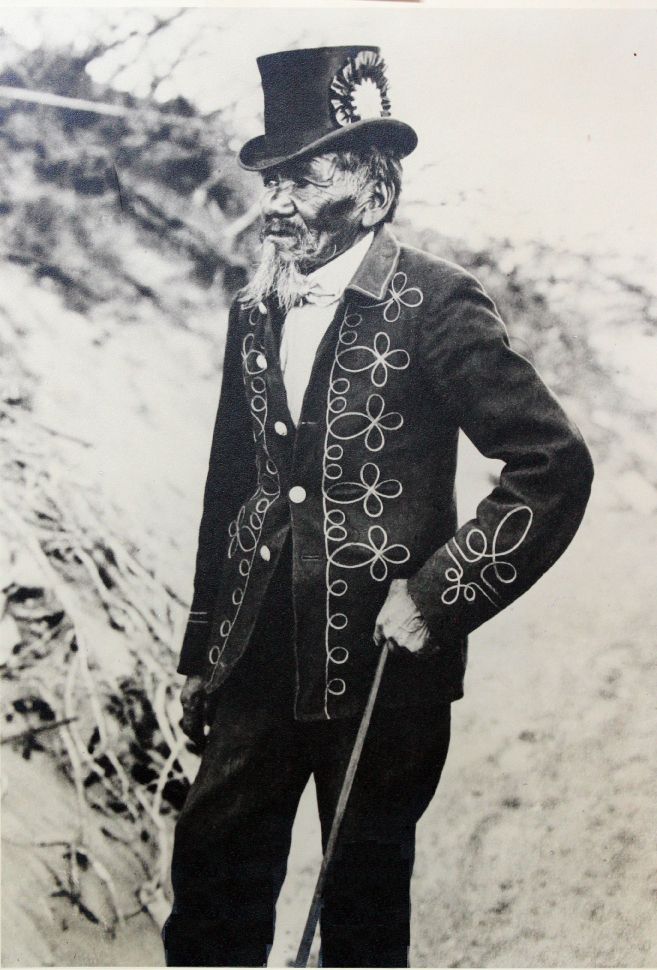
Chief Tecopa, very early 1900s.
Tecopa, very early 1900s.

Tecopa, who’s name means wildcat, along with several other warriors joined Kit Carson and John C. Fremont in the battle of Resting Springs which lasted for three days.

Tecopa maintained peaceful relations with the white settlers to the region and was known as a peacemaker. He often wore a bright red band suit with gold braid and a silk top hat. These clothes are replaced by local white miners when the clothes wore out. This gesture is in gratitude for Tecopa’s help in maintaining peaceful relations with the Paiute.

Tecopa is buried with his son and grandson at the Chief Tecopa Cemetery in the Pahrump Valley, Nevada.

Nevada State Historic Marker Text

Chief Tecopa – Peacemaker of the Paiutes

Chief Tecopa was a young man when the first European Americans came to Southern Nevada. As a leader among the Southern Paiutes, he fought with vigor to save their land and maintain a traditional way of life. He soon realized if his people were to survive and prosper, he would have to establish peace and live in harmony with the foreigners.

During his life, which spanned almost the entire nineteenth century, his time and energy were devoted to the betterment of his people until his death here in Pahrump Valley.

Chief Tecopa is honored for the peaceful relations he maintained between the Southern Paiutes and the settlers who came to live among them.

STATE HISTORICAL MARKER NO. 171
STATE HISTORIC PRESERVATION OFFICE
CALIFORNIA & NEVADA DEVELOPMENTORGANIZATION

Nevada State Historic Marker Summary

NameChief Tecopa – Peacemaker of the Paiutes
LocationPahrump, Nye County, Nevada
Nevada State Historic Marker171
Latitude, Longitude36.2091, -115.9895

Nevada State Historic Marker Location

References