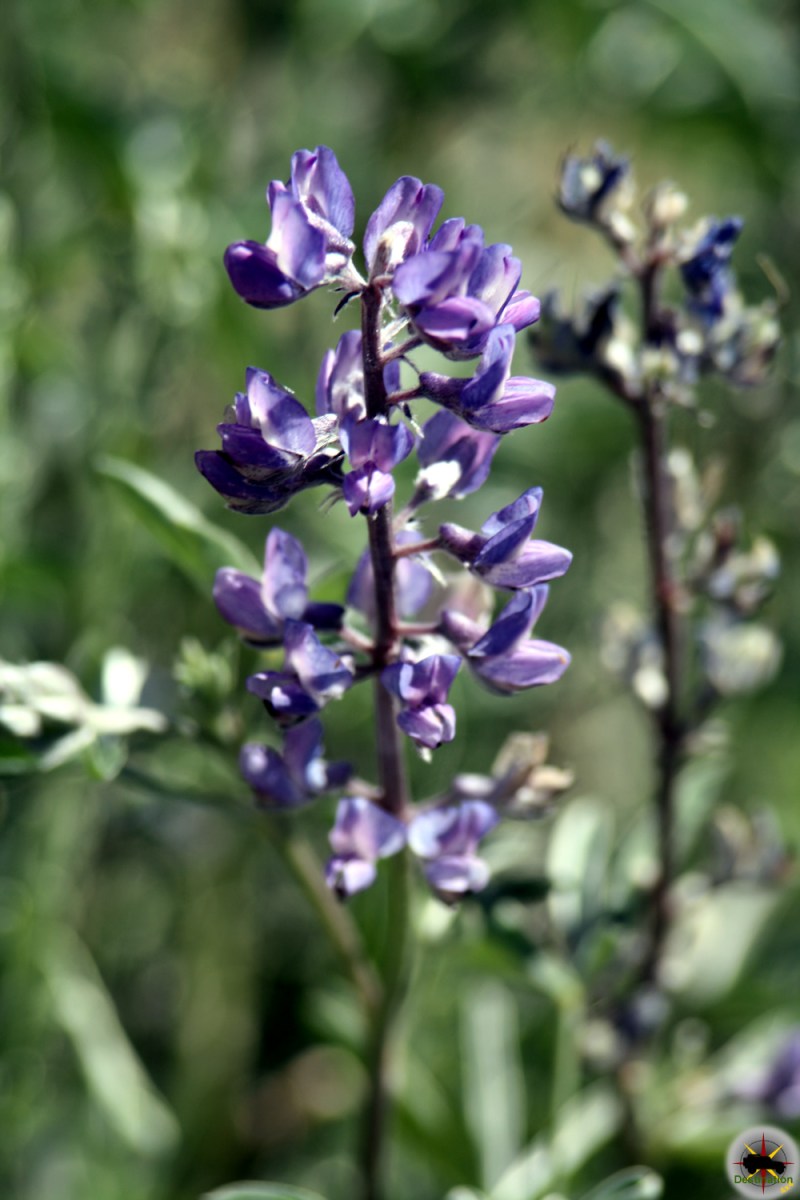
Spreading Phlox ( Phlox diffusa )

Spreading Phlox ( Phlox diffusa ) is a perennial shrub with small needle like leaves.  This is a small white flowering plant prefers alpine, sub-alpine environments and rocky or sandy soil.  This is a low growing plant which is commonly only two to eight inches tall which probably offers survival advantages when confronted with the harsh landscapes of sub-alpine and alpine environments, in which it thrives.

Photographed in the White Moundtains, Phlox diffusa is a small white flowering plant which prefers alpine and sub-alpine environments.
Photographed in the White Moundtains in California Phlox diffusa is a small white flowering plant which prefers alpine and sub-alpine environments. Photograph by James L Rathbun

Spreading Phlox is commonly found and adapted high in the mountains and distributed throughout in the western United States and Canada. This plant employs a tap route, which is ideally suited to capture water deeper under ground and also offers an anchor to help the plant cling to the mountain in high wind conditions. The plant is short, and when in full bloom, the flowers may completely obscure the green needle like leaves from view.

The five petaled flowers range in color from a clean, magnificent white to calming understated lavender or pink color.  

The blooms are typically visible from May to August and a welcome sight to those who hike at elevation.

Desert Marigolds (Baileya multiradiata)

Desert Marigolds located off the Old Mojave Road.
Desert Marigolds photographed near the Old Mojave Road.

Biological Report: Desert Marigold

Scientific Taxonomy

  • Kingdom: Plantae
  • Clade: Tracheophytes
  • Clade: Angiosperms
  • Clade: Eudicots
  • Clade: Asterids
  • Order: Asterales
  • Family: Asteraceae (Aster or Sunflower family)
  • Genus: Baileya
  • Species: Baileya multiradiata Harv. & A. Gray ex A. Gray

Common names include desert marigold, showy desert marigold, paper daisy, desert baileya, and hierba amarilla. Synonyms include Baileya australis, Baileya multiradiata var. nudicaulis, Baileya multiradiata var. thurberi, and Baileya thurberi. The genus is named after American botanist Jacob Whitman Bailey; “multiradiata” refers to the many-rayed flower heads.

Description

Desert marigold is a native, sun-loving biennial or short-lived perennial forb/herb that typically grows 12–18 inches (30–52 cm) tall and spreads 4–12 inches (10–30 cm) wide, forming attractive mound-shaped clumps. The basal leaves are grayish-green, woolly (covered in soft white hairs that help retain moisture), pinnately lobed to entire, and clustered at the base (4–10 cm long). The stems are mostly leafless and branched in the lower half. Flower heads are solitary, daisy-like composites borne on long, naked stalks (10–32 cm). Each head measures about 1.5–2 inches (4–5 cm) across with 25–50 bright yellow ray florets (the “petals”) surrounding a central disk of 25–50+ yellow disk florets. As the flowers age, the rays fade and become papery, giving rise to the common name “paper daisy.” The plant is adapted to arid conditions and is distinguished from similar species like woolly desert marigold (Baileya pleniradiata) by its taller stature, longer bloom period, and greater abundance.

Blooms

The showy, bright-yellow composite flower heads bloom intermittently from March (or April) through November, and can continue year-round in favorable conditions with adequate moisture. Flowering is sporadic but prolific, often triggered by rainfall, producing impressive mounds of nearly solid yellow. The long-lasting blooms turn papery and persist on the plant as they age. This extended blooming period makes it one of the most reliable and conspicuous desert wildflowers.

Range and Distribution

Desert marigold is native to the Mojave, Sonoran, and Chihuahuan deserts of the southwestern United States and northern Mexico. In the U.S., it occurs in Arizona, California, Nevada, New Mexico, Texas, and Utah (primarily at lower to mid-elevations). In Mexico, it extends into states including Sonora, Chihuahua, Coahuila, Durango, and Aguascalientes. It grows on sandy or gravelly (often alkaline) soils in washes, roadsides, rocky slopes, sandy plains, mesas, and semidesert grasslands, from near sea level up to about 5,000–6,500 ft (100–1,981 m). It thrives in full sun and well-drained soils across desert ecosystems.

This hardy, drought-tolerant wildflower is an iconic component of southwestern desert landscapes, valued for its cheerful blooms and adaptability.

This yellow wild flower is also known as:

  • Desert Marigold
  • Showy Desert Marigold
  • Paper Daisy
  • Desert Baileya

Desert Primrose (Oenothera deltoides)

Desert Primrose photographed in Anza Burego, CA

Classification (Taxonomy)

Oenothera deltoides belongs to the evening primrose family and is classified as follows (using a combination of traditional Linnaean ranks and modern phylogenetic clades):

  • Kingdom: Plantae
  • Clade: Tracheophytes (vascular plants)
  • Clade: Angiosperms (flowering plants)
  • Clade: Eudicots
  • Clade: Rosids
  • Order: Myrtales
  • Family: Onagraceae Juss. (Evening Primrose family)
  • Genus: Oenothera L.
  • Species: Oenothera deltoides Torr. & Frém. (described in 1845 by John Torrey and John C. Frémont)

The species includes several subspecies (e.g., O. d. subsp. howellii, which is federally endangered in California, and others such as subsp. deltoides, subsp. piperi, subsp. ambigua, subsp. cognata, and subsp. julpunensis). The overall species is considered secure.

Description

Oenothera deltoides, commonly known as the Desert Primrose, is a bushy or mounded annual (sometimes short-lived perennial) herb in the Evening Primrose family. It typically grows 2–18 inches (5–46 cm) tall but can reach up to 3 feet (about 1 m) in favorable conditions, with a spread up to 40 inches (1 m) wide. The plant often forms a dense basal rosette with a central erect stem and several decumbent to ascending leafy branches. The herbage is grayish-green to pale green and may be hairy or glandular.

Leaves: Primarily basal and sparse along the stems; deltoid (triangular) to obovate or oblanceolate in shape, up to 4 inches (10 cm) long. Margins are often toothed, lobed, grooved, or cleft, giving a distinctive triangular appearance (reflected in the species epithet deltoides).

Flowers: Large, showy, and fragrant, measuring 1.5–3 inches (4–8 cm) wide with four white petals forming a saucer or cup shape (sometimes turning yellowish toward the center). They open in the early evening (around sunset) and close by mid-morning, a classic evening-primrose trait. The flowers are solitary in the upper leaf axils and fade to pinkish with age. They are pollinated primarily by nocturnal moths (such as the white-lined sphinx moth) and native bees.

Fruit: A woody capsule that persists after flowering.

Distinctive Feature: After the plant dies (typically after setting seed), the stems curl upward and inward, forming a hollow, cage- or basket-like structure. This gives rise to many of its common names and allows the dried plant to tumble in the wind, dispersing seeds.

The plant is highly adapted to arid conditions and often carpets sandy desert floors with white “tissue-paper-like” blooms following abundant winter rains.

Range and Distribution

Oenothera deltoides is native to the Southwestern United States and northern Mexico. Its range includes the Mojave and Colorado Deserts, extending into parts of the Great Basin and coastal sandy areas. It occurs in the following U.S. states: Arizona (AZ), California (CA), Nevada (NV), Oregon (OR), and Utah (UT). In Mexico, it is found in northern Baja California and northwestern regions.

Habitat: Dry, open sandy soils, dunes, desert washes, rocky cliffs, hillsides, and occasionally beaches or coastal dunes. Elevations are generally below 2,500–5,500 feet (760–1,680 m), depending on the region. It thrives in full sun and is most abundant in the Mojave, Sonoran, and adjacent desert regions after wet winters.

Flowering season is primarily January–May (varying slightly by location and rainfall), with peak blooms often in February–April.

List of Other Common Names

In addition to Desert Primrose (or Dune Primrose), the species is known by many evocative names that reference its flowers, fragrance, or post-death “cage” structure:

  • Birdcage evening primrose
  • Basket evening primrose
  • Birdcage primrose
  • Dune evening primrose
  • Lion in a cage (or Lion-in-a-cage)
  • Devil’s lantern (or Desert lantern)
  • Fragrant primrose
  • Desert evening-primrose
  • Hairy evening primrose (occasional reference)

These names vary regionally but consistently highlight the plant’s striking appearance and unique dried form.

Oenothera deltoides is a beautiful and ecologically important desert wildflower, providing nectar for pollinators and contributing to the spectacular spring displays of the American Southwest. It is widely available for native plant gardening in arid regions and requires well-drained sandy soil with minimal irrigation once established.

The Green Gopher

Growing up in the 70’s I learned and spent a lot of time camping, hiking, being outdoors and active.  Every spring summer and fall, my parents and I would load up the truck, and later the trailer and head out.  Typically preparations would start the week before departure, and the loading process would start on Thursday afternoon with my brother and I hauling all the gear into the yard, while my mom packed the vehicles.  Friday could not come soon enough and when it did, my dad would come home from work, change is clothes, wrangle up two kids, maybe a dog, adjust the mirrors, and exclaim “We’re off” as we drove out of the driveway in The Green Gopher.  For the most part, for my family nothing much has changed much from my dad.  It is however the details that matter.

In 1972, I was one year old and to celebrate my dad bought a new truck.  Details of the vehicle back then are scarce.  From my point of view, my dad previously owned a 1964 International Scout.  He drive this car for years all over the desert south west in the late 1960s.  When my dad married my mom, my mom made him sell the Scout because the breaks were horrible, and at least three times they failed completely.  It was a wise decision considering the stakes for the family at the time, but the loss of his beloved Scout was difficult and for decades despite its faults the Scout cast a long shadow in our family.

Returning to 1972, my dad decided to purchase his truck.  He chose a Sea Foam Green 1972 Ford F-100 pickup sporting a 302 inch V-8 sporting with a 3.2:1 gear ratio, two fuel tanks, and a four speed manual transmission which included a “Granny Gear”.  The extra costs of a four wheel drive were not an option for my dad at that time.  So, the truck became the “ultimate compromise”.  He opted for 2 wheel drive, but to offer improved traction he chose a four speed with granny gear.  The differential was geared up to offer improve gas mileage, but the little 200 HP V-8 could not pull a grade at any sort of highway speeds.  A camper shell, home built bed, pass-through rear window and the “green gopher” was complete for the initial incarnation.

Continue Reading →

Bitter Springs

Bitter Springs is a 28 miles back country road which connects I-15 to the North shore Road highway 167 located inside Lake Mead National Recreation Area near Echo Bay.  The trail takes you by old mining roads and washes throughout the Muddy Mountains.

To reach the trail head, head North on the I-15 from Las Vegas. Exit the Valley of Fire offramp (exit 75), and turn right towards the state park, Valley of Fire. There is a lot of excellent camping in Valley of Fire.

Unless you have a need for fireworks or booze, proceed past the Moapa Indian Reservation store. After three miles the paved road bends left. The trail is the dirt road heading straight into the dessert towards the mountains.

Once you hit the Muddy Mountains, you will be greeted with large red rock out cropping. Keep on eye out on the right side of the tail for a small damn and water hole. Should you visit at the correct time, you will see tadpoles and frogs in the water.

As you proceed into and through the muddy mountains, there are numerous places to stop and picnic or camp. There is a small quarry that sits on the trail, so be sure to travel carefully if there are workers.

Once you are through the pass, the trail gradually follows the alluvial fan into a drainage. Once in the drainage section, the trails turns into pure sand. Be sure to check the weather when travelling this portion of the trail and keep an eye open for Big Horn sheep and wild horses.

Bitter Springs Trail Map