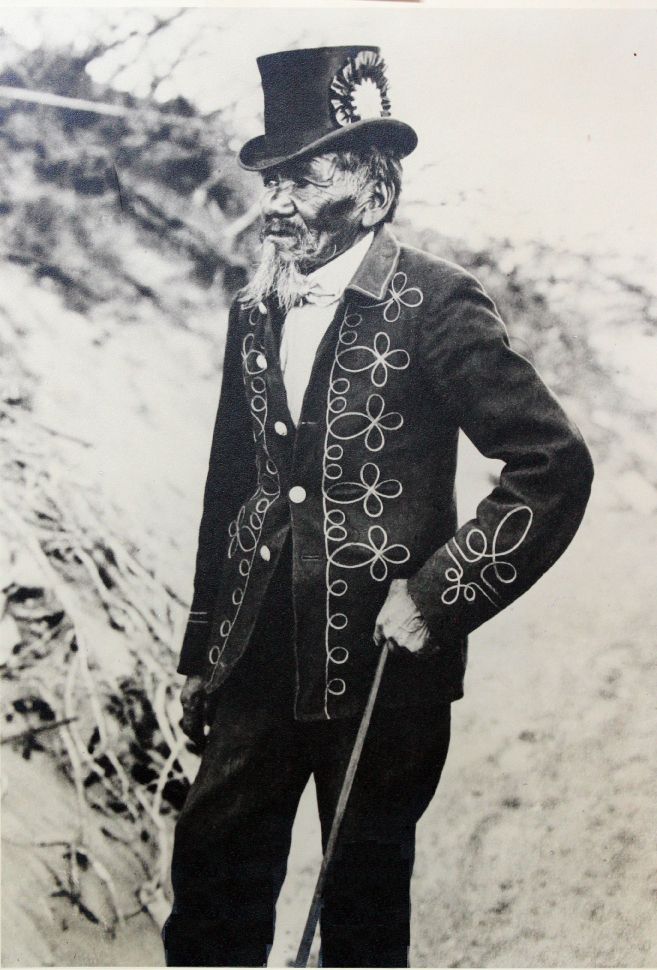
James Cooksey Earp

James Cooksey Earp ( June 28, 1841 -  January 25, 1926 )
James Cooksey Earp ( June 28, 1841 – January 25, 1926 )

James Cooksey Earp ( June 28, 1841 – January 25, 1926 ) was an American lawman and the lesser-known older brother of the famous Earp brothers, particularly Wyatt, Virgil, and Morgan Earp, who were key figures in the history of the American Old West. Though James was not as prominent as his brothers, he played a role in their lives and the events that shaped their legendary status.

Early Life

James Cooksey Earp was born on June 28, 1841, in Hartford, Kentucky, to Nicholas Porter Earp and Virginia Ann Cooksey. He was the third of nine children in the Earp family. The Earp family moved frequently during James’s childhood, living in various locations across the Midwest, including Monmouth, Illinois, and Pella, Iowa.

Military Service

At the outbreak of the Civil War, James enlisted in the Union Army in 1861. He served in Company F of the 17th Illinois Infantry, participating in several battles, including the Battle of Fredericktown. However, he sustained a severe shoulder wound early in the war, which led to his discharge in 1863.

Post-War Years and Family Life

After the war, James Earp returned to civilian life and worked various jobs, including saloon keeping and law enforcement. He married Nellie “Bessie” Ketchum in 1865, and the couple would remain together until James’s death. They did not have any children.

Tombstone and the Earp Vendetta Ride

James Earp is perhaps best known for his connection to the events in Tombstone, Arizona. In 1879, he followed his younger brothers to the boomtown, where they became involved in law enforcement and the infamous conflict with the Clanton-McLaury gang. Unlike his brothers, James played a more background role in Tombstone, focusing on managing a saloon rather than directly engaging in law enforcement or the gunfight at the O.K. Corral.

Following the assassination of their brother Morgan in 1882, the Earp brothers, led by Wyatt, embarked on what became known as the Earp Vendetta Ride, seeking revenge against those they believed responsible for Morgan’s death. James did not participate in the Vendetta Ride, choosing instead to stay with his family and manage their business interests.

Later Life and Death

After the events in Tombstone, James Earp and his wife moved to various locations, including California, where they eventually settled in San Bernardino. James lived a relatively quiet life compared to his more famous brothers, staying out of the spotlight as the legends around the Earp family grew.

James Cooksey Earp passed away on January 25, 1926, in San Bernardino, California, at the age of 84. He was buried in the Mountain View Cemetery in San Bernardino. His life, though overshadowed by the exploits of his brothers, is an integral part of the Earp family history, offering a glimpse into the quieter side of the tumultuous times they lived through.

Earp Family Members

James Cooksey Earp ( June 28, 1841 - January 25, 1926 )

James Cooksey Earp

James Cooksey Earp ( June 28, 1841 - January 25, 1926 ) James Cooksey Earp ( June 28, 1841 - January 25, 1926 ) was…
Morgan Earp historical photo, 1881. Probably taken by C.S. Fly.

Morgan Seth Earp

Morgan Seth Earp, born on April 24, 1851, in Pella, Iowa, was a notable figure of the American Old West, primarily recognized for his association…
Virgil Earp 1843 -1905

Virgil Walter Earp

Virgil Walter Earp ( July 18, 1843 – October 19, 1905) was born in Lincoln County, Kentucky, was a prominent lawman and frontier figure known for his…
Warren Baster Earp ( March 9, 1855 - July 6, 1900 )

Warren Baxter Earp

Warren Baxter Earp ( March 9, 1855 - July 6, 1900 ), the youngest of the Earp brothers, was born into a family that would…
Wyatt Berry Stapp Earp - Aged 39

Wyatt Berry Stapp Earp

Wyatt Berry Stapp Earp (March 19, 1848 – January 13, 1929) was an American lawman and gambler who became a legendary figure of the Old…

Asa Merton Russell “Panamint Russ” 

Asa Merton Russell “Panamint Russ” (1895–1970) was a California prospector, small-scale miner, desert homesteader, and occasional writer whose four-decade presence in the Butte Valley district of the Panamint Mountains made him one of the last classic solitary operators in Death Valley country. Universally known by his nickname “Panamint Russ,” he built the stone cabin now called the Geologist’s Cabin (or Russell Camp), developed a reliable spring, planted the only locust trees and Concord grapevines for scores of miles around, and doggedly drove a horizontal tunnel into the granite of Manly Peak—all while holding down a day job in Los Angeles until his 1960 retirement. Though his claims yielded little recorded production, Russell’s wry, faith-filled 1955 Desert Magazine article “Life on the Desert” remains one of the most vivid firsthand accounts of mid-20th-century desert mining life.

Asa Merton Russell "Panamint Russ" in front of the Geologist cabin - Courtesy of Desert Magazine April 1955
Asa Russell “Panamint Russ” in front of the Geologist cabin – Courtesy of Desert Magazine April 1955

Early Life and Military Service

Born in 1895, Russell served as a sergeant (SGT) in the U.S. military, though specific details of his enlistment, branch, or conflict are not recorded in surviving sources. By the 1920s he had settled in southern California and found steady employment with the Los Angeles Department of Water and Power. He married and had at least one son. His wife occasionally tried to break what she called his “desert habit,” complaining that he stayed too long each year in the remote Panamints.

A 1925 prospecting trip into the Redlands Canyon area of the Panamints reportedly yielded a brief but tantalizing discovery of a rich gold vein that he later “lost”—a story that foreshadowed the persistence and frustration that would define his later career.

Arrival in Butte Valley and the 1930 Strike

Russell’s serious mining career began in 1930. While exploring high on the western slope of 7,200-foot Manly Peak, he located gold-bearing quartz and immediately filed the Lucky Strike Quartz Mining Claim (March 1931) along with several others between 1933 and 1947. The claims sat in the South Park Mining District on the east side of the Panamint Range, in what is today Death Valley National Park.

That same year he began construction of a modest stone cabin at the base of Manly Peak, on the site of the old Ten Spot Mill / Last Chance Claim. The one-room structure—later known as the Geologist’s Cabin or Russell Camp—became his seasonal headquarters. Roughly a quarter-mile south of the historic Mengel/Stella cabin and at an elevation of about 4,500 feet, the camp offered commanding views across Butte Valley.

In 1929–1930 he also improved a nearby spring, creating a gravity-fed water system that supported drinking water, a small orchard, and vines. He planted locust trees (the only ones known within 125 miles) and Concord grapevines, which he proudly tended for decades. By the late 1950s or early 1960s the system included a 500-gallon storage tank.

Mining Operations and Daily Life

Russell’s principal working was a long horizontal tunnel driven into the granite of Manly Peak, reached by a steep, winding burro trail about one mile above camp. For most of the 1930s and 1940s he performed the required annual assessment work during two-week vacations from his Los Angeles job, often laboring entirely alone. Helpers were scarce and unreliable; scorpions, rattlesnakes, cloudbursts, twisters, flat tires, and pack rats nesting in dynamite all conspired against him.

In his April 1955 Desert Magazine article “Life on the Desert,” written at age 60, Russell described these hardships with humor and quiet determination. He recounted a twister that nearly tore the roof off his shack, a cloudburst that stranded him for days, a double hernia suffered while prying boulders, the theft or shooting of his beloved burro “Jubilee,” and the endless search for trustworthy labor. Through it all he returned to the theme of “Good Faith”—the inner resolve required to keep returning to the desert year after year. He closed the piece with an unshakeable optimism:

“But out here, there’s always a blue sky, good pure water filtered by Nature through lime and granite rocks, smogless air, no 50-cent parking lots, fresh sage and pinyon pine… I have Faith, and it will pay off!”

Retirement and Final Years

Russell retired from the Los Angeles Department of Water and Power in May 1960. That fall he moved permanently to Russell Camp, living full-time amid the Panamints. In 1962 he transferred ownership of the nearby Carl Mengel cabin and associated claims to Clinton and Stella Anderson, further establishing himself as a quiet steward of the local mining landscape. He continued sporadic work on the Lucky Strike and other claims into the early 1970s.

Death and Legacy

Asa Merton Russell died in 1970 at age 75. He is buried in a marked grave (Find A Grave Memorial #3748983).

Though his mines produced no major bonanza and left no great fortune, Russell’s legacy is written in stone and living green. The Geologist’s Cabin, the spring-fed water system, the locust trees, and the grapevines he planted still stand as testaments to one man’s determination. His camp remains a landmark for backcountry travelers in Butte Valley within Death Valley National Park. More than half a century after its publication, “Life on the Desert” continues to be read and quoted, offering later generations an intimate portrait of the isolation, frustration, beauty, and quiet faith that defined the final chapter of small-scale Panamint mining.

In the tradition of contemporaries like Pete Aguereberry, Carl Mengel, and Seldom Seen Slim, Panamint Russ proved that a man could build a meaningful life in one of America’s harshest environments—not through spectacular wealth, but through stubborn persistence, self-reliance, and an unshakable belief that the next fifty feet of tunnel might finally pay off.

The concord grapes are doing well, too. Twenty-five years ago coming through Riverside, California, I stopped at a nursery and bought a half dozen bare-root size, wrapped them in a newspaper, laid them on the running board with a wet gunny sack and today they are 20 feet of beauty.

Life on the Desert – by Panamint Russ – Desert Magazine, April, 1955

References

Courtney Chauncey Julian

Courtney Chauncey Julian
C. C. Julian

Courtney Chauncey Julian, C. C. Julian, was a businessman and shameless promoter who’s business dealings forced him to flee to California for China. He is noteworthy in his dealing in Death Valley National Park for his promotion of the town of Leadfield. After numerous court battles, he fled to Shanghai, China where he is poisoned or committed suicide.

C.C. Julian launched a newspaper blitz promoting his Julian Petroleum Corporation in 1923. The promotional blitz formed the basis for a ponzi scheme for investment into the JPC. The scandal became known as the “Julian Pete Scandal”. By 1927, it is estimated that Julian sold four million dollars in stock, which was stolen from his investors. Others estimate the value of the scheme at over eight million.

Drama followed the man, as he received death threats, however the nature of this threat is never resolved. It was reported by the United Press on Jan 4, 1924, that gun shots are fired threw the windows of his $100,000.00 house in Hollywood.

Perhaps one of his wierdest altercations came with famed film star Charles Chaplin. Just weeks after the shooting, Julian literally bumped into a table where Chaplin was eating at Club Petrouschka in Hollywood. A fight ensured and Chaplin got the better of Julian and knocked him out.

As one would expect from a thief, Julian had assets seized, by Collector of Internal Revenue, of $250,000.00 in cash and securities for failure to file is earnings from 1919-1923. He is able to maintain his house because it is deeded by his wife.

Julian at the Western Lead Mine located in Leadfield, California - Photo Los Angeles Times
Julian at the Western Lead Mine located in Leadfield, California – Photo Los Angeles Times

The end of Julian Petroleum Corporation stated in 1925. Julian sold his interest in the company to Sheridan C. (S.C.) Lewis and Jacob Berman for the sum on $500,000.00. The following year the company merged with California-Eastern Oil Company. An internal audit revealed the company had issued 4,200,000 unauthorized shares of stock. On May 5, 1927, the Los Angeles Stock Exchange halted trading in Julian Petroleum.

In 1931, Julian was charged with conspiracy to commit fraud in Oklahoma. He jumped bail and fled to country for Shanghai, China. Courtney Chauncey Julian is found dead of suicide in March, 1934.

"The Last Days of C. C. Julian," Los Angeles Times, 29 Sept. 1935
“The Last Days of C. C. Julian,” Los Angeles Times, 29 Sept. 1935

This town was the brain child of C. C. Julian, who could have sold ice to an Eskimo. He wandered into Titus Canyon with money on his mind. He blasted some tunnels and liberally salted them with lead ore he had brought from Tonopah. Then he sat down and drew up some enticing, maps of the area. He moved the usually dry and never deep Amargosa River miles from its normal bed.

He drew pictures of ships steaming up the river hauling out the bountiful ore from his mines. Then he distributed handbills and lured Eastern promoters into investing money. Miners flocked in at the scent of a big strike and dug their hopeful holes. They built a few shacks. Julian was such a promoter he even conned the U. S. Government into building a post office here. 

Desert Magazine – 1971 – Betty J. Tucker

References

William Brown – Virginia city saloon owner

William A G Brown - Owner of the Boston Saloon, Virginia City, Nevada
William A G Brown – Owner of the Boston Saloon, Virginia City, Nevada


William A.G. Brown was a notable African American entrepreneur and saloon owner in Virginia City, Nevada, during the height of the Comstock Lode silver mining boom.

Born free in Massachusetts (likely in the early 1830s, based on his reported age at death), Brown arrived in Virginia City around 1862 or 1863 amid the town’s explosive growth following the 1859 discovery of silver. Initially, he worked as a bootblack (a shoeshine operator) on the bustling streets of the mining camp.

By 1864, he had transitioned into business ownership, founding the Boston Saloon. This establishment primarily catered to the town’s African American community—numbering rarely more than about 100 people during the era—though it welcomed patrons of various backgrounds. Unlike many saloons of the time, the Boston Saloon stood out for its quality: archaeological excavations later revealed that Brown served finely prepared meals featuring premium cuts of meat, along with drinks, indicating a level of sophistication and success uncommon for Black-owned businesses in the 19th-century West.

The saloon operated for over a decade, with locations shifting several times (initially on B Street, later near D and Union Streets on the western, upslope side of town). Its final phase ran prominently from around 1866 to 1875. Brown sold the business shortly before the devastating Great Fire of 1875 ravaged Virginia City, destroying much of the town—including the Boston Saloon’s building.

After selling the saloon, Brown remained in the Comstock region. Records indicate he passed away in Virginia City in 1893 at the age of 63.

His legacy endured in obscurity for many years until the late 1990s and early 2000s, when archaeologists excavated the saloon’s site (now near the parking lot of the modern Bucket of Blood Saloon). The dig uncovered artifacts like fine dishware, gas lighting fixtures, and evidence of high-quality food service, shedding light on Black life and entrepreneurship in the Old West. In 2006, a rare 1880s photograph of Brown—discovered and acquired by a local bookstore owner—provided the only known image of him, depicting a sophisticated, well-dressed man.

William A.G. Brown exemplifies the resilience and economic ambition of free Black individuals in the frontier mining towns, contributing to Virginia City’s diverse historical tapestry alongside figures like Mark Twain, who also lived there briefly during the same era.

Jackson Lee Davis “Diamondfield Jack”

Jackson Lee “Diamondfield Jack” Davis who was pardoned for murder in Idaho and moved to Nevada where he founded several mining camps. Davis was a hired gun who worked for the cattlemen “protecting” cattle herds and their grazing land from sheep famers.

Jackson Lee "Diamondfield Jack" Davis (12 Aug 1863–2 Jan 1949)
Jackson Lee “Diamondfield Jack” Davis (12 Aug 1863–2 Jan 1949)

In 1895, Davis is hired by the Sparks-Harrell cattle company to keep the sheepherders off of the grazing lands. After an altercation where Davis wounded Bill Tolman in a shooting. Following this incident, he fled south to Nevada to star or of sight. While in Nevada, Davis is known to brad about his exploits.

In February, 1896, Davis returned to Idaho and returned to work for Sparks-Harrell in Idaho. During this time, two sheepherders, Daniel Cummings and John Wilson, are shot and killed. Due to he previous bragging and his being in the area at the time, Davis became a suspect. Davis fled to Arizona and is eventually captured. Upon his capture, he is returned to Idaho, tried, found guilty and sentenced to death for of the shooting.

DiamondField Nevada  - 1904 - Paher
DiamondField Nevada – 1904 – Paher

keep the sheep back. Don’t kill but shoot to wound if necessary. Use what measures you think best. If you have to kill, the company will stand behind you – regardless what happens.

While “Diamondfield Jack” is waiting his execution, two other men, James Bower and Jeff Gray, confess to the killing. During their trial, the two men are found not guilty. Regardless, this trial raised doubt as to the trial and Davis is reprieved one day before his scheduled execution.

Following a series of appeals, Davis is again scheduled for execution on July 3rd, 1901. At this point in time, public opinion no longer supported the death penalty. His execution is rescheduled until the Board of Pardons commutes his sentence to life in prisons. Davis is eventually pardoned on December 17th, 1902.

Following his release, Davis moved south into Nevada. In the spring of 1903, when news of promising gold strikes in Goldfield, Davis travelled to the town. After exploring and prospecting he uncovered promising ore ledges on McMahon Ridge northeast of town.

Within weeks of his discovery, prospectors flooded into the area. “Diamondfield Jack”, ever the opportunist plotted a townsite for the location and build a toll road to the new town from Goldfield. In the fall of 1904, the town reached its apex. At that time, it boasted a Post Office, three saloons, restaurants, general stores, schools, church, livery, butcher shop, blacksmith and union hall for the miners, which is impressive for a town just six months old. Public servants such as a sheriff, notary public and lawyer also maintained offices in the new formed district.

Nevada State Historic Marker #251 Text

This historical marker commemorates the lasting notoriety of flamboyant western gunman Jackson Lee Davis (1870-1949), who was better known by the colorful name, “Diamondfield Jack.” As a young man, after unsuccessfully prospecting for diamonds in the nearby hills, Davis was jokingly called “Diamondfield Jack,” a nickname that he carried the rest of his life.

In the late 1890’s, Davis gained a measure of fame as a gunman for the cattle interests, including rancher John Sparks, who would later become a Nevada governor, that were attempting to restrict sheep ranchers from southern Idaho and northeastern Nevada rangelands. Following a sensational trial in 1896, Davis was convicted of murdering two sheepherders. He was sentenced to be hanged, even after others confessed to the murders.

In 1902, Davis was finally pardoned for the crimes. He moved to the central Nevada mining towns of Tonopah and Goldfield, where he became a successful mine operator. He also helped found several mining camps, including one called Diamondfield. In later years, he drifted into obscurity and died in Las Vegas in 1949 after being struck by a car.

Nevada State Historic Marker #251 Summary

Nevada State Historic Marker251
NameDiamondfield Jack Davis
LocationElko County, Nevada
Latitude, Longitude41.9847, -114.6720

Resources