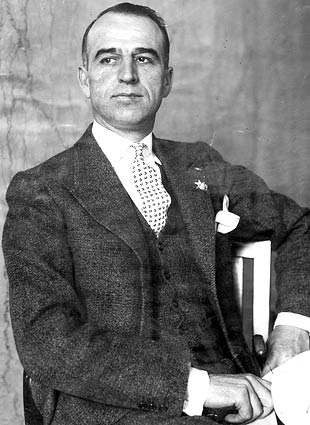
Francis Marion Smith – “Borax Smith”

Francis Marion "Borax" Smith
Francis Marion “Borax” Smith

Francis Marion Smith, also known as “Borax” Smith was a miner and business man who made a fortune in the hostile deserts of Nevada and California. He was born in Richmond, Wisconsin in 1846. He went to the public schools and graduated from Milton College. He left Wisconsin seeking his fortune in the American West. and set off for Nevada.

In 1872, while working as a woodcutter, he discovered a rich supply of ulexite at Teel’s Marsh, near the future townsite of Marietta, Nevada. Seeing his opportunity, Smith staked a claim started a company with his brother Julius Smith. The brothers established a borax works at the edge of the marsh to concentrate the borax crystals and separate them from dirt and other impurities.

In 1877, Scientific American reported that the Smith Brothers shipped their product in a 30-ton load using two large wagons with a third wagon for food and water drawn by a 24-mule team for 160 miles (260 km) across the Great Basin Desert from Marietta to the nearest Central Pacific Railroad siding in Wadsworth, Nevada.

Building upon his success, Smith grew his operations and purchased claims at Fish Lake and Columbus March. He bought his brothers shares in the venture in 1884. As he closed down his operations in Teel’s Marsh, Smith purchased the Harmony Borax works from William Tell Coleman who was financially over extended.

Smith then consolidated all of his mining operations with his own holdings to form the Pacific Coast Borax Company in 1890. The Pacific Coast Borax Company then established and promoted the 20-Mule-Team Borax brand and trademark.

In his later years, Francis Marion “Borax” Smith expanded his interest in railroads and charitable work in his hometown of Oakland, California.

References

Articles Tagged for Borax Smith

More details Borate & Daggett Rail Road in Mule Canyon on way to Borate – Courtesy National Park Service, Death Valley National Park

Borate and Daggett Railroad

More details Borate & Daggett Rail Road in Mule Canyon on way to Borate – Courtesy National Park Service, Death Valley National Park The Borate…
Rhyolite Train Depot is located at the north end of town in Rhyolite, Nye County, Nevada. - Photo by James L Rathbun

Las Vegas and Tonopah Railroad

The Las Vegas and Tonopah Railroad was a standard gauge railroad which operated along 197 miles between the town of Las Vegas and Goldfield, NV.…
More details Tonopah & Tidewater #1 was a Baldwin 4-6-0 steam locomotive, originally built for the Wisconsin and Michigan Railroad, later going to the Randsburg Railway on the Santa Fe as their #1 (later #260). Went to the T&T in 1904 and used in passenger and shunting service. It was scrapped in 1941, and the bell was saved by the Railway & Locomotive Historical Society at Pomona, CA.

Tonopah and Tidewater Railroad

Explorers of the Mojave Desert in southern California are bound to have heard the stories of the Tonopah and Tidewater Railroad. The Tonopah and Tidewater…

James Crysanthus Phelan – Rhyolite Shopkeeper

James Crysanthus Phelan

James Crysanthus Phelan was a business man and early pioneer of the desert southwest, who like many others followed the boom towns west. Early in his life, he owned a series of butcher shops in various towns throughout the south west, including Rhyolite. It is believed that his butcher shop was located on Golden Street across the street from the Cook Bank Building and near the Porter Brothers Store.

Biography

The automobile garage owned by James C. Phelan, and named after him, is cleverly planned, well built, and managed according to up-to-date methods. Mr. Phelan’s father, who was an honored veteran of the Union Army in our Civil War, is D. F. Phelan, and he is still living at Los Angeles.

Prior to casting his lot in the Golden State, he was a pioneer in Colorado. Mrs. Phelan, who was Annie Donahue before her marriage, is deceased. Born in the Centennial State on October 25, 1867, James C. Phelan was educated at the public schools in Colorado and New Mexico, and also, as he likes to put it, in ” the great school of experience.”

As a young man, he ventured in both the grocery and butcher business, having a store when only nineteen years of age, at Albuquerque, N. M. For fourteen years, too, his business at Williams, Arizona, was one of the most progressive and profitable establishments in that town. On September 9, 1893, Mr. Phelan was married to Miss Myrtie Dickinson, and this union was blessed with three boys and four girls, viz : Mary M., Chris E., Roy N., Jimmie J., Ruth E., Bernice L., and Leoma C, all of whom were educated in the public schools of Fresno, the two eldest studied at Heald’s Business College, while Roy N., is a student at the University of California at Berkeley.

Cook Bank Building, Rhyolite Nevada, Photo marked 1908 and "Courtesy of the Nevada Historical Society"
Cook Bank Building, Rhyolite Nevada, Photo marked 1908 and “Courtesy of the Nevada Historical Society”

Mr. Phelan has accepted the doctrines of the Christian Scientists, socially he finds recreation in the circles of the Woodmen of the World, the Knights of Pythias, and the Young Men’s Christian Association. In May, 1916, he built the finest and most complete auto establishment in California, spending $90,000 upon the same. He then became agent, for the San Joaquin Valley, of the Maxwell, Mitchell and Marmon automobiles, and the Kleiber and Maxwell Trucks. He employs from forty to fifty men to man the several departments, each of which is complete in itself.

When he first came to California, in 1905, he worked for three years on the Fresno ranch ; and then, getting into the automobile business in a modest way, he has made success after success. Mr. Phelan sold out in August. 1919. Mr. Phelan is a stanch Democrat, but always something more than a political partisan. In advocating and working for good roads, for example, his public-spiritedness has been particularly shown.

References

Christian Brevoort Zabriskie

Christian Brevoort Zabriskie was a vice president and general manager Pacific Coast Borax Company located in Death Valley National Park. Zabriske served the Pacific Coast Borax Company for some thirty six years, and due to this activity is honored by the naming an Zabriske Point.

Christian Brevoort Zabriskie

Christian Brevoort Zabriskie (1864–1936) was born at Fort Bridger in the Wyoming Territory. After schooling, he worked for the Virginia & Truckee Railroad located in Carson City, Nevada. For a time, he relocated to Candelaria, Nevada at work for the Esmeralda County Bank. He briefly venture into the mortuary business with a partnership formed with a local cabinet maker. His lack of knowledge in the art of embalming was not considered a liability as burial speed was a huge priority.

In 1885, at the age of twenty one, Zabriske was hired by Francis Marion “Borax” Smith to supervise the Chinese laborer’s. These men worked for the Pacific Coast Borax Company is the Columbus Marsh located near Candelaria. During his thirty six year tenure with the Pacific Coast Borax Company, the company closed up Candelaria operations and relocated to Death Valley to increase production. The company also expanded into the Calico Mountains and Trona, California

Zabriskie Point named for Christian Brevoort Zabriskie - Photo by James L Rathbun
Zabriskie Point named for Christian Brevoort Zabriskie – Photo by James L Rathbun

Zabriske retired from the Pacific Coast Borax Company in 1933 as Vice President and General Manager. All of his work in Death Valley took place before the area was designated National Monument. He passed away just three years later, on February 8thm 1936 at the age of 71. He is buried in Carson City, Nevada.

Zabriske Point is named to honor the man for his many years of service to the Pacific Coast Borax Company.

References

John S Cook

John S Cook overseeing bars of gold bullion.  Photo Goldfield Historical Society
John S Cook overseeing bars of gold bullion. Photo Goldfield Historical Society

John S. Cook (1870–1945) was a Nevada banker whose vision and investments helped define the brief but spectacular boom of Rhyolite, one of the American West’s most iconic gold-rush ghost towns.

Born March 28, 1870, in Columbus, Franklin County, Ohio, to John R. Cook and Louisa Stimmel, he grew up in the Midwest before heading west in search of opportunity. By 1898 he had reached Arizona, where he married Jesusita Moreno (also known as Jessie or Susie) in Globe. Census records show him working as a bank cashier in Austin, Nevada, by 1900. His big break came when he was hired as cashier for George Nixon’s bank in the booming mining town of Tonopah.

In January 1905, Cook and his brother launched the John S. Cook & Company Bank in the even hotter Goldfield mining district. It began in a modest wooden shack next to the Palace Saloon before moving into the more substantial Nixon Block Building. Deposits quickly reached $5–6 million as the bank financed mining claims tied to investors like Nixon and George Wingfield. Cook was remembered as a man of quiet disposition—courteous, precise, and thorough in business methods.

That same year, as word of rich gold strikes spread to the Bullfrog district just east of Death Valley, Cook opened a branch in the brand-new camp of Rhyolite. The first location was a rented storefront on Main Street. Rhyolite exploded from a few tents in 1904 to a town of roughly 10,000 people by 1908, complete with electricity, railroads, hotels, and an opera house. Sensing permanence, Cook purchased a prime lot at the southwest corner of Golden and Broadway streets. Construction on the Cook Bank Building began in spring 1907 and finished in January 1908 at a cost of nearly $90,000 (the equivalent of roughly $3 million today).

The three-story steel-and-concrete structure was the tallest and most luxurious building in Rhyolite—and one of the grandest in southern Nevada. It featured Italian-marble stairs and flooring, rich mahogany woodwork, imported stained-glass windows, two massive vaults, indoor plumbing, electric lights, telephones, and steam heat. The bank occupied the first floor, the U.S. Post Office moved into the basement in 1908, and brokers’ offices filled the upper stories. To residents and visitors alike, the Cook Bank symbolized Rhyolite’s transformation from tent city to thriving metropolis.

Cook Bank Building, Rhyolite Nevada, Photo marked 1908 and "Courtesy of the Nevada Historical Society"
Cook Bank Building, Rhyolite Nevada, Photo marked 1908 and “Courtesy of the Nevada Historical Society”

The optimism proved short-lived. The national financial panic of October 1907 triggered runs on banks across the country. In Goldfield, depositors emptied other institutions, but Cook’s bank survived—largely because saloon owner Rickards publicly deposited gold and silver bars back into Cook’s vaults, visibly reassuring the public. It was the only Goldfield bank to remain open. Yet Rhyolite’s mines could not weather the downturn. Production faltered, jobs vanished, and the population collapsed. By 1910 the Rhyolite branch had closed; Cook sold off the building’s elegant fixtures, and the grand structure stood empty.

In 1909 George Wingfield bought out Cook’s interest in the Goldfield bank to consolidate control. Cook relocated north to Reno, where he continued working for the Cook banking chain. The empire endured until the Great Depression; Wingfield’s banks, including those bearing Cook’s name, failed in 1932. John S. Cook spent his later years in Arizona and California, working variously as a vice president and bookkeeper. He died in Los Angeles County in July 1945 and was buried at Holy Cross Cemetery in Culver City.

Today, the roofless, sun-bleached concrete shell of the Cook Bank Building remains Rhyolite’s most photographed ruin and one of Nevada’s most recognizable ghost-town landmarks. It has appeared in films ranging from silent-era Westerns to The Island (2005). Its hollow windows frame the desert mountains, a stark monument to the boom-and-bust cycle that defined the early-20th-century mining West—and to the banker who, for a few heady years, bet everything on Rhyolite’s future.

The building’s ruins at sunset or under stormy skies still draw thousands of visitors each year, serving as a silent testament to John S. Cook’s brief but indelible role in Nevada history.

References

Pete Aguereberry – A Panamint Valley Miner

Jean Pierre “Pete” Aguereberry (1874–1945), universally known as Pete Aguereberry, was a Basque-born prospector and miner whose four-decade solitary vigil at the Eureka Mine in the Panamint Mountains of California’s Death Valley region exemplified the quiet persistence of the post-boom desert prospector. Though the 1905 Harrisburg gold strike never yielded the riches of earlier rushes, Aguereberry’s unyielding labor, self-built cabin, and hand-constructed scenic overlook—now officially Aguereberry Point—made him a legendary figure in Death Valley mining lore and left a lasting geographic legacy within what is today Death Valley National Park.

Pete Aguereberry
Pete Aguereberry

Early Life and Immigration

Born on October 18, 1874, into a hardworking Basque family in the village of Mauleon in the French Pyrenees, young Jean Pierre grew up hearing tales of the California Gold Rush. As a boy he devoured stories of western American gold discoveries and begged his father to let him emigrate. At age sixteen, in 1890, his father finally consented, and Pete sailed alone for the United States.

Language and culture barriers made the early years difficult. He took whatever work he could find: professional handball player, sheepherder, cattle driver, milk-truck driver, ice-delivery man, ranch hand, and stage driver. By about 1902 he had reached the booming mining town of Goldfield, Nevada, where the desert’s call fully took hold.

Arrival in Death Valley and the 1905 Strike

In June 1905 Pete ventured into Death Valley during the brutal summer heat and nearly died of dehydration and exposure. He was rescued and nursed back to health by Oscar Denton, caretaker at Greenland Ranch (later Furnace Creek Ranch). Within a month he had recovered enough to join forces with the already-legendary desert prospector Frank “Shorty” Harris. The pair set out across the Panamint Range toward Ballarat for the Fourth of July celebration.

On July 1, 1905, while crossing what is now known as Harrisburg Flats, Pete spotted a promising ledge of quartz. The two men worked the outcrop and quickly found free gold. Pete staked claims on the north side of the hill; Shorty took the south. Word spread rapidly. By August, more than twenty parties were prospecting the area, ore samples assayed as high as $500 per ton, and a makeshift camp of roughly three hundred people sprang up. Originally the partners jokingly called the settlement “Harrisberry,” but Shorty later popularized “Harrisburg,” and the name stuck.

Pete’s northern claims became the Eureka Mine. The strike briefly revived interest in the Panamint region, which had already seen earlier silver booms at Panamint City in the 1870s.

The Eureka Mine and Litigation

The Eureka Mine soon became entangled in a complex legal dispute that lasted from 1907 until 1909. When the dust settled, Pete emerged as sole owner. He immediately began serious development work, driving tunnels and stopes almost entirely by himself. Except for occasional help from a nephew in his later years, Aguereberry worked the property single-handedly for the next three decades.

Though high-grade ore was present, the remote location, limited water, and modest scale of operations prevented him from ever becoming wealthy. He often grubstaked other prospectors or took odd jobs to sustain himself, yet he never abandoned the claim. The Eureka remained his life’s work and home.

Life at Aguereberry Camp

In 1907 Pete built a modest two-room cabin at the mine site—now preserved as Aguereberry Camp along the road to Aguereberry Point. The simple wood-frame structure, later equipped with a gas stove and refrigerator, served as his residence until his death. Two additional cabins were added later (a 1941 guest house and another of uncertain purpose around 1946), but Pete lived frugally amid the stark Panamint landscape.

In his later years he delighted in guiding visitors up the road he had laboriously constructed to a spectacular overlook 6,433 feet above the valley floor. He proudly called it “The Great View.” From there visitors could see Mount Charleston 80 miles east in Nevada, Furnace Creek’s green oasis, and the white salt flats of Badwater Basin. That viewpoint is now officially named Aguereberry Point in his honor.

Final Years, Death, and Burial

By the early 1930s Pete’s health was failing, yet he continued to live at the mine. He died on November 23, 1945, at age 71, at Tecopa Hot Springs. Though he had expressed a wish to be buried at his beloved “Great View,” federal officials—citing the area’s status as part of Death Valley National Monument (established 1933)—denied the request. Father Frank Crowley officiated his burial at Mount Whitney Cemetery in Lone Pine, California. A plaque there honors him as “a modest, hardworking, and honorable man.”

Legacy

Pete Aguereberry never struck it rich, but his remarkable persistence in one of the harshest environments on Earth made him a symbol of the twentieth-century desert prospector. The Eureka Mine tunnels (now safely gated for bat habitat) and the surviving cabins at Aguereberry Camp remain accessible along the dirt road off Highway 190. The panoramic vista he built and loved continues to draw thousands of visitors each year. In the tradition of fellow Panamint Valley figures such as Shorty Harris and “Seldom Seen Slim,” Pete Aguereberry proved that a man could carve out a meaningful life amid isolation, heat, and hardship—leaving behind not only a mine but a viewpoint that still bears his name and offers future generations the same “Great View” he cherished.

References