West Side Road

The hottest place on earth, Death Valley National Park is on the order with California and Nevada

West Side Road is a prominent backcountry route in Death Valley National Park, running parallel to the park’s iconic Badwater Road along the western edge of the Death Valley basin. This 40-mile, mostly graded dirt and gravel road offers a scenic alternative for exploring the park’s western margin, with access to several side trails, historic sites, and stunning views of the Panamint Mountains. It’s a relatively accessible route for high-clearance vehicles, though 4WD is recommended due to variable conditions.

Trail Details

  • Starting Point: Junction with Badwater Road, approximately 6 miles south of CA-190 near Furnace Creek.
  • Endpoint: Junction with Harry Wade Road near the southern boundary of the park.
  • Distance: Approximately 40 miles one-way.
  • Vehicle Requirements: High-clearance 2WD vehicles can manage in good conditions; 4WD recommended for soft sand, washouts, or wet weather.
  • Camping: Dispersed camping is permitted along most of the road, except within 2 miles of the Badwater Road junction. Popular spots include near Warm Springs Canyon and Galena Canyon.
  • Difficulty: Easy to moderate, depending on weather and road maintenance.
  • Estimated Time: 2–3 hours one-way, excluding stops or side trips.

Route Description
West Side Road begins at its junction with Badwater Road, just south of Furnace Creek, and heads south along the base of the Panamint Mountains. The road follows an ancient lakebed, offering views of the salt flats of Badwater Basin to the east and the towering Panamints to the west. The surface is primarily graded gravel and dirt, but sections may be washboarded, sandy, or rutted, especially after heavy rains.

Key points of interest along the route include:

  • Shorty’s Well: Located 5 miles from the start, this artesian well is a historic water source once used by miners and is now a curiosity for visitors.
  • Galena Canyon: A side trail at mile 14.7 leads to historic mining sites and rugged terrain (see below for details).
  • Warm Springs Canyon: At mile 29, this major 4WD trail leads to Butte Valley and Mengel Pass, offering access to historic cabins and Striped Butte.
  • Eagle Borax Works: Near mile 30, the ruins of the first borax operation in Death Valley (1881–1883) are visible, marked by adobe walls and old machinery.
  • Trail Canyon: At mile 33.5, another 4WD trail heads west into the Panamints, leading to Aguereberry Point and historic mining sites.

The road ends at its junction with Harry Wade Road, which continues south toward the park’s boundary. The route is ideal for those seeking a less crowded alternative to Badwater Road, with opportunities for photography, hiking, and off-road exploration.

Trail Conditions (as of August 2025)
West Side Road is generally well-maintained but can become impassable after flash floods or heavy rain, particularly in winter or spring. Recent reports indicate the road is open, but soft sand and washouts are possible in sections. Check the Death Valley National Park website or the Death Valley Road Conditions Facebook page for real-time updates. Summer temperatures often exceed 100°F, making fall through spring (October–April) the best time to visit. Carry extra water, food, and emergency supplies, as services are over 30 miles away in Furnace Creek.

Tips for Travelers

  • Navigation: GPS may be unreliable in remote areas; carry a detailed map or guidebook.
  • Preparation: Bring ample water (1 gallon per person per day), sunscreen, and a spare tire.
  • Respect History: Do not disturb historic sites like Eagle Borax Works.
  • Wildlife: Watch for wild burros, coyotes, and occasional bighorn sheep.
  • Leave No Trace: Pack out all trash to preserve the park’s pristine environment.

Other 4×4 Trails Accessible from West Side Road

West Side Road serves as a gateway to several challenging 4WD trails in the Panamint Mountains. Below are the primary routes accessible from West Side Road, each offering unique scenery and history.

  1. Warm Springs Canyon to Butte Valley
    • Access: Mile 29 from West Side Road.
      high-clearance vehicle for the first 10 miles to the talc mines; 4WD required beyond.
    • Distance: 21 miles one-way to Butte Valley.
    • Difficulty: Moderate to challenging, with rocky sections and potential washouts.
    • Highlights: Leads to Butte Valley, home to Striped Butte, Geologist’s Cabin, Russell Camp, and Mengel’s Home. The trail continues over Mengel Pass to Goler Wash and Panamint Valley, but this section is extremely rough.
    • Notes: Active talc mines maintain the first 10 miles, but the road deteriorates significantly afterward. Check conditions, as flash floods can make the route impassable.
  2. Galena Canyon
    • Access: Mile 14.7 from West Side Road.
    • Vehicle Requirements: High-clearance 4WD required.
    • Distance: Approximately 8 miles one-way to the end of the drivable section.
    • Difficulty: Moderate, with rocky terrain and narrow sections.
    • Highlights: Historic mining sites, including remnants of the Gold Hill District, and scenic views of the Panamint Range.
    • Notes: The trail is less traveled and can be rough, with limited turnaround points. Suitable for experienced off-roaders.
  3. Trail Canyon to Aguereberry Point
    • Access: Mile 33.5 from West Side Road.
    • Vehicle Requirements: High-clearance 4WD recommended.
    • Distance: 15 miles one-way to Aguereberry Point.
    • Difficulty: Moderate, with steep grades and rocky sections.
    • Highlights: Leads to Aguereberry Point (6,433 feet), offering panoramic views of Death Valley. The trail passes the Cashier Mine and Aguereberry Camp, historic mining sites from the early 1900s.
    • Notes: The road is narrow and exposed in places, requiring caution. Snow or ice may be present in winter at higher elevations.

Trail Map

History of the Region

Prehistoric and Native American Era
The Death Valley region, including the area along West Side Road, has been inhabited for thousands of years by the Timbisha Shoshone people. They utilized the valley’s scarce water sources, such as Shorty’s Well, for survival in the harsh desert environment. Archaeological evidence suggests seasonal camps and trade routes through the area, with the Panamint Mountains serving as a natural barrier and resource zone.

Mining Boom (1870s–1900s)
The region’s modern history is tied to the mining boom of the late 19th century. The discovery of borax in 1881 led to the establishment of the Eagle Borax Works near West Side Road, the first commercial borax operation in Death Valley. Operated by Isadore Daunet, it ran until 1883, when flooding and financial issues forced its closure. The ruins, including adobe walls and rusted machinery, remain visible today.

In the 1870s and 1880s, prospectors explored the Panamint Mountains for gold and silver, with the Gold Hill District (accessible via Galena Canyon) becoming a focal point. The Butte Valley Mining Company, formed in 1889, worked claims in nearby Goler Canyon, targeting gold, silver, and tellurium. Talc mining began in the early 1900s, with operations in Warm Springs Canyon continuing into the late 20th century. Notable figures like Pete Aguereberry, who worked the Cashier Mine near Trail Canyon, and Carl Mengel, a prospector in Butte Valley, left lasting marks on the region.

20th Century Development
The early 1900s saw continued mining activity, though transportation challenges limited large-scale operations. The construction of West Side Road in the mid-20th century improved access to the western side of Death Valley, facilitating tourism and exploration. The road was graded to connect mining sites and provide an alternative route through the park, but its remote location kept it less trafficked than Badwater Road.

Infamous Associations
In the late 1960s, the remote trails off West Side Road, particularly Goler Wash near Butte Valley, gained notoriety as the hideout of Charles Manson and his followers at Barker Ranch. They were arrested in 1969, marking a dark chapter in the region’s history. The ranch, now burned down, remains a point of interest for some visitors.

Modern Era
Today, West Side Road and its connecting trails are part of Death Valley National Park, established in 1994. The area is managed by the National Park Service, which maintains the road and regulates access to protect its natural and cultural resources. The region remains a haven for off-roaders, hikers, and history buffs, offering a glimpse into Death Valley’s rugged past and stunning landscapes.

Trails Available from West Side Road

The hottest place on earth, Death Valley National Park is on the order with California and Nevada

Hanaupah Canyon Road

Hanaupah Canyon Road, situated in the southern Panamint Range within Death Valley National Park, is a rugged backcountry route that serves as both a 4x4…
The hottest place on earth, Death Valley National Park is on the order with California and Nevada

Johnson Canyon Road

Johnson Canyon Road, located in the southern Panamint Range of Death Valley National Park, is a remote backcountry route that functions as both a challenging…
The hottest place on earth, Death Valley National Park is on the order with California and Nevada

Queen of Sheba Mine Road

Queen of Sheba Mine Road, located in the southern part of Death Valley National Park near the Ibex Hills, is a rugged backcountry route that…
The hottest place on earth, Death Valley National Park is on the order with California and Nevada

Trail Canyon Road

Trail Canyon, located in the southern part of Death Valley National Park, is not one of the park's more famous frontcountry hikes like Golden Canyon…

Lucy Grey Goldmine

The Lucy Grey Goldmine trail is a short 4×4 trip out of Primm, Nevada up to an old mine site.  The route is fairly accessible and almost any SUV or 4×4, but the route finding can be tricky is you are not careful.  A slight mistake in navigation and you will be in some rough country.  To find the trail head, exit and head past the outlet stores and the Lotto Store. The trail head is the dirt road where the paved road turns left.

Lucy Grey gold mine - An old truck marks the trail up to the mine. Built rigs might be able to make it, but I choose to hike. Photo by James L Rathbun
Lucy Grey gold mine – An old truck marks the trail up to the mine. Built rigs might be able to make it, but I choose to hike. Photo by James L Rathbun

The trail heads straight out into the desert. When you reach the railroad tracks, turn right and follow the road next to tracks until you reach a railroad signal station. There is a pass through under the train track and a nice little sign which reads Lucy Grey to let you know you are on your way.

From the railroad signal station the trail heads up an alluvial fan into the hills. Once you reach the gully and head into the hills, the trail becomes hard to follow, so pay attention to GPS coordinates, or your map. The trek is mostly easy with one or two small sections that will require you to pay a little more attention. The most difficult part of this trail is the route finding up to the mine and town site.

Continue Reading →

St Thomas Nevada – Clark County Ghost Town

Founded in 1865 when Brigham Young sent settles to the confluence of the Virgin River and Muddy Rivers.  St Thomas Nevada remained a Mormon settlement until 1871 when a surveying correction placed the town in Nevada.   When the Mormons abandoned the area, other settlers claimed the property.  St Thomas used to served as a pit stop for travelers between Los Angeles, California and Salt Lake City, Utah using along the old Arrow Highway (US 91).

St Thomas Ghost Town is accessible with lower water levels in Lake Mead, Lake Mead National Recreation Area, Nevada

The United States Federal Government “purchased” the land as part of the Hoover Dam project.  In actuality, there were multiple suits as the residents of St. Thomas raise complaints about the amount the federal government was paying for their land.  In time, the residence lost and the entire town was doomed to its destiny and the water of Lake Mead continued to rise.

St Thomas Trail head

The last known resident as Hugh Lord, who remained until the water surrounded his home.  He loaded is possessions into a row boat, set fire to his home, and rowed off into history.  Soon the rising water of Lake Mead swallowed the entire down, and wasted the landscape with water 60 feet deep.  From time to time, the lake level will drop low enough to expose this lost town.

The town is currently exposed, and lies in the lake bed surrounded by a large expanse of tamarisk.  The dirt road to the trail-head is located just inside the entrance to Lake Mead National Recreation Area when coming from Moapa and Overton and the trail is beyond simple and suitable for almost every vehicle.

Fresh Water Clam shells litter the area

The 2.5 miles hiking trail is very easy and takes you from the trail-head and loops through the town.  The trail would be a bit more difficult if you attempt the trail during the hot summer months.  Remains of the town are limited to foundations, some old wood fence posts and some metal artifacts such as farming equipment and a V-8 small block.  The park service appears to cut the tamarisk back to expose the foundations for visitors, however the cut off tamarisk trucks can be a tripping hazard and would be harsh it you fell on one, so keep in eye on where you step.

A building foundation in St. Thomas, Nevada
A building foundation in St. Thomas

I have been to many ghost towns over the years.  Many of them lost in history due to mines failing to produce, fire, hard environments and disease.  St Thomas is different from all the others.  This is a ghost town by design, by protest and there is no better reminder than the fresh water clam shells which litter the site.  The fact that there are viable towns (Moapa and Overton) just a few miles away make St Thomas all the more poignant.

The tallest building remains of St. Thomas,
The tallest building remains of St. Thomas

St Thomas Trail Map

Racetrack Valley

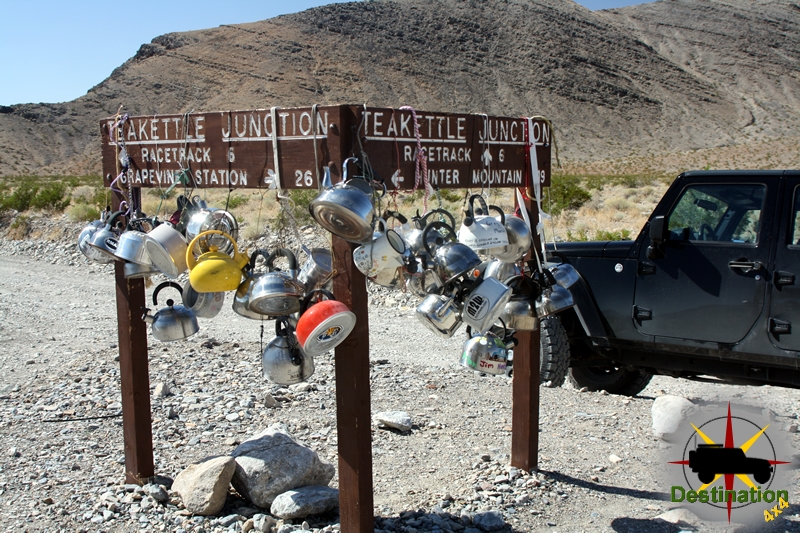
TeaKettle Junction lets you know you are starting to get close to the Racetrack.

Racetrack valley is a rough graded road which departs the Ubehebe Crater site and heads south into the desert. The road is rough, but easily passable in a regular car. However, when entering back country areas such as this it is always a good idea to have the insurance of a reliable vehicle, high clearance, four wheel drive, etc…  Do yourself a huge favor and air down your tires if you are properly equipped to air up when the trip is over.

Looking north from the Lippincott Mine towards the Racetrack off in the distance.

The racetrack valley road is a 25 miles one way trip to the playa. The road is grated, but can be heavily wash-boarded depending on the time of year, rain fall, etc…

Along the way, there are many side trips and alternate trails to help expand your visit.

As you leave Ubehebe Crater, you will be driving south and gradually gaining elevation. Take your time and enjoy the drive, if you are lucky you may see a big horn sheep herd. The road gradually gains in elevation and climbs through a Joshua Tree Forest.

Once you reach the pass, the road continues to drop in elevation all the way down to the playa. Continue straight through tea kettle junction, and bear left down the valley past the side road to the Lippincott mine, which is a great side trail.

The Racetrack Playa of Death Valley.

As you continue past the road to the Lippincott mine the road drops down to the Racetrack Playa itself. The first stop is ‘The Grandstand’ which is an outcropping of rock located in the north west corner of the racetrack. The second stop is the parking area to hike towards the stones. Don’t try to hike to the stones from the first Grandstand parking lot, or you will be hiking significantly further.

The highlight of the trip, is a short hike to the sailing or racing stones. The start of the hike is the parking area at the southern end of the racetrack playa.

Jeeps and Labradors are not allowed on the playa!

To reach the stones hike east from the parking lot across the playa towards the dark stone hillside. It is short FLAT, meaning really FLAT hike towards the stones. Be sure the check the temperatures before you leave, and bring lots of water. This is true with anything you might want to do in Death Valley. Don’t walk on the playa if it is wet or muddy.

The Racing stones.
The Racing stones.

At the end of the 30 miles road there is a small primitive campground for overnight visits. Be sure to check with the National Park Service for regulations of back country camping within the park.

Every racetrack needs a grandstand.

Notoriety

On September 19th, 1969 a Michigan front end loading is found burning along the road near the playa. Apparently, Manson order the machine burned. Park Rangers were deployed to the Racetrack. The rangers followed a set of tire tracked which belonged to a Toyota Land Cruiser which was stolen by Manson. The follow up investigate lead to the arrest of Charles Manson at Barker Ranch on October 12th, 1969.

Racetrack Valley Trail Map

References

Johnson Canyon Road

Johnson Canyon Road, located in the southern Panamint Range of Death Valley National Park, is a remote backcountry route that functions as both a challenging 4×4 road and a hiking trail. This rugged path leads through a dramatic canyon with steep walls, alluvial fans, and lush oases, offering opportunities to explore historic mining sites, Native American heritage, and wildlife such as bighorn sheep or desert tortoises. Less crowded than frontcountry trails like Golden Canyon, it provides solitude and stunning views of the valley floor. The road starts from West Side Road and ascends into the canyon, with options for day hikes to Willow Spring or Hungry Bill’s Ranch, or longer backpacking trips. High-clearance 4×4 vehicles are required for driving, but hiking is often preferred to avoid damage from rough terrain. Note that while called a “road,” it becomes increasingly trail-like beyond the initial miles.

Key Trail Statistics

AspectDetails
LengthFull out-and-back: ~20 miles (10 miles one-way to road’s end); shorter options: 6-8 miles round-trip to Willow Spring; add 2-4 miles for hike to Hungry Bill’s Ranch from road end. AllTrails lists it as 23.1 miles out-and-back for the full route.
Elevation Gain~3,000-4,000 feet overall (starting ~200 feet below sea level, reaching ~5,000 feet at Hungry Bill’s Ranch); steady climb up the alluvial fan.
DifficultyModerately challenging to strenuous; rocky, eroded sections with loose gravel, steep inclines, and potential washouts. 4×4 high-clearance required for driving; hiking involves boulder-hopping and brushy areas.
Time Required6-10 hours for full road out-and-back hike; 3-5 hours for shorter day hikes; multi-day for backpacking with explorations.
Best Time to VisitOctober to April to avoid extreme heat (over 120°F in summer); year-round access, but flash floods possible July-September.
AccessJunction 7.7 miles from northern end of West Side Road (via Badwater Road). Unmarked—use GPS or park maps. No day-use permit; free backcountry permits for overnight (from visitor centers or online). Dispersed camping allowed 1 mile off West Side Road.
Water and AmenitiesWillow Spring and upper canyon springs (treat water); carry 1+ gallon per person per day. No facilities; nearest at Furnace Creek (~30 miles away).

Trail Map

What to Expect on the Hike

The route begins on a gravelly road from West Side Road, climbing tediously up the alluvial fan with loose rocks and ruts—drivable with caution in 4×4 for the first 5-7 miles, but often hiked to preserve vehicles. The canyon narrows, revealing colorful geologic layers, narrow washes, and views of the Panamint Mountains. Around 3-4 miles in, Willow Spring offers a shaded oasis with cottonwoods and year-round water. Continuing, the road ends at a parking area (~10 miles), where a foot trail leads 1-2 miles to Hungry Bill’s Ranch—featuring historic stone walls, remnant orchards (apples, figs), and Shoshone village sites. Side explorations include old mining tunnels and talc prospects. The terrain includes brushy sections (watch for rattlesnakes) and steep scrambles, with profound desert silence and starry skies for campers. Flash floods can alter the path, creating sand traps or debris.

This low-use trail suits adventurers seeking history and isolation, but demands preparation—no cell service, and self-rescue may be necessary.

Current Conditions (as of August, 2025)

Johnson Canyon Road is open and accessible for hiking and 4×4 travel, following repairs to West Side Road after 2023-2024 floods. Recent reports from late 2024 indicate good conditions, with some rutted alluvial fan sections and brushy areas harboring rattlesnakes, but no major closures. West Side Road is fully open, though high-elevation roads elsewhere in the park reopened in April 2025 after historic flooding. Summer heat remains extreme (temperatures often exceed 110°F), and flash flood risks persist during monsoons—avoid during storms. Check the NPS website or Furnace Creek Visitor Center for updates, as conditions can change rapidly. Tire punctures are common on gravel approaches; carry spares and emergency gear.

History of the Region

History of Johnson Canyon

Johnson Canyon’s history intertwines Indigenous heritage, ranching, and mining, emblematic of Death Valley’s resource-rich but harsh landscape. The area was an ancestral village site for the Timbisha Shoshone (also known as Panamint Shoshone), who utilized its reliable springs and canyons for seasonal habitation, hunting, and gathering for centuries. In the late 1800s, Euro-American settlers arrived; rancher William Johnson established a homestead in the canyon around the 1870s, giving it his name, though he clashed with Native residents over land use.

A key figure was Hungry Bill (real name Bah-Vanda-Sada), a Timbisha Shoshone leader who filed a homestead claim in 1907 on 160 acres in upper Johnson Canyon, planting orchards with apples, figs, and grapes using traditional irrigation. He never received the patent due to bureaucratic hurdles, but his family maintained the ranch into the 1920s, producing crops amid the desert. Mining activity surged in the early 1900s, with gold, silver, and talc claims; prospectors and Natives alike filed claims, extracting minerals from tunnels and open pits. Operations were small-scale due to isolation, peaking during World War eras for strategic minerals like talc, but declined by mid-century as deposits dwindled.

Today, remnants include Hungry Bill’s stone walls, fruit trees, and mining ruins, preserved as cultural sites. The Timbisha gained federal recognition and land rights in the 1980s-2000s, including areas near Furnace Creek, marking a reclamation of ancestral lands.

Broader History of Death Valley National Park

Death Valley’s human history dates back over 10,000 years, with Native American groups like the Timbisha Shoshone inhabiting the region since at least 1000 CE, adapting to its extremes through migratory patterns and using resources like mesquite pods and pinyon nuts. European-American exploration began infamously in 1849, when the “Lost ’49ers”—a group of gold rush pioneers—became trapped en route to California, enduring hardships that inspired the name “Death Valley” despite most surviving.

Mining booms defined the late 19th and early 20th centuries: borax extraction in the 1880s (famous for 20-mule teams), gold and silver rushes around 1900 (birthing ghost towns like Rhyolite and Skidoo), and later talc, lead, and tungsten mining. Tourism emerged in the 1920s with resorts like Furnace Creek Inn. In 1933, President Herbert Hoover designated it a national monument to protect against unchecked exploitation, with the Civilian Conservation Corps building roads and facilities in the 1930s. Expanded dramatically under the 1994 California Desert Protection Act, it became the largest national park in the contiguous U.S., spanning 3.4 million acres.

The park now draws over a million visitors annually for its geologic wonders—like Badwater Basin (-282 feet, North America’s lowest point) and record heat (134°F in 1913)—while addressing modern challenges such as climate change, flash floods, and cultural preservation.