Leadfield California – A Death Valley Ghost Town

Leadfield California is a ghost town located in Inyo County and Death Valley National Park and found on the Titus Canyon Trail. The town boom in 1925 and 1926, however, Leadfield is a town that was started on fraud and deceit.

Leadfield Gost Town, Death Valley, California

According to Legend and an article in Desert Magazine, and shameless promoter C. C. Julian wandered into Titus Canyon and started blasting tunnels. He then discovered lead ore which he purchased and brought down from Tonopah, Nevada. Julian then produced maps and other promotional materials and found investors from the East coast. The town of Leadfield was born and died on the imagination of this one man.

Photograph of an exterior view of the Leadfield Hotel in Death Valley's Titus Canyon, [s.d.]. The hotel is a simple wooden structure with a slanted roof and a rectangular façade. The upper left corner of the façade is missing, revealing the interior of the building. Three large rectangular windows and two doors alternate across the front of the building. There are three people standing on a caved-in porch in front of the hotel. A large rocky mountain rises up behind the hotel. The hotel was part of C. C. Julian's Leadfield boomtown, the hey day of which was in 1925. Photo Credit “University of Southern California. Libraries” and “California Historical Society” as the source. Digitally reproduced by the USC Digital Library.
Photograph of an exterior view of the Leadfield Hotel in Death Valley’s Titus Canyon, [s.d.]. The hotel is a simple wooden structure with a slanted roof and a rectangular façade. The upper left corner of the façade is missing, revealing the interior of the building. Three large rectangular windows and two doors alternate across the front of the building. There are three people standing on a caved-in porch in front of the hotel. A large rocky mountain rises up behind the hotel. The hotel was part of C. C. Julian’s Leadfield boomtown, the hey day of which was in 1925. Photo Credit “University of Southern California. Libraries” and “California Historical Society” as the source. Digitally reproduced by the USC Digital Library.

The truth of the tale is not quite as interesting or spectacular. According the the National Park Service, Leadfield ore was first worked in 1905. During the Bullfrog boom, which took place outside of Beatty, prospectors worked the land looking for the next big hit. In the fall of 1905, nine mine sights were identified and claimed by W. H. Seaman and Curtis Durnford. The ore from these sites was assayed in Rhyolite at $40 per ton. The men bought out a local consortium and the Death Valley Consolidated Mining Company was incorporated which released promotional material and sold shares for 2.5 cents each.

The mine and its ore did produce, however the Death Valley Consolidated Mining Company soon discovered that the expense of hauling the ore to Rhyolite and then the frieght costs to ship the material to smelters further off caused the ore to be not profitable. After six months of operation the Death Valley Colisidated Mining Company disappeared.

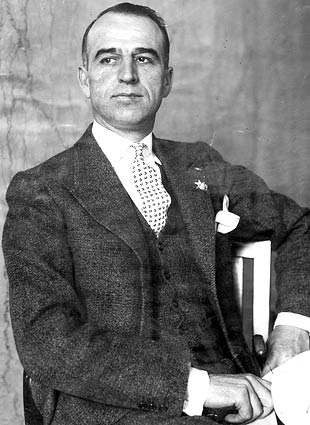
C. C. Julian
C. C. Julian

Despite early failures, in March of 1924 three prospectors wandered into the canyon and staked several claims. Ben Chambers, L. Christensen and Frank Metts worked their claims of lead ore for over one year before selling the claims to John Salsberry. Mr. Salsberry saw enough promise to form the Western Lead Mines Company and started to raise capital via stock sales at $0.10 per share. By the end of 1925, the Western Lead Mines Company was working 50 claims in the valley and soon began in invest in infastructure in the form of a compressor plant. A long steep road was constructed for LeadField to the Beatty Highway.

In early 1926, the Western Lead Mines Company build a boarding house and piped in water from a nearby spring. The town of Leadfield was named officially January 30th, 1926. Stock from the Western Lead Mines Company went on sale in January and within a 24 hour period, 40,000 share of stock were sold at $1.57 per share.

In February 1926 it became known to the public that C. C. Julian purchase shares and was now President of Western Lead Mines Company. Almost immediately the California State Corporation Commission began an investigation into the stock sale because a permit was not granted for the stock sale. The promoter went to work, along with several other mine operations, raise interest and money for the town. City plans were filed with Inyo County, however the spectre of investigation loomed.

Julian at the Western Lead Mine located in Leadfield, California - Photo Los Angeles Times
Julian at the Western Lead Mine located in Leadfield, California – Photo Los Angeles Times

Despite the arrival of a post office, investment into the location, and hundreds of feet of tunnel, C. C. Julian was ordered to cease sale of stock by the California State Corporation Commission. Around the same time, the primary tunnel of the Western Lead Mines Company penetrated to the ledge which experts predicted the highest quality ore. This ore was assayed at 2% and far too low for profit considered freight costs.

"The Last Days of C. C. Julian," Los Angeles Times, 29 Sept. 1935
“The Last Days of C. C. Julian,” Los Angeles Times, 29 Sept. 1935

Leadfield and the surrounding mines where gone months later. Mr. Julian was blamed despite the facts that he did not start the venture, there was ore at the location, and he invested money and time towards the venture. Once his Leadfield venture faltered, he moved onto to Oklahoma and was caught up in yet another scam. Julian later fled the country for Shanghai in March of 1933 m where he committed suicide in 1923 after several more failed schemes. Julian was buried in a beggers coffin and his funeral was attended by nine people.

Mr. Julian is responsible for the road through Titus Canyon, which many is a favorite route of visitors every year.

Leadfield Sign, Death Valley, California

For a detailed history, the NPS offers a great article.

Leadfield Town Summary

NameLeadfield
LocationInyo County, Death Valley, California
Latitude, Longitude36.8466107,-117.0592307
GNIS1658952
Elevation4000 feet
Newspaper Leadfield Chronicle ( 192?-19?? )
National Register of Historic Places75000221

Further Reading

Leadfield Map

Resources

St Thomas Nevada – Clark County Ghost Town

Founded in 1865 when Brigham Young sent settles to the confluence of the Virgin River and Muddy Rivers.  St Thomas Nevada remained a Mormon settlement until 1871 when a surveying correction placed the town in Nevada.   When the Mormons abandoned the area, other settlers claimed the property.  St Thomas used to served as a pit stop for travelers between Los Angeles, California and Salt Lake City, Utah using along the old Arrow Highway (US 91).

St Thomas Ghost Town is accessible with lower water levels in Lake Mead, Lake Mead National Recreation Area, Nevada

The United States Federal Government “purchased” the land as part of the Hoover Dam project.  In actuality, there were multiple suits as the residents of St. Thomas raise complaints about the amount the federal government was paying for their land.  In time, the residence lost and the entire town was doomed to its destiny and the water of Lake Mead continued to rise.

St Thomas Trail head

The last known resident as Hugh Lord, who remained until the water surrounded his home.  He loaded is possessions into a row boat, set fire to his home, and rowed off into history.  Soon the rising water of Lake Mead swallowed the entire down, and wasted the landscape with water 60 feet deep.  From time to time, the lake level will drop low enough to expose this lost town.

The town is currently exposed, and lies in the lake bed surrounded by a large expanse of tamarisk.  The dirt road to the trail-head is located just inside the entrance to Lake Mead National Recreation Area when coming from Moapa and Overton and the trail is beyond simple and suitable for almost every vehicle.

Fresh Water Clam shells litter the area

The 2.5 miles hiking trail is very easy and takes you from the trail-head and loops through the town.  The trail would be a bit more difficult if you attempt the trail during the hot summer months.  Remains of the town are limited to foundations, some old wood fence posts and some metal artifacts such as farming equipment and a V-8 small block.  The park service appears to cut the tamarisk back to expose the foundations for visitors, however the cut off tamarisk trucks can be a tripping hazard and would be harsh it you fell on one, so keep in eye on where you step.

A building foundation in St. Thomas, Nevada
A building foundation in St. Thomas

I have been to many ghost towns over the years.  Many of them lost in history due to mines failing to produce, fire, hard environments and disease.  St Thomas is different from all the others.  This is a ghost town by design, by protest and there is no better reminder than the fresh water clam shells which litter the site.  The fact that there are viable towns (Moapa and Overton) just a few miles away make St Thomas all the more poignant.

The tallest building remains of St. Thomas,
The tallest building remains of St. Thomas

St Thomas Trail Map

Tip Top Arizona

Founded in 1876, Tip Top Arizona is a old Silver Mining town and ghost town located in Yavapai County, Arizona. The town site is located west of Black Canyon City, in the southern foothills of the Bradshaw Mountains.

Northern end of Tip Top, circa 1888. Visible are the stamp mill (1), assay office (2), brewery (3), beer hall (4), restaurant (5), saloon (6), hotel (7), and mine workings (8).

In the late 1870s, gold and silver were discovered in the Bradshaw Mountains, attracting prospectors and miners seeking their fortune. In 1876, the Tip Top Mining District was established by two men, Jack Moore and Bill Corning, and the town of Tip Top sprung up around it. Initially, nearby Gillett served as the milling town.

The district quickly gained a reputation for its rich ore deposits and attracted significant investment and development. The first mining claims were staked, and a stamp mill was constructed to process the ores. With the arrival of the railroad in nearby Phoenix, Tip Top saw an influx of miners, merchants, and entrepreneurs, leading to its rapid growth. A Post Office is established on August 12, 1880

During the boom times, Tip Top boasted six saloons, a brewery, two restaurants, a Chinese laundry, a feed yard, a blacksmith shop, a shoe store, and many residences. The Post Office is closed February 14, 1895.

Southern part of Tip Top, circa 1888. Visible are the stamp mill (1) and the mine office (2).

During is heyday, the silver mines of Tip Top produced over $4,000,000 from its ore deposits.

Town Summary

NameTip Top, Arizona
LocationYavapai County, Arizona
Latitude, Longitude34.0508662, -112.2468296
Elevation765 meters / 2510 feet
GNIS1669455
Population1200
Post OfficeAugust 12, 1880 – February 14, 1895

Trail Map

According to Dangerous Roads the trail into Tip Top Arizona is closed and and the area is undergoing land changes. Other resources state that the road was closed in 2009.

References

Hazen Nevada

Hazen is an unincorporated community in Churchill County, Nevada, often described as a semi-ghost town. It sits on the high desert plain at an elevation of approximately 4,006 feet (1,221 m), about 12 miles (19 km) southeast of Fernley and 16 miles (26 km) northwest of Fallon. The site lies along the historic Southern Pacific Railroad (now part of the Union Pacific system) and U.S. Route 50 Alternate—the former alignment of the Lincoln Highway, U.S. Highway 40, and early U.S. 50.

"Saloons and disreputable places of Hazen (Nev.) June 24, 1905." By Lubkin - NARA - 532037.jpg
“Saloons and disreputable places of Hazen (Nev.) June 24, 1905.” By Lubkin – NARA – 532037.jpg

Geographically, Hazen occupies a strategic transportation corridor in the arid Great Basin, positioned between the Truckee River and Carson Sink regions. Its location made it an ideal junction for rail and highway traffic in the early 20th century, though modern interstates later bypassed it. Today, scattered buildings, railroad remnants, and a few ranches remain, with the area still traversed by active freight trains.

William "Nevada Red" Wood, was Hung on February 27th, 1905 in Hazen, Nevada
William “Nevada Red” Wood, was Hung on February 27th, 1905 in Hazen, Nevada

Early History/Founding

The immediate area had limited pre-1903 activity. In the late 1870s, J.M. Sturdevant operated a small station or roadhouse along the overland route from Wadsworth eastward, serving stage and wagon traffic. However, no formal town existed until the Southern Pacific Railroad (SP) realigned its transcontinental main line in 1902–1903. The railroad shifted eastward from the old Wadsworth route (bypassing the steep Hot Springs Grade), creating a new siding and construction camp at the site.

Hazen was officially established in 1903 and named for Union Army General William Babcock Hazen (1830–1887), a Civil War veteran who served under General William Tecumseh Sherman during the “March to the Sea” and fought in major battles such as Shiloh, Corinth, Murfreesboro, and Chickamauga. General Hazen had no known connection to Nevada and died long before the town’s founding; the name was simply “generously donated” as a railroad honor. A U.S. post office opened on April 25, 1904, formalizing the settlement.

Some secondary sources note possible scattered settlement as early as 1869, but Hazen does not appear on maps until the 1903 railroad development. The town quickly grew from a tent city into a modest rail stop with hotels, saloons, restaurants, and worker housing.

Economic Activities

Hazen’s economy revolved around two major early-20th-century infrastructure projects: the Southern Pacific Railroad and the Newlands Irrigation Project (Nevada’s first major federal reclamation effort, authorized under the 1902 Reclamation Act and championed by U.S. Senator Francis G. Newlands).

  • Railroad Hub: Hazen became a key division point and junction. In 1905, the Nevada & California Railroad (an SP subsidiary) completed a standard-gauge line from Hazen southward, linking the transcontinental main line to the narrow-gauge Carson & Colorado Railroad and tapping the booming mining districts of Tonopah and Goldfield. A branch line to Fallon was built in 1906–1907. By 1906, the SP had constructed a large roundhouse and fine depot at Hazen. These facilities supported passenger and freight traffic, including ore shipments from southern Nevada mines. Hotels and eating houses catered to rail crews and travelers.
  • Newlands Project Construction Camp: In 1904, the U.S. Reclamation Service (USRS, now Bureau of Reclamation) moved its headquarters and established a commissary in Hazen to support construction of Derby Dam, the Truckee Canal, and (later) Lahontan Dam. Hundreds of laborers lived in tents and rudimentary housing, driving demand for saloons, brothels, stores, and services. The project aimed to irrigate the arid Carson-Truckee basin for agriculture, transforming desert land into farmland—a hallmark of Progressive Era federal reclamation.
  • Supporting Industries: Local ranching and farming supplied food to rail and construction crews. By the 1910s, the Western Ore Purchasing Company operated a sampling and assay plant in Hazen, processing ore samples from Nevada’s mining camps before smelting. A small school, churches, and businesses (including the original Hazen Store, ca. 1904) served the population, which peaked around several hundred during boom years.

Hazen earned a reputation as one of Nevada’s toughest towns. With no resident sheriff, crime (robberies, assaults, and vice) was common in the construction camps. On February 27–28, 1905, a mob of about 30 men broke into the small wooden jail (built in 1904 near Constable Judd Allen’s hotel) and lynched ex-convict William “Red” Wood (also called “Nevada Red”), a morphine addict and suspected murderer who had been arrested for robbing the depot. He was hanged from a telegraph pole roughly 30 feet away—the last recorded lynching in Nevada history. No arrests followed.

Decline/Abandonment

Hazen’s peak proved short-lived. A devastating fire on August 23, 1908, started in the rear of a mercantile store and destroyed nearly the entire business district (including the post office, multiple hotels, saloons, restaurants, and stores), with losses estimated at $100,000. Explosions of stored dynamite and gasoline complicated firefighting, though the depot was saved.

The USRS relocated its offices to Fallon in 1908 as work shifted to Lahontan Dam (completed 1915), ending the construction boom. Many families stayed temporarily due to Fallon’s housing shortage, but economic activity slowed. A 1908 rebuild (e.g., the brick Palace Hotel) provided temporary relief, and the Lincoln Highway (1913) brought some auto traffic through town.

Long-term decline accelerated with transportation changes:

  • 1944 highway realignment bypassed the original townsite, forcing businesses (including the Hazen Store and post office) to relocate south to the new alignment.
  • Completion of Interstate 80 in the 1960s rerouted most cross-state traffic onto a four-lane freeway, leaving Hazen on the quieter Alternate U.S. 50.
  • Railroad traffic diminished as mining booms faded and highways competed; the Tonopah line was truncated, and the Fallon branch saw only sporadic use.

The post office operated until June 25, 1979 (with a brief temporary closure in 1977) and never reopened. By the late 20th century, Hazen had shrunk to a handful of residents, mostly ranchers, with many historic structures abandoned or demolished.

Legacy/Current Status

Hazen survives as a quiet, sparsely populated community that preserves echoes of Nevada’s railroad and reclamation eras. It is not fully abandoned but qualifies as a semi-ghost town, with a small number of residents and active railroad use. The Hawthorne Army Depot remains connected to the national rail network via a 120-mile spur originating at Hazen.

Notable surviving features include:

  • The Hazen Store (ca. 1904, later relocated and stuccoed), listed on the National Register of Historic Places for its architectural and transportation significance.
  • Foundations of the roundhouse, depot, and substation.
  • A small cemetery (with at least one recorded burial from 1906).
  • Remnants of worker housing and the former Recreation Inn.

A Nevada State Historic Marker (No. 178) commemorates the town’s founding, railroad role, Newlands Project ties, and the 1905 lynching. In recent decades, limited geothermal exploration has occurred nearby, but the area retains its remote, historic character. Hazen stands as a testament to the boom-and-bust cycles driven by federal infrastructure projects and rail expansion in early 20th-century Nevada.

Town Summary

NameHazen, Nevada
Other NamesHazen Station.
LocationChurchill County, Nevada
Latitude, Longitude39.5653, -119.0464
GNIS864634
Population250
Post Office1904 – Current
Elevation4,000 Feet
NewspaperThe Harvest

Hazen Historic Events

William "Nevada Red" Wood, was Hung on February 27th, 1905 in Hazen, Nevada

The Hanging of William “Nevada Red” Wood

Hazen, a small railroad and construction-camp settlement in Churchill County, Nevada, established in 1903 along the Southern Pacific Railroad, became a hub for workers on…

References

Tenabo Nevada

Located at 5,354 above sea level, Tenabo Nevada is a gold mining camp and ghost town located in Lander County, Nevada

 Wagon train hauling silver ore from the Little Gem mine in Tenabo to the railhead at Beowawe, 25 miles south - 1910 - Stanley W Paher, "Nevada Ghost Towns and Mining Camps, (1970), Howell-North Books, William Kornmayer collection, p 91
Wagon train hauling silver ore from the Little Gem mine in Tenabo to the railhead at Beowawe, 25 miles south – 1910 – Stanley W Paher, “Nevada Ghost Towns and Mining Camps, (1970), Howell-North Books, William Kornmayer collection, p 91

In 1907, silver is discovered in the Bullion mining district. The discovery lead to the formation of Tenabo on the eastern slope of the Shoshone Range. The townsite is platted out and located just east of the mining district. Several wooden structures are built and with months a population of about 1,000 people called the town home.

The citizens of Tenabo ran and were serviced by several businesses including a hotel, restaurant, assay office, grocery store, school, post office. Saloons and “Sporting Houses” kept the men inline and happy. Goods and services along with people are delivered with tri-weekly stage service from Beowawe. Automobiles and a steam traction service also provided access to the town.

For three years, several active mines kept the mill running in Mill Gultch. After 1911, the high cost of goods and water hauling hampered continued mining operations. The post office is closed on July 31st, 1912.

About 1916, A. E. Raleigh finds placer gold in Mill Gulch and soon a camp is named for him. Placer mining continue in the surrounding ravines for the next twenty years. In the 1930’s a floating dredge continue placer mining operations and recovered significant amounts of gold until the 1940’s

In 1972, the mines near Tenabo are purchased by the Mid-West Oil Corporation. Mid-West Oil in turn sold the mining rights to the Tenabo Gold Placers Limited Partnership. Today the mines are still actively worked by the Flowery Gold Mines Company of Nevada.

Tenabo Town Summary

NameTenabo Nevada
LocationLander County, Nevada
Latitude, Longitutude40.314444, -116.676667
Elevation5,354
GNIS844209
Post OfficeDecember 7, 1906 – July 31, 1912
Population1,000

Tenabo Map

Directions

Tenabo Nevada is located about twenty five miles south east of Battle Mountain, Nevada just off I-80 at the Beowawe exit.

References