South Campground

South Campground is one of the most popular campgrounds in Zion National Park, located in Springdale, Utah. It is situated at an elevation of 3,900 feet, surrounded by the towering cliffs of Zion Canyon and offering access to some of the park’s most iconic hikes and attractions.

South Campground, Zion National Park, Utah, Medium Format Photograph: James L Rathbun
Temple of Sinawava, Zion National Park, Utah, Medium Format Photograph: James L Rathbun

Amenities and Facilities:

South Campground offers a range of amenities and facilities to make your camping experience as comfortable and enjoyable as possible. Some of the key amenities include:

  1. Campsites: South Campground offers a total of 127 campsites, including 13 group sites and 4 accessible sites. The campsites are arranged in loops, with each loop offering its own set of amenities and facilities.
  2. Restrooms: There are two sets of restrooms located within South Campground, each with running water and flush toilets. The restrooms are cleaned daily and are equipped with hand dryers and baby changing stations.
  3. Picnic tables and fire pits: Each campsite at South Campground comes with a picnic table and a fire pit, allowing campers to enjoy meals and roast marshmallows over a campfire.
  4. Water: There are several water spigots located throughout, allowing campers to fill up their water bottles and clean their dishes.
  5. Dump station: There is a dump station located near the entrance, allowing campers to dispose of their waste.
  6. Camp store: There is a camp store located near the entrance, offering a range of supplies and souvenirs for campers.

Features:

South Campground is known for its stunning natural beauty and its proximity to some of Zion National Park’s most iconic features. Here are some of the key features of South Campground:

  1. Zion Canyon: South Campground is located in Zion Canyon, which is known for its towering cliffs, narrow canyons, and stunning vistas. The canyon can be accessed via the Zion Canyon Scenic Drive, which is closed to private vehicles from April to October.
  2. Hiking trails: South Campground offers access to a range of hiking trails, including the famous Angels Landing and The Narrows hikes. Angels Landing is a strenuous hike that involves a steep ascent up a narrow ridge to a scenic overlook, while The Narrows is a water hike that takes you through the narrowest section of Zion Canyon.
  3. Wildlife: The area is home to a range of wildlife, including mule deer, coyotes, and a variety of birds. Visitors are advised to keep a safe distance from wildlife and to store food and other items in bear-proof containers.
  4. Dark skies: Zion National Park is known for its dark skies, making it an ideal location for stargazing. Visitors can enjoy views of the Milky Way and other celestial objects on clear nights.

Reservations

South Campground is a popular destination, and reservations are strongly recommended, especially during peak season (March to November). Reservations can be made up to six months in advance through the National Park Service website or by calling the reservation line. There are no walk-in sites available and campers are required to have a reservation before arriving.

Campground Map

References

Watchman Campground

Zion National Park Campgrounds

Watchman Campground is located in Zion National Park in southwestern Utah and offers visitors the opportunity to experience the beauty of Zion up close while also enjoying the convenience of modern amenities.

History:

Watchman Campground was established in the 1960s and was named after the Watchman rock formation that rises above the campground. The campground was designed to provide a comfortable and convenient base for visitors to explore the park, while also preserving the natural beauty of the area.

Amenities:

Watchman Campground offers a variety of amenities to make visitors’ stay comfortable and enjoyable. These include:

  • Campsites: The campground offers a total of 176 campsites, including 95 RV sites and 81 tent sites. All sites are equipped with a picnic table and fire pit or grill, and most sites have electric hookups.
  • Restrooms: The campground has three modern restroom facilities with flush toilets and sinks, as well as several water filling stations.
  • Dump station: There is a dump station located at the entrance to the campground for RVs to use.
  • Laundry facilities: The campground has a coin-operated laundry facility available for guests to use.
  • Camp store: The Watchman Campground store offers a variety of camping supplies, snacks, souvenirs, and other items.

Activities:

There are numerous activities available to visitors at Watchman Campground and the surrounding area. Some of these include:

  • Hiking: There are numerous hiking trails in Zion National Park that are easily accessible from the campground, including the Watchman Trail, which offers stunning views of the surrounding area.
  • Biking: Biking is allowed on the Pa’rus Trail, which is accessible from the campground and offers a scenic route through the park.
  • Rock climbing: Zion National Park is a popular destination for rock climbers, and there are numerous climbing routes available throughout the park.
  • Wildlife viewing: Zion is home to a variety of wildlife, including bighorn sheep, mule deer, and numerous bird species. Visitors can often see these animals while hiking or exploring the park.
  • Ranger programs: The park offers a variety of ranger-led programs, including guided hikes, campfire talks, and stargazing events.

Reservations

Reservations for Watchman Campground can be made online or by phone up to six months in advance. The campground is open year-round, although some sites may be closed during the winter months due to snow. During peak season (March through November), reservations are highly recommended, as the campground often fills up quickly.

Fees

The nightly fee for a campsite at Watchman Campground varies depending on the season and type of site. Tent sites are generally less expensive than RV sites, and fees are higher during peak season. In addition to the nightly fee, visitors to Zion National Park are required to pay an entrance fee. The fee varies depending on the type of vehicle and the length of stay.

Recreation.gov

Accessibility

Watchman Campground is accessible to visitors with disabilities, with several ADA-accessible campsites and restrooms available. The Pa’rus Trail, which is accessible from the campground, is also ADA-accessible.

Conclusion

Watchman Campground is a popular destination for visitors to Zion National Park, offering modern amenities and convenient access to the park’s many activities and attractions. With its stunning scenery, numerous hiking trails, and abundant wildlife, Zion is a must-see destination for anyone interested in exploring the beauty of the American Southwest. Whether you’re camping in a tent or RV, Watchman Campground provides the perfect base for your Zion adventure.

Campground Map

Carl Mengel – Panamint Valley Miner

Carl Mengel (1868–1944) was a German-born American prospector and small-scale miner whose decades of solitary toil in the rugged Panamint Mountains of California’s Death Valley region epitomized the hardscrabble, post-boom era of desert mining. Though he never struck it rich and died impoverished, Mengel left a lasting geographic imprint on the landscape: Mengel Pass in the southern Panamint Range bears his name, as does the spring and cabin site where he lived for more than three decades. His claims, most notably the Keystone Mine (later incorporated into the Lotus Mine), represent the persistent, low-capital prospecting that continued in the Panamints long after the famous 1870s silver stampede at Panamint City had faded.

Carl Mengel with dog "Whitey at his home in Butte Valley, April 1940. Photo courtesy of DEVA NM.
Carl Mengel with dog “Whitey at his home in Butte Valley, April 1940. Photo courtesy of DEVA NM.

Early Life and Path to Mining

Carl Mengel was born in 1868 in Germany (Alsace-Lorraine region according to family lore). His father was from Alsace-Lorraine and his mother Saxon; the family immigrated to the United States when Carl was about six (circa 1874). Both parents died before he turned eleven. An uncle in Ventura, California, became his guardian, but at age seventeen Mengel ran away, working first on a ranch in California’s San Joaquin Valley and later at Angels Camp in Calaveras County during the lingering Gold Rush era. He eventually gained possession of his uncle’s orchard near Visalia. Stricken with Bright’s disease (chronic kidney inflammation), he sold the land and moved to Seattle, where he bought an old rum boat for $75, sailed it, regained his health, and sold the vessel for a profit before returning to California.

By the late 1890s Mengel had turned to prospecting. He claimed to have first entered Butte Valley (on the eastern flank of the Panamint Mountains) in 1898. In the early 1900s he worked claims in Nevada’s Esmeralda and Nye counties (1905–1907) and made a notable strike in the Black Rock Desert of Humboldt County, where he operated “Camp Mengel.” The 1910 U.S. Census confirms his presence in Humboldt County as a naturalized citizen born in Germany.

The Mining Accident and Move to the Panamints

Sometime before 1912 Mengel suffered a devastating mining accident—most likely in Nevada—that cost him part of his left leg. Accounts vary: one places it at Silver Peak, Nevada, around 1905, when a rock fall crushed his leg and required amputation; another claims he performed a self-amputation with a tourniquet while awaiting rescue; a third dates it even earlier, to about 1888. Whatever the exact circumstances, Mengel survived, was fitted with a wooden peg leg (later replaced by a mechanical prosthetic), and continued prospecting with remarkable agility. The injury did not deter him; if anything, it cemented his reputation as a tough, one-legged desert rat.

In 1912 Mengel settled permanently in the Panamint Mountains west of Death Valley. He purchased the Oro Fino claim in Goler Wash and refurbished an abandoned cabin at a spring (later called Mengel Spring or Greater View Spring) that Mormon prospectors had left in 1869. The site, about half a mile south of Anvil Spring in Butte Valley, offered commanding views across the valley floor. Here he made his home for the rest of his life, staking and working claims in the surrounding canyons and washes.

Role in Panamint Mountains Mining History

The Panamint Range had already seen its share of boom-and-bust cycles. The 1873–1876 silver rush at Panamint City in Surprise Canyon had drawn thousands before collapsing. Later gold strikes at Skidoo and other districts brought renewed activity in the early 1900s. By the time Mengel arrived, however, large-scale operations had largely given way to individual prospectors and small partnerships working marginal deposits of gold, silver, lead, and zinc.

Mengel became a fixture in the Butte Valley–Anvil Spring–Goler Wash district. In October 1924 he filed a cluster of claims south and west of Anvil Spring: the Topah Nos. 1–4, Topah Extension, and Mah Jongg Nos. 1–6. His most significant holding was the Keystone Mine, high above Goler Canyon on the west slope of the Panamints. Though never a major producer, the Keystone represented Mengel’s determined search for ore in the mineralized veins of the range.

In 1935, at an advanced age, Mengel sold majority interest in the Keystone to the Monte Cristo Mines company. They expanded the property into six unpatented claims. Shortly afterward the holdings passed to Lotus Mines of Burbank, California. The Lotus operation drove tunnels from the opposite side of the mountain to tap the same ore body Mengel had been pursuing, installing an aerial tram and other infrastructure. The Lotus/Keystone complex thus stands as a direct legacy of Mengel’s early work, illustrating how lone prospectors’ claims sometimes seeded later, modestly capitalized developments in the remote Panamints.

Mengel was no recluse. He maintained friendships with legendary Death Valley figures such as Shorty Harris and Pete Aguereberry and was a frequent visitor to the nearby communities of Shoshone and Tecopa, where locals remembered him as an elusive but colorful storyteller. He lived frugally in his stone-and-wood cabin at Greater View Spring, sometimes called the Stella-Mengel Cabin, surrounded by the stark beauty of the Panamints.

Final Years and Legacy

Mengel’s health declined sharply in 1943. He died on April 28, 1944, at age 76 in the San Bernardino County Charity Hospital from complications of tuberculosis. True to his desert life, he left no fortune—only his claims, cabin, and prosthetic leg. Friends Barbara and Bill Myers scattered his ashes atop the pass between Goler Wash and Butte Valley and built a stone cairn there, placing his old wooden peg leg on top. The site, roughly fifty feet outside the then-boundary of Death Valley National Monument, became known as Mengel Pass and remains a modest but poignant memorial within what is now Death Valley National Park.

Carl Mengel never achieved the fame or wealth of the region’s earlier mining barons, yet his story endures as a classic tale of the twentieth-century desert prospector. In the Panamint Mountains—where silver bonanzas had long since played out—he embodied the gritty persistence that kept small-scale mining alive amid isolation, injury, and economic hardship. Today, hikers and backcountry explorers still pass his namesake pass, visit the ruins of his cabin, and trace the tunnels of the Keystone/Lotus Mine, reminders of one man’s lifelong gamble on the mineral riches hidden in the Panamints.

References

 Albert Mussey Johnson – Death Valley Ranch Owner

Albert Mussey Johnson

Albert Mussey Johnson (1872 – 1948) was a businessman and investor who received notoriety as the millionaire, who built “Scotty’s Castle” in Death Valley, California. He was born into a Quaker family n Oberlin Ohio and attended Cornell University to study engineering.

Johnson borrowed a sum of $40,000 from his father and invested in some mining operations in Joplin, Missouri. This initial investment returned five hundred percent dur to a zinc boom. Albert travelled across Utah and Colorado, in December if 1899, with his father looking for investment opportunities in power production or mining ventures. While on this trip, the father and son team are involved in a rail accident which kills his fater and leaves Albert bedridden with a broken back.

Johnson eventually recovered from his broken back but he suffered with chronic medical issues and walked with a noticeable limp. This injury caused Johnson to focus his professional efforts in economic investment pursuits. He pursue relationships with his fathers partners and soon built up a career as a vice president of the Arkansas Midland Railroad and later the president of the North American Cold Storage Company.

In 1904, Walter Scott AKA Death Valley Scotty ran into Johnson while Scotty is looking for new investors for his gold mines in Death Valley, California. Scott was a conman who would defraud investors of this infamous gold mines. Despite no return on is investment, Johnson continued to send Scott’s ventures.

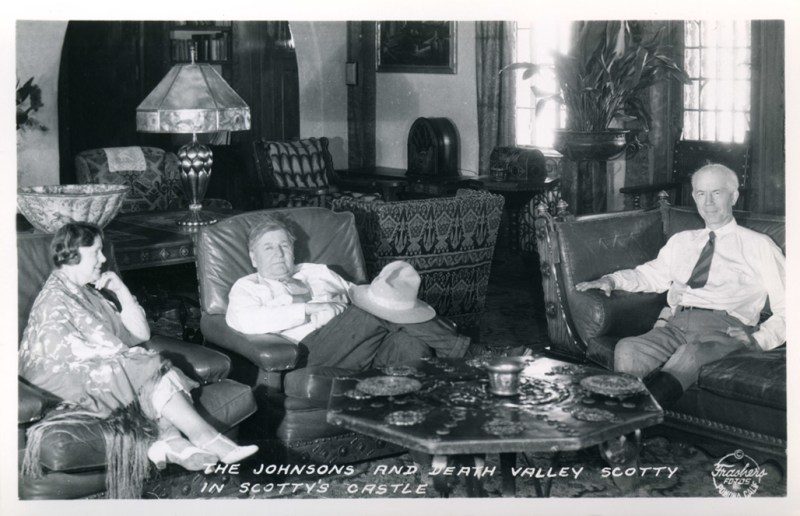
Death Valley Scotty and the Johnsons

Johnson first visited Death Valley in 1906 to tour Scott’s Gold Mines. The two became embroiled in the Battle of Wingate Pass, where Scott’s brother is shot in the groin. This injury forced a retreat from Death Valley. Johnson did not return to Death Valley for another three years. In 1909, he returned to the valley seeking to visit the mines in which he invested. It is said the dry air was a benefit to Johnson’s health. For whatever the reason, Johnson began purchasing land. Johnson purchased about 1500 acres of land. The Steininger Ranch was the most important parcel. Nestled in a spring-fed verdant valley, this was soon to be the site of the Death Valley Ranch.

Scotty's Castle located in Grapevine Canyon in Death Valley.
Scotty’s Castle located in Grapevine Canyon in Death Valley.

In 1922, Johnson started building Scotty’s castle as a vacation home.  When the size and scope of the property was realized, people assumed Scotty used the proceeds for his gold mine to pay for the Ranch.  Scotty, ever the promoter did nothing to correct the record and soon The Johnson’ vacation home.

Due to its remote location, the Death Valley Ranch needed to maintain its own power station and water supply and evaporation cooling system. Despite the conditions, Scotty’s Castle boasts a 1,121 pipe theater organ, fountains, clock tower and a massive unfinished swimming pool.

The stock market crash impacted Johnson’s fortune. He was not able to complete the Death Valley Ranch.

References

Walter Edward Perry Scott – “Death Valley Scotty”

Walter Edward Perry Scott  (September 20, 1872 – January 5, 1954), also known as “Death Valley Scotty”, was a miner, prospector and conman who operated around Death Valley, California. Later in life, he was befriended by Albert Johnson, who built the Death Valley Ranch in Grapevine Canyon in Death Valley, which is commonly known as “Scotty’s Castle“.

Walter Scott (1872 - 1954)
Walter Scott (1872 – 1954)

Early Life and Beginnings

Walter Edward Perry Scott, better known as “Death Valley Scotty,” was born on September 20, 1872, in Cynthiana, Kentucky, the youngest of six children in a family immersed in the harness racing circuit. His early years were spent traveling with his family, fostering a love for adventure and performance. At age 11, Scott left home to join his older brothers, Warner and Bill, on a ranch near Wells, Nevada. His first job in the West was as a water boy for a survey party along the California-Nevada border in 1884, which introduced him to the stark beauty of Death Valley. This early exposure to the desert marked the beginning of a lifelong connection to the region. By 16, his horsemanship skills earned him a spot as a stunt rider in Buffalo Bill Cody’s Wild West Show, where he toured the United States and Europe for 12 years, honing his flair for showmanship and self-promotion.

The Conman’s Rise to Fame

After a falling out with Buffalo Bill in 1900, Scott turned to gold prospecting, leveraging his charisma to convince wealthy investors to fund his ventures. He claimed to have discovered a lucrative gold mine in Death Valley, a story that was entirely fabricated. In 1902, he began soliciting funds from wealthy backers, including a New Yorker who invested over $5,000 without seeing any returns. Scott’s schemes escalated in 1904 when he claimed to be transporting $12,000 in gold dust on an eastbound train, only for the bag to be “stolen” before reaching Philadelphia, a story that captivated newspapers and launched his reputation as a flamboyant hustler. His most audacious stunt came in 1905, when he chartered the “Coyote Special,” a three-car train, to break the rail speed record from Los Angeles to Chicago in just 44 hours and 54 minutes. The press dubbed him “Death Valley Scotty,” a moniker that stuck for life.

The Battle of Wingate Pass

One of Scott’s most infamous cons was the 1906 “Battle” of Wingate Pass, designed to convince a mining engineer, A.Y. Pearl, and his investors of the existence of his gold mine. When Pearl insisted on seeing the mine, Scott staged an elaborate hoax, leading the group into Death Valley. The expedition turned chaotic when gunfire erupted—likely orchestrated by Scott—creating the illusion of a dangerous ambush. The stunt backfired when investors grew suspicious, but it added to Scott’s growing legend as a roguish figure. Despite the fraud, Scott’s charm and storytelling kept him in the public eye.

Friendship with Albert Johnson and Scotty’s Castle

Scott’s most significant relationship was with Albert Mussey Johnson, a Chicago insurance executive he met in 1904. Johnson, intrigued by Scott’s tales, invested in his fictitious mines. In 1906, Johnson visited Death Valley to inspect the claims, enduring the Wingate Pass fiasco. Surprisingly, Johnson was not deterred by the deception. The desert’s dry air benefited his health, and he developed a genuine fondness for Scott’s eccentric personality. The two formed an unlikely lifelong friendship. In 1922, Johnson and his wife, Bessie, began constructing a lavish Spanish-style mansion in Grapevine Canyon, known as Death Valley Ranch but popularly called Scotty’s Castle. Scott falsely claimed he funded the $1.5–$2.5 million estate with his mining wealth, a myth he perpetuated by entertaining guests with tales of his secret mines. In reality, Johnson built the castle as a vacation home, incorporating luxurious features like a pipe organ, custom furniture, and a Chimes Tower with 25 carillon chimes. Scott lived primarily in a nearby five-room cabin at Lower Vine Ranch, making appearances at the castle to maintain his persona.

Death Valley Scotty and the Johnsons

Dubious Reputation and Legal Troubles

Scott’s reputation as a conman was well-earned. He faced lawsuits from creditors in 1912 after falsely claiming to have sold a mine for $12 million, landing him in jail briefly. His schemes often involved fencing stolen high-grade ore, using leased mines as a front. Despite these misdeeds, Scott’s charisma and media savvy kept him a beloved figure. Newspapers called him the “Sphinx of the American Desert” and “King of the Desert Mine,” romanticizing his exploits. His friendship with Johnson shielded him from severe consequences, as Johnson continued to support him financially, even paying him a $30 monthly stipend.

Later Years and Legacy

Construction on Scotty’s Castle halted in the 1930s due to a surveying error revealing the land was federal property and Johnson’s financial troubles during the Great Depression. Johnson willed the estate to the Gospel Foundation, with the condition that Scott could live there until his death. Scott remained a fixture at the castle, regaling tourists with exaggerated stories of his adventures. He died on January 5, 1954, at age 82, and was buried on a hill overlooking the castle beside his dog, Windy. The National Park Service purchased the property in 1970 for $850,000, and it became a major attraction in Death Valley National Park, though it closed in 2015 due to flood damage and a 2021 fire.

Scott’s legacy is a blend of fact and fiction. His grave marker, dedicated by the Death Valley ’49ers Inc., bears his quote: “I got four things to live by. Don’t say anything that will hurt anybody. Don’t give advice—nobody will take it anyway. Don’t complain. Don’t explain.” This encapsulates his philosophy of living large without apology. While his scams and self-promotion earned him a dubious reputation, his friendship with Johnson and the enduring allure of Scotty’s Castle cemented his status as a colorful figure in American frontier history.

References