Upper Antelope Canyon

Located just outside of Page, Arizona Upper Antelope Canyon is arguably the best known slot canyon on the planet, yet few people will know its name outside of desert enthusiasts.  For those unaware of these structures, slot canyons are extremely narrow canyons, carved by water, which are typically just a few feet wide, but may be just a few inches.  The typically arid dessert can instantly turn into raging torrent of water in just a few minutes with just a few inches of water.  This water picks up speed, and debris such as sand, which scours the landscape including rock.  Antelope Canyon is found on Navajo Tribal land, and access to the canyon is only allowed with a Navajo Guide.

Molten Wave - Located in Antelope Canyon near Page, Arizona Antelope Canyon is the best known slot canyon.
Molten Wave – Located in Antelope Canyon near Page, Arizona Antelope Canyon is the best known slot canyon.
Parallelism – The smooth canyon walls of Antelop Canyon offer amazing photographic images.

Antelope Canyon is actually two separate slot canyons located a short distance from each other on either side of US 98.  Upper Antelope Canyon is know as Tse’ bighanilini, which in Navajo means “the place where water runs through rocks.”  Travel to the Canyon is done via Navajo run transport and you are allowed about 2 hours for your visit.  The site is at about 4,000 feet elevation and the canyon walls rise 120 feet above a stream bed.

I would like to thank the LeChee Chapter of the Navajo Nation for keeping this location sacred and available to us.

James Rathbun, Destination4x4.com

Access into the upper canyon is simply a walking into a canyon.  The trail is flat and sandy and very easy to manage.  Upon entrance into the Upper Antelope Canyon you are immediately struck by the texture and color of this place.  Just inside the entrance, is a small chamber which seems to great you, and the pink and orange glow of the light bouncing off the walls force your eyes up.  The geography is such, that the narrow opening high above you lets in a small fraction of the available light, and that light bounces down towards the bottom of the canyon.

Relatively short, Upper Antelope Canyon may be traversed in just 5 minutes.  However, this is simply a waste of your time if you just rush through.  The only complaint of the canyon, are the other visitors.  As a photographer, I have many photographs ruined by people turning a corner and walking into my frame while I was making an exposure.  This does not mean they were rude or anything but patient, but rather an unfortunate side effect of composing photographs with long exposure times in a 18 inch wide slot Canyon.

French Curve - Upper Antelope Canyon
French Curve – Upper Antelope Canyon

As with all beautiful things, we must share this location and Antelope Canyon is a must stop location every time I visit the area.  There is a hidden danger, in that the very forces which sculpt a slot canyon are still very much in play and every few years a new story will appear about someone being killed in a slot canyon due to a sudden flash flood.

I would like to thank the LeChee Chapter of the Navajo Nation for keeping this location sacred and available to us.

Upper Antelope Canyon Map

Goblin Valley Utah

A Goblin formed from a soft limestone, water and time offer a unique hiking experience. Photograph by James L Rathbun

Goblin Valley is located in Utah is a state park and campground which is adjacent to eroded flood plain. Formed by water, time and a soft sandstone, erosion sculpted the limestone into unique rock formations which some have stated appears to be goblins.  The Goblin Valley itself is a day use hiking area which allows one to get lost in the maze of spires and rock formations.

Valley Queen, Goblin Valley, Utah Photography by James L Rathbun
Valley Queen, Goblin Valley Utah. Photograph by James L Rathbun

Each rock spire ranges in height from 3 feet to about 20 feet tall.  The fragile structures litter the landscape and sadly on occasion have been felled by people who do not have respect for nature.  There are three established self, however the Valley of the Goblins is a open trail flat mud plane after a easy and short trail down from the parking area.

Goblin Valley State Park does offer an established campground of 22 campsites just over a hill from the Valley of the Goblins.  The campground features, paved sites, bathrooms, showers, water and dump stations. The campground is very popular destination due to location next to Goblin Valley and is also a wonderful centralized base camp location for exploring the San Rafael Swell.

A solitary Pronghorn ( Antilocapra americana ) found near Golbin Valley, Utah

We stated in Goblin Valley in the off season several years ago. We were greeted with lots of camp sites available, privacy and a minor wind and rain storm. Despite the less then desirable conditions, we enjoyed our stay and will try to make it back again in the future.

Continue Reading →

Racetrack Valley

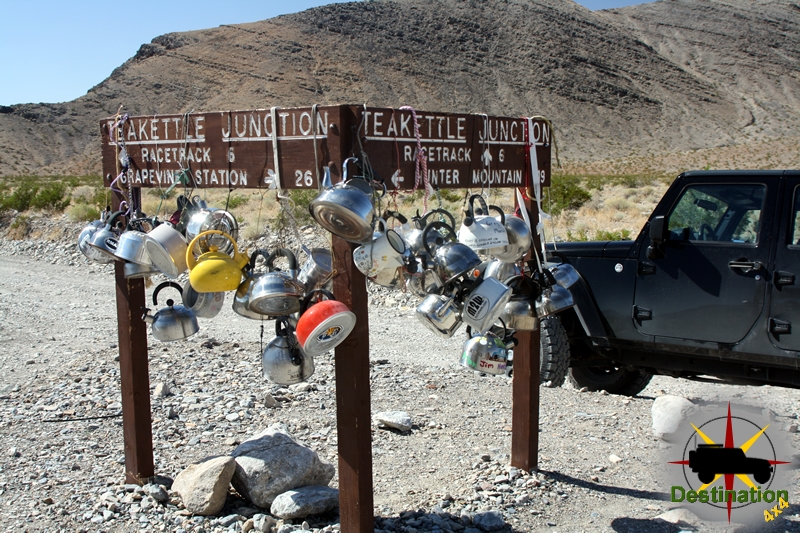
TeaKettle Junction lets you know you are starting to get close to the Racetrack.

Racetrack valley is a rough graded road which departs the Ubehebe Crater site and heads south into the desert. The road is rough, but easily passable in a regular car. However, when entering back country areas such as this it is always a good idea to have the insurance of a reliable vehicle, high clearance, four wheel drive, etc…  Do yourself a huge favor and air down your tires if you are properly equipped to air up when the trip is over.

Looking north from the Lippincott Mine towards the Racetrack off in the distance.

The racetrack valley road is a 25 miles one way trip to the playa. The road is grated, but can be heavily wash-boarded depending on the time of year, rain fall, etc…

Along the way, there are many side trips and alternate trails to help expand your visit.

As you leave Ubehebe Crater, you will be driving south and gradually gaining elevation. Take your time and enjoy the drive, if you are lucky you may see a big horn sheep herd. The road gradually gains in elevation and climbs through a Joshua Tree Forest.

Once you reach the pass, the road continues to drop in elevation all the way down to the playa. Continue straight through tea kettle junction, and bear left down the valley past the side road to the Lippincott mine, which is a great side trail.

The Racetrack Playa of Death Valley.

As you continue past the road to the Lippincott mine the road drops down to the Racetrack Playa itself. The first stop is ‘The Grandstand’ which is an outcropping of rock located in the north west corner of the racetrack. The second stop is the parking area to hike towards the stones. Don’t try to hike to the stones from the first Grandstand parking lot, or you will be hiking significantly further.

The highlight of the trip, is a short hike to the sailing or racing stones. The start of the hike is the parking area at the southern end of the racetrack playa.

Jeeps and Labradors are not allowed on the playa!

To reach the stones hike east from the parking lot across the playa towards the dark stone hillside. It is short FLAT, meaning really FLAT hike towards the stones. Be sure the check the temperatures before you leave, and bring lots of water. This is true with anything you might want to do in Death Valley. Don’t walk on the playa if it is wet or muddy.

The Racing stones.
The Racing stones.

At the end of the 30 miles road there is a small primitive campground for overnight visits. Be sure to check with the National Park Service for regulations of back country camping within the park.

Every racetrack needs a grandstand.

Notoriety

On September 19th, 1969 a Michigan front end loading is found burning along the road near the playa. Apparently, Manson order the machine burned. Park Rangers were deployed to the Racetrack. The rangers followed a set of tire tracked which belonged to a Toyota Land Cruiser which was stolen by Manson. The follow up investigate lead to the arrest of Charles Manson at Barker Ranch on October 12th, 1969.

Racetrack Valley Trail Map

References

Devil’s Gate – Nevada State Historic Marker 223

Devil’s Gate is a historic natural landmark and narrow gorge in Gold Canyon, located in Lyon County, Nevada, on the boundary line with Storey County. Situated approximately 3.5 miles south of Virginia City along what is now Nevada State Route 341/342 (near the entrance to Silver City), it consists of a rugged reef of metamorphic rock forming twin craggy walls that nearly meet in the center, creating a dramatic, constricted passage. Once a critical gateway for travelers and miners heading to the Comstock Lode, the site earned its ominous name from its foreboding appearance and reputation. It was never a large town but featured a short-lived settlement with hotels, saloons, and a toll station. Today, it is preserved as Nevada State Historic Marker No. 223, serving as a tangible reminder of the early Nevada Territory’s mining frenzy.

Devil's Gate near Silver City. This was a toll road on the way to Virginia City.
Devil’s Gate near Silver City. This was a toll road on the way to Virginia City.

Early Discovery and Placer Mining (1850–1859)

The history of Devil’s Gate is inextricably linked to the first gold discoveries in Gold Canyon, which foreshadowed the massive Comstock Lode silver boom. In June 1850, prospectors John Orr and Nicholas Kelly unearthed the first gold nugget found in Gold Canyon near the site. For the next decade, the canyon south of Devil’s Gate became a hub of placer mining activity.

By the late 1850s, the narrow passage through the rock formation had become a well-traveled route. Part of the jagged rock wall was blasted away in the mid-19th century to widen it for wagon traffic, transforming it into a practical (if still intimidating) thoroughfare. An official toll station operated at the gate, as it provided the easiest access toward Virginia City and the emerging mines.

The Silver City mining district (initially called the Devil’s Gate district) was formally established on November 19, 1859. The first claim, the Wildcat, was recorded shortly after, and by early 1860 over 100 claims existed in the roughly 3.5-by-4-mile area centered near Silver City.

The Boom Era, Toll Road, and Paiute War (1860s)

Devil’s Gate reached its peak significance in the early 1860s as thousands of adventurers, miners, and freight teams paraded through the gorge en route to the gold and silver mines of the Comstock Lode. In summer 1860, one of the first stamp mills in the Nevada Territory was erected just south of the gate to process ore from the surrounding placer operations.

The site gained a notorious reputation as a hideout for highwaymen and robbers in the late 1850s and early 1860s. Travelers frequently reported being robbed of watches, wallets, and valuables in the narrows. Journalist J. Ross Browne, in his 1860 account A Peep at Washoe, described the place as giving “a forcible impression of the unhallowed character of the place,” noting that the trip through the gate felt unsafe due to its ominous atmosphere.

During the brief Paiute War (also known as the Pyramid Lake War) in May 1860, residents of the growing nearby settlement of Silver City constructed a stone battlement and fort atop the eastern summit of Devil’s Gate. They even mounted a wooden cannon for defense against potential attacks.

A small settlement called Devil’s Gate briefly flourished right at the gate itself, serving travelers and miners with two hotels, several saloons, shops, stables, and other businesses. Silver City, which developed adjacent to the gate, grew into an important milling and supply center for the Comstock mines and the ore-processing mills along the Carson River. At its height in 1861, Silver City had a population of about 1,200.

Decline and Transition (Late 1860s–1900s)

The completion of the Virginia and Truckee Railroad in 1869 bypassed much of the freight traffic that had sustained Devil’s Gate and Silver City, leading to a sharp decline. Local mines and mills proved less productive than those in Virginia City and Gold Hill, and the area’s role as a transportation hub diminished. The short-lived settlement at Devil’s Gate faded, though Silver City retained some historic structures and continued as a smaller community tied to the broader Comstock region.

Modern Era and Preservation (20th Century–Present)

Devil’s Gate survives today primarily as a historic landmark rather than an active community. The Nevada State Historic Marker (No. 223), erected by the Division of Historic Preservation and Archaeology and sponsored by the Reno Chapter of the National Society Daughters of the American Colonists, stands near the site and recounts its story. The surrounding area near Silver City preserves remnants of 19th-century mining infrastructure, including foundations, wooden vats, and milling frames.

The site remains accessible via public roads and continues to draw history enthusiasts, hikers, and those interested in the Comstock Lode era. It is not a populated census-designated place but is integral to the historic fabric of Lyon and Storey counties. Nearby Silver City maintains a small population, a post office, and historic buildings that echo the region’s mining past.

Conclusion

Devil’s Gate exemplifies the raw, perilous, and opportunistic spirit of Nevada’s territorial mining frontier. From the 1850 gold discovery that sparked placer operations to its role as a dangerous yet vital gateway for thousands bound for the Comstock Lode, the site played a foundational part in the development of Lyon County and the broader American West. Though the settlement was short-lived and the robberies and wartime defenses are now distant memories, the narrow gorge and its historic marker stand as enduring symbols of the rugged journey that built Nevada’s mining legacy. Today, it offers visitors a direct connection to the adventurous souls who transformed a remote canyon into a cornerstone of the Silver State’s history.

Nevada State Historic Marker 223

Nevada State Historical Markers identify significant places of interest in Nevada’s history. The Nevada State Legislature started the program in 1967 to bring the state’s heritage to the public’s attention with on-site markers. These roadside markers bring attention to the places, people, and events that make up Nevada’s heritage. They are as diverse as the counties they are located within and range from the typical mining boom and bust town to the largest and most accessible petroglyph sites in Northern Nevada Budget cuts to the program caused the program to become dormant in 2009. Many of the markers are lost or damaged.

It gives … “a forcible impression of the unhallowed character of the place.” J. Ross Browne . 1860

This rugged reef of metamorphic rock was once one of the famous landmarks of the Nevada Territory.  In June of 1850, John Orr and Nicholas Kelly unearthed a gold nugget nearby, the first ever found in Gold Canyon.  For the next ten years, the can was the scene of placer mining and one of the first stamp mills in the Territory was erected just to the south of Devil’s Gate during the summer of 1860.

During the brief Paiute War of May, 1860, the people of Silver City built a stone battlement atop the eastern summit and constructed a wooden cannon for protection.

Devil’s Gate marks the boundary line between Storey and Lyon Counties.  Through this narrow gorge paraded thousands of the most adventurous souls of the mining West as they made their way to the gold and silver mines of the Comstock Lode.

STATE HISTORICAL MARKER No. 223

DIVISION OFHISTORIC PRESERVATION AND ARCHAEOLOGY

SPONSORED BY:

RENO CHAPTER OF THE NATIONAL SOCIETY

DAUGHTERS OF THE AMERICAN COLONISTS

Devil’s Gate Historic Marker Map

Nevada State Historic Marker number two hundred twenty three is location on the western side of Nevada State Route near the geologic feature. The marker is just north of Silver City, Nevada.

Devil's Gate as seen from the townsite of Silver City. State Route 342 goes through the "gate" on its way to Virginia City. Original view is circa 1866
Devil’s Gate as seen from the townsite of Silver City. State Route 342 goes through the “gate” on its way to Virginia City. Original view is circa 1866

Nevada State Historic Marker Summary

NameDevil’s Gate
LocationLyon County, Nevada
Latitude, Longitude39.2667, -119.6419
GNIS222304
Nevada State Historic Marker 223

References

Subway Canyon – Left Fork of North Creek

Subway Slot Canyon is a unique geological formation located in the Zion National Park in southwestern Utah, USA. It is considered one of the most popular hiking trails in the park, known for its challenging terrain and breathtaking views. The canyon gets its name from its tubular shape, which resembles the underground trains or subway tunnels.

The Subway Slot Canyon located in Zion National Park, Utah.  Photograph by James L Rathbun
The Subway Slot Canyon located in Zion National Park, Utah. Photograph by James L Rathbun

History

The Subway Slot Canyon was formed millions of years ago by the erosion of Navajo Sandstone, a red-colored rock formation that is found in the southwestern United States. The slot canyon was created by the flow of water, which gradually wore away the sandstone, forming a narrow, winding passage through the rock. The canyon was first discovered by explorers in the 1930s, but it was not until the 1970s that it became a popular destination for hikers.

Geology

The Subway Slot Canyon is a part of the Zion Wilderness, which covers an area of approximately 124,406 acres. The canyon is about 9 miles long and ranges in width from 5 to 15 feet. The canyon walls are made up of Navajo Sandstone, which is known for its unique patterns and colors. The sandstone is layered, with different colors and textures, giving the canyon walls a unique and stunning appearance. The canyon also features a series of pools and waterfalls, which add to its beauty.

Flora and Fauna

The Subway Slot Canyon is home to a variety of flora and fauna. The area around the canyon is covered with sagebrush, juniper, and pinyon trees. The canyon itself is home to a variety of ferns, mosses, and other plant species. The canyon is also home to a variety of animals, including bighorn sheep, mule deer, and mountain lions. Hikers may also see a variety of birds, including hawks, eagles, and owls.

Hiking Experience

The Subway Slot Canyon is considered one of the most challenging hiking trails in the Zion National Park. The trail is rated as moderate to strenuous and requires a permit to hike. Hikers must be prepared for a difficult and sometimes dangerous hike, as the trail includes steep drops, narrow passageways, and deep pools of water. Hikers must also be prepared for changing weather conditions, as the canyon can be very hot in the summer and very cold in the winter.

The Subway Slot Canyon is a unique geological formation that offers hikers a challenging and rewarding experience. The canyon’s unique colors, textures, and shapes make it a must-see destination for anyone visiting the Zion National Park. However, hikers must be prepared for the challenges that come with hiking in the canyon, including difficult terrain and changing weather conditions. With proper preparation and precautions, hikers can safely explore the beauty of the Subway Slot Canyon and experience one of the most stunning geological formations in the world.