French Visitor Dies in Death Valley National Park

The hottest place on earth, Death Valley National Park is on the order with California and Nevada

DEATH VALLEY, Calif. — A 68-year-old French visitor died Monday, Aug. 17, after he and a traveling companion became stranded on a remote road in Death Valley National Park.

Pierre Michel Formosa, 68, and his travel companion, both from France, were traveling on West Side Road when their vehicle became stuck in mud near Queen of Sheba Mine Road. With no other vehicles in the area, the men began walking across the salt flats toward Badwater Road to seek assistance. Temperatures reached 116°F that day. After about 1.3 miles, the man was unable to continue. His companion continued toward Badwater Road, where he eventually received assistance from a passing motorist and reported the incident at the Furnace Creek Visitor Center shortly after 2 p.m.

National Park Service rangers and an Inyo County deputy began a search and rescue operation about 2:13 p.m. A California Highway Patrol helicopter joined the search and located the man later that afternoon, approximately 1.5 miles from Badwater Road. He was pronounced dead at the scene. The Inyo County coroner will determine the cause and manner of death.

“Our deepest condolences are with the family and friends of the visitor who died,” said Death Valley National Park Superintendent Mike Reynolds. “This is a heartbreaking reminder of how quickly conditions here can turn dangerous. Death Valley is an extraordinary place, but its heat, distances, and remoteness can be dangerous, regardless of experience. We’re grateful to everyone who took part in the search, and our thoughts are with his loved ones.”

Planning Ahead in Death Valley

Death Valley National Park covers vast, remote terrain where cell service is limited or nonexistent, and emergency help can be hours away. The park encourages all visitors to prepare for that reality before they set out:

  • Plan your route in advance and check current road and weather conditions.
  • Tell someone your plans — where you’re going and when you expect to return.
  • Carry ample water and supplies. The park recommends at least one gallon of water per person, per day, plus extra for vehicle emergencies.
  • Match your vehicle to the road. Many backcountry roads require high-clearance or four-wheel-drive vehicles, and conditions can change without warning.
  • Bring a way to call for help where cell service may not reach, such as a satellite communicator or emergency beacon.
  • If your vehicle becomes disabled, staying with it is often the safest choice. It provides shade and shelter, and it’s far easier for search teams to spot than a person on foot in open terrain.
  • During periods of extreme heat, visitors are encouraged to stay on paved roads and avoid hiking at lower elevations.

The National Park Service urges all visitors to arrive prepared with the knowledge, equipment, and supplies to keep themselves safe until help arrives.

-nps.gov-

https://www.nps.gov/deva/learn/news/2026-08-21.htm

Back County Camping in Death Valley National Park

Primitive backcountry camping in Death Valley National Park offers profound solitude amid vast desert landscapes, with few other people, excellent wildlife viewing, and some of the darkest night skies in the United States.

Homestake, Death Valley

Death Valley encompasses more than 3 million acres of designated wilderness (over 93% of the park). Away from developed areas and popular roads, campers often experience true isolation—nights without the sounds or lights of other visitors, under an immense canopy of stars. The park is an International Dark Sky Park (Gold Tier level), with exceptionally clear, dry air and minimal light pollution. On moonless nights the Milky Way can stretch horizon to horizon, and celestial objects invisible from most urban or suburban locations become visible. Backcountry locations far from Furnace Creek or Stovepipe Wells provide the darkest viewing.

Wildlife viewing opportunities arise from the park’s surprising diversity of habitats—colorful badlands, canyons, alluvial fans, springs, and higher-elevation woodlands. Desert bighorn sheep, coyotes, kit foxes, lizards, snakes, birds, and smaller mammals inhabit the area. Springs and water sources are critical for wildlife; camping near them is restricted to protect these fragile habitats. Visitors should never feed or approach animals.

NPS Directives on Campsite Locations, Campfires, Water, and Related Rules

Campsite locations

  • Dispersed (backcountry) camping is generally allowed at least one mile from any paved road, developed area, or “day-use only” dirt road.
  • Roadside (vehicle-accessible) camping along many dirt roads is permitted only in previously disturbed areas immediately adjacent to the roadway (vehicles must stay on designated roads; off-road driving is prohibited). The wilderness boundary typically begins 50 feet from the centerline of most dirt roads.
  • Certain popular corridors (Echo Canyon, Hole in the Wall, Cottonwood Canyon/Marble Canyon, and Greenwater Valley/Furnace Creek Wash) require mandatory paid permits ($10/night) for designated or limited dispersed roadside sites; these are reserved online via Recreation.gov up to six months in advance. Overnight backpacking in those corridors is allowed farther than one mile from the road centerline.
  • All other roadside camping, backpacking, or canyoneering is free and permits are recommended (not mandatory); obtain them at Furnace Creek Visitor Center, Stovepipe Wells Ranger Station, the self-service drop box, or online.
  • Prohibited areas include: the valley floor from Ashford Mill north to the Mesquite Flat Sand Dunes; Eureka and Mesquite Flat Sand Dunes; within one mile of Greenwater Canyon or Darwin Falls Trail; many “day-use only” roads (Titus Canyon, Mosaic Canyon, West Side Road, Wildrose Road, Skidoo Road, Aguereberry Point Road, first 8 miles of Cottonwood Canyon Road, etc.); and near certain historic mining sites.
  • Camp at least 100 feet from any flowing stream, spring, or natural body of water (some older guidance references 100–200 yards; follow the stricter current rule).
  • Group size is limited to 12 people and no more than 4 vehicles; larger groups must split up and camp/travel at least ½ mile apart.
  • Maximum stay is generally 30 days per calendar year (some developed sites have shorter limits). Camp only in previously disturbed spots where possible and practice Leave No Trace.

Campfires

  • Traditional campfires (wood or charcoal that contact the ground) are not allowed in the backcountry.
  • Portable gas stoves are permitted.
  • Fire pans or other fireproof barriers that keep the fire completely off the natural surface are allowed in many areas (below 3,000 feet year-round; above 3,000 feet only from approximately September 16 to June 14). Wood gathering is prohibited; all ash and unburned material must be packed out. Check current fire restrictions, as they can change.
  • In designated primitive campgrounds (e.g., Wildrose area), fires may be restricted or limited to provided grates during high-fire-danger periods.

Water and other essentials

  • There is no potable water in the backcountry. Natural springs are unreliable, often dry, and can be contaminated (e.g., by wildlife or other sources). Carry all the water you will need—commonly one gallon or more per person per day in hot weather—or carefully cache it in advance. Purify any backcountry water before drinking.
  • Pack out all trash, leftover food, and (in many situations) human waste. Bury human waste at least 6 inches deep and 200 feet from water sources; pack out toilet paper.
  • Pets are restricted: they are not allowed on trails or in wilderness areas and must stay within 50 feet of roads or developed areas.
  • Cell service is nonexistent in most of the park. Self-reliance is essential—carry extra food, water, spare tires/repair kits, maps, and a communication plan. High-clearance (and often 4WD) vehicles are required for most backcountry roads.

Primitive backcountry camping here rewards careful preparation with solitude, wildlife encounters, and unparalleled night skies. Always check current conditions, road status, and regulations on the official NPS Death Valley website (nps.gov/deva) before your trip, as rules and access can change with weather, fire danger, or management needs.

Panamint City California – Inyo County Ghost Town

Panamint City is one of the most legendary ghost towns in the Panamint Range of Death Valley National Park, California. Perched high in Surprise Canyon at an elevation of around 6,000–6,500 feet (about 1,800–2,000 m), it was once a notorious silver boomtown known for its lawlessness, rapid rise, and swift decline. Today, the site lies in a remote, rugged wilderness area within the park (though some remnants are on private inholdings or patented claims).

Panamint City California - 1875
Panamint City California – 1875

Historical Background and Founding (1872–1873)

The story of Panamint City begins in late 1872 amid the chaotic aftermath of earlier California gold and silver rushes. Prospectors William L. Kennedy, Robert Polk Stewart, and Richard C. Jacobs (some accounts name them as William Ledlie Kennedy et al.) were searching for the fabled Lost Gunsight Mine (a legendary lost gold deposit tied to early Death Valley lore) when they stumbled upon rich silver outcrops in Surprise Canyon. The canyon’s isolation had long made it a favorite hideout for outlaws evading law enforcement after stagecoach robberies and other crimes.

When the prospectors returned to stake formal claims, a gang of six bandits (who had followed them) forced a partnership to share in the profits—despite the outlaws being wanted for crimes like robbing a Wells Fargo stage of $12,000. This unlikely alliance marked the birth of the Panamint Mining District, officially formed in February 1873. Ore samples sent to Los Angeles attracted attention, and word spread quickly.

Senator John Percival Jones

Boom Period (1873–1875)

The real boom ignited when Nevada’s “Silver Senators”—John P. Jones and William M. Stewart (prominent Comstock Lode investors)—learned of the discoveries. They organized the Panamint Mining Company with $2 million in capital stock and bought up major claims, injecting serious investment. By late 1874, Panamint City exploded into a full-fledged town:

  • Population peaked at around 1,500–2,000 residents, including miners, merchants, saloonkeepers, prostitutes, gamblers, and outlaws.
  • The main street stretched nearly one mile up the narrow canyon, lined with wooden buildings: hotels, restaurants, stores, assay offices, two banks, a post office, and the Panamint News newspaper.
  • Saloons and a red-light district thrived, contributing to the town’s reputation as one of the “toughest, rawest, most hard-boiled little hellholes” in the West.
  • Lawlessness was rampant—reports claim over 50 murders in the first few years, with shootouts, claim-jumping, and vigilante justice common. Wells Fargo refused to operate a stage line due to the banditry; instead, bullion was cast into heavy 400-pound cubes to deter theft during transport.
  • Key mines included the Wyoming Mine, Wonder Mine, and others producing high-grade silver ore (some assays showed values in the thousands of dollars per ton), along with copper and lesser gold.

The town even inspired ambitious infrastructure plans, such as Senator Jones’ short-lived railroad project from Santa Monica (which never fully materialized beyond initial segments).

William M. Stewart. Photo by Matthew Brady

Decline and Abandonment (1875–1877)

The bust came as quickly as the boom. By late 1875, the richest surface and near-surface ore bodies in the major mines began depleting rapidly. Veins pinched out or became too low-grade to process profitably with 1870s technology. Investors pulled out, and production plummeted.

A catastrophic flash flood in 1876 roared down Surprise Canyon, washing away much of the lower town, destroying buildings, roads, and equipment. This disaster accelerated the exodus. By 1877, major operations shut down entirely, and Panamint City was largely abandoned. Scavengers and a few holdouts lingered briefly, but the population evaporated within months.

Later History and Remnants

The site is protected; visitors must hike and plan trips carefully (flash flood risk remains high). Sporadic small-scale prospecting occurred in the early 20th century, but nothing revived the town. The area saw renewed minor activity during later Panamint Range booms (e.g., gold at nearby Skidoo in 1905–1917), but Panamint City itself remained a ghost town.

In the mid-20th century, some structures were salvaged or burned; flash floods continued to erode the site.

Today, within Death Valley National Park (established 1994, expanded to include the Panamint Range), remnants include:

  • Foundation stones and walls of former buildings.
  • Mine adits, shafts, and tailings piles.
  • The old smelter stack base and scattered artifacts.
Panamint City Stamp Mill

Panamint City exemplifies the classic Western mining boom-bust cycle: fueled by rich silver discoveries, hyped by big investors, plagued by lawlessness and isolation, and doomed by ore depletion and natural disaster. Its brief, violent heyday left an enduring legend in Death Valley lore—one of outlaws turning prospectors, senators chasing silver, and a canyon that swallowed a town almost as fast as it rose.

Panamint Town Summary

NamePanamint
LocationInyo County
Latitude, Longitude36.1182827, -117.0953327
GNIS1661185
Elevation6,300 Feet
NewspaperPanamint News ( 1874-1875 )

Panamint Map

References

William Morris Stewart

William Morris Stewart (August 9, 1827 – April 23, 1909), often called the “Silver Senator,” was a prominent American lawyer, politician, and mining investor whose career intertwined deeply with the mining booms of California and Nevada. Known for his aggressive legal tactics, advocacy for free silver and mining rights, and involvement in high-profile (and sometimes controversial) ventures, Stewart amassed significant wealth through prospecting, litigation, and speculation before and during his long political tenure.

William M. Stewart. Photo by Matthew Brady

Early Life and Arrival in the West

Born in Galen, near Lyons, Wayne County, New York, Stewart was the oldest son of Frederick A. and Miranda Morris Stewart. His family moved to a farm in Trumbull County, Ohio, during his childhood, but he returned to Lyons for high school. In 1848, he entered Yale University but left after three semesters to join the California Gold Rush. Traveling via the Isthmus of Panama, he arrived in San Francisco in spring 1850 and headed to the gold fields near Nevada City, California. There, he prospected successfully, discovering the famed Eureka diggings and profiting enough to sell his interests at a substantial gain. This early success funded his shift from mining to law.

Legal Career and California Mining Ties (1850s)

Stewart studied law under John R. McConnell in Nevada City and was admitted to the bar in 1852. He served as district attorney of Nevada County in 1853 and briefly as acting attorney general of California in 1854. In 1855, he married Annie Elizabeth Foote (daughter of former Mississippi Senator Henry S. Foote) and moved to Downieville, California, in 1856, continuing his legal practice amid the region’s placer and quartz mining operations. His expertise in mining law—gained through litigation over claims, water rights, and ore disputes—laid the foundation for his later prominence.

Move to Nevada and the Comstock Lode (1859–1875)

The 1859 discovery of the Comstock Lode—one of the richest silver deposits in history—in what was then Utah Territory (soon Nevada) drew Stewart to Virginia City in 1860. He became the most prominent lawyer on the Comstock, specializing in mining litigation. He championed the “single ledge” theory (arguing the Comstock was one continuous vein), which influenced massive stakes in control of the lode. Stewart estimated earning $500,000 from four years of such cases, amid litigation costing up to $10 million overall. His aggressive style—sometimes described as not always strictly ethical—earned him a fearsome reputation.

Politically, Stewart helped shape Nevada: he served on the territorial council (1861), attended the 1863 constitutional convention, and became one of Nevada’s first U.S. Senators upon statehood in 1864 (serving until 1875). He drafted key national mining laws (1866 and 1872) formalizing Western practices like claim location and free access to public lands. He also contributed to the Fifteenth Amendment and supported railroad interests.

Investments and Controversies in Mining

Beyond law and politics, Stewart invested directly in mining:

  • Comstock Lode: He participated as a capitalist after his legal work, profiting from the silver boom.
  • Emma Mine (Utah, 1870s): Stewart promoted this silver mine in Little Cottonwood Canyon to British investors, raising millions. Accusations of fraud arose when the mine proved depleted or overvalued; he and partners sold shares profitably, tarnishing his reputation.
  • Panamint City (California, 1873–1877): In late 1872/early 1873, prospectors (including outlaws) discovered rich silver in Surprise Canyon, Panamint Range (near Death Valley), while searching for the legendary Lost Gunsight Mine. Stewart partnered with fellow Nevada Senator John P. Jones (both dubbed “Silver Senators” for their mining ties) to form the Panamint Mining Company (capitalized at $2 million). They invested heavily—over $250,000–$350,000—buying claims (e.g., Wyoming, Wonder, Challenge), arranging amnesty for bandit discoverers (with restitution to Wells Fargo), and promoting the boom. Panamint City swelled to 1,500–2,000 residents with mills and infrastructure, but ore depleted quickly, and a 1876 flash flood devastated the town. The venture collapsed by 1877, adding to Stewart’s controversial legacy.

Stewart’s mining pursuits often blended speculation, promotion, and politics, drawing criticism for prioritizing profit and development over restraint.

Later Career and Legacy

After leaving the Senate in 1875 (due to financial pressures against rival William Sharon), Stewart practiced law in San Francisco and pursued unsuccessful mining schemes. He represented clients in scandals (e.g., William Sharon’s divorce) and briefly joined the Silver Party (1892–1899) to advocate remonetizing silver, editing the Silver Knight newspaper. Rejoining Republicans in 1900, he returned to the Senate (1887–1905), championing Western irrigation, mining safety, and opposing figures like John Wesley Powell on land policy.

In 1905, at nearly 80, Stewart moved to the Bullfrog mining district in southern Nevada, opening a law firm and dabbling in ventures. He died in Washington, D.C., in 1909, leaving a fortune from mining and law (estimated at millions earlier). Inducted into the Hall of Great Westerners (1964), Stewart embodied the rugged, opportunistic spirit of the mining West—shaping laws that enabled its development while embodying its excesses and controversies. His investments in California (early gold fields, Panamint) and Nevada (Comstock, later camps) helped fuel booms that transformed the region, for better and worse.

The Battle of Wingate Pass – February 26, 1906

The Battle of Wingate pass as reports by Los Angeles herald (Los Angeles [Calif.]), March 21, 1906

The so-called “Battle” of Wingate Pass, which occurred on February 26, 1906, in the rugged terrain of Death Valley, California, was not a genuine conflict but a staged hoax orchestrated by the infamous con artist Walter Edward Perry Scott, better known as “Death Valley Scotty.” This incident stemmed from Scotty’s elaborate schemes to defraud investors by promoting nonexistent gold mines in the desert. What followed the event was a chaotic sequence of retreats, media scrutiny, arrests, lawsuits, and jurisdictional disputes that exposed the fraud and led to short-lived legal repercussions. Below is a detailed chronological account of the events leading up to the “battle,” the incident itself, and the immediate aftermath, with a focus on the court actions that unfolded in the weeks and months following.

Background on Death Valley Scotty

Walter Scott (1872 - 1954)
Walter Scott (1872 – 1954)

Walter Edward Perry Scott (1872–1954), famously dubbed “Death Valley Scotty,” was born in Cynthiana, Kentucky, and rose to prominence as one of the American West’s most colorful con artists. Scotty began his career as a performer in Buffalo Bill’s Wild West Show in the 1890s, where he honed his skills in showmanship and tall tales. By the early 1900s, he had relocated to California and began promoting himself as a wealthy gold prospector with secret mines in Death Valley, often flashing rolls of cash (later revealed to be “upholstered” with newspaper) to lure investors. His schemes involved “grubstakers”—investors who funded his expeditions in exchange for shares in supposed riches. Scotty’s charisma and exaggerated stories attracted figures like Chicago businessmen Albert M. Johnson and Edward A. Shedd, who invested $2,500 for a two-thirds stake in his fictional mine. However, as investors demanded proof, Scotty’s deceptions escalated, leading to elaborate hoaxes to maintain the illusion. His persona became synonymous with Death Valley, and he later lived at the opulent Scotty’s Castle (built by Johnson), perpetuating myths of hidden wealth until his death.

Events Leading Up to the “Battle”

Newspaper cartoon of "Death Valley Scotty", around 1905
Newspaper cartoon of “Death Valley Scotty”, around 1905

By early 1906, Scotty’s investors were growing suspicious. New England mining promoter A.Y. Pearl had introduced Scotty to Eastern bankers and businessmen eager to inspect his claimed gold properties in Death Valley. They insisted on an evaluation by Daniel E. Owen, a reputable Boston mining engineer based in Nevada. Fearing exposure—since Scotty had no real mine—he persuaded his associate Bill Keys (a prospector and half-Cherokee Indian) to allow the group to view Keys’ modest Desert Hound Mine as a stand-in. Still anxious that Owen would deem it unworthy, Scotty hatched a plan for a staged ambush to make the area seem too dangerous for further exploration.

On February 23, 1906, the party departed from Daggett, California, equipped with two wagons, mules, horses, provisions, and whiskey. The group included Scotty, Owen, Pearl, Albert M. Johnson (president of the National Life Insurance Company of Chicago), Scotty’s brothers Bill and Warner Scott, Bill Keys, A.W. DeLyle St. Clair (a Los Angeles miner), and Jack Brody (a local desert character). Keys and Brody were sent ahead to prepare the ambush, possibly with help from an Indian named Bob Belt. The party camped at Granite Wells on February 24 and proceeded toward Lone Willow Spring the next day, leaving Bill Scott behind to guard extra animals.

Description of the “Battle”

The hoax unfolded on February 25, 1906, as the group approached Wingate Pass near Dry Lake. Shots rang out from behind stone breastworks (five of which still exist today as historical remnants), simulating an attack by claim jumpers or bandits. An ex-deputy sheriff from Goldfield, Nevada, reported being ambushed earlier, causing his pack train to stampede, adding to the chaos. Scotty fired two warning shots, startling the mules and tipping Owen from his wagon. Then, a rifle shot from the hidden assailants struck Warner Scott in the groin, an accidental injury likely due to the ambushers’ drunkenness (possibly Bob Belt). Scotty galloped toward the “attackers,” yelling for them to stop, which inadvertently exposed the ruse to the suspicious Owen.

The “battle” was brief and one-sided, with no return fire from the party. Panic ensued, and the group retreated hastily to Daggett, abandoning provisions in the desert. Warner was rushed to Los Angeles for medical treatment, where he survived after surgery. The staged nature became evident through Scotty’s over-the-top reaction and the lack of pursuit by the “ambushers.” The event involved real bullets, turning a planned scare tactic into a near-tragedy due to poor execution.

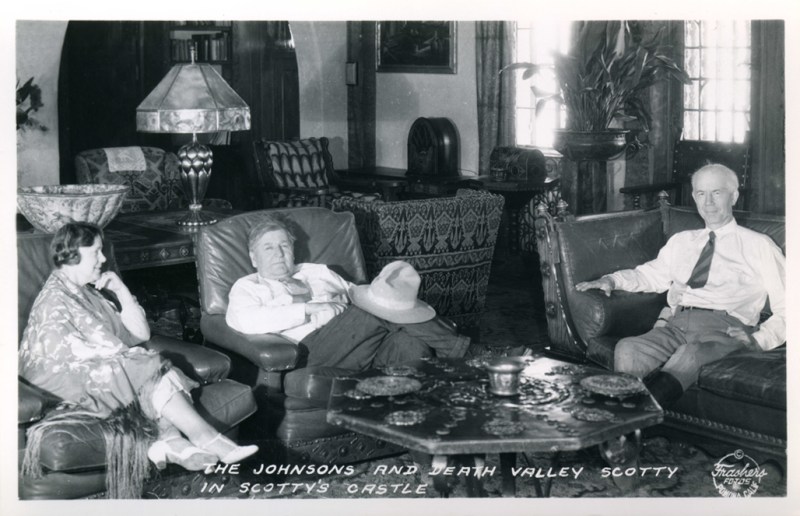
Death Valley Scotty and the Johnsons

Immediate Events Following the “Battle” (Late February to March 1906)

The group’s return to civilization sparked immediate chaos. Los Angeles newspapers sensationalized the story, with Pearl initially claiming it was a genuine fight against four outlaws who were “claim jumpers” guarding Scotty’s mine. However, Owen, suspecting foul play, reported the true details to the San Bernardino County sheriff and the press, asserting that Scotty had orchestrated the ambush in an attempt to kill him and cover up the fraud. This led to a public unraveling of the hoax, as investors like Johnson realized they had been duped—though Johnson would later reconcile with Scotty and fund the construction of Scotty’s Castle in Death Valley.

The sheriff’s investigation uncovered incriminating evidence: abandoned provisions at Scotty’s “Camp Holdout” and a witness statement from the Nevada lawman who spotted Keys fleeing the scene. Media coverage intensified, portraying Scotty as a swindler and the “battle” as a farce. Scotty, ever the showman, initially denied involvement but soon faced mounting pressure.

Court Actions and Legal Proceedings (March to April 1906)

The legal fallout began swiftly. On March 14, 1906, just over two weeks after the incident, the San Bernardino County District Attorney issued arrest warrants for Scotty, Bill Keys, and Jack Brody on charges of assault with a deadly weapon. Scotty was arrested in Seattle on March 24 and released on $500 bail. He was rearrested two days later on March 26 but again released. On April 7, Scotty pleaded not guilty to two counts of assault in San Bernardino County Court and was freed on $2,000 bail.

Meanwhile, Warner Scott, seeking compensation for his injury, filed a civil lawsuit on or around April 1906 in Los Angeles County Court against Walter Scott, Bill Scott, Bill Keys, A.Y. Pearl, and a “John Doe” (likely Brody or another accomplice). The suit demanded $152,000 in damages for his wounds and related suffering.

Keys was apprehended on April 10 at Ballarat, a mining camp near Death Valley, and pleaded not guilty before being jailed in San Bernardino. On April 13, Scotty, Pearl, and Bill Scott were arrested once more and briefly jailed in San Bernardino. However, they were released the next day after a successful habeas corpus petition challenged their detention.

The cases collapsed on April 27, 1906, when all criminal charges were dismissed by the San Bernardino County Court due to a jurisdictional error: the “battle” had occurred in Inyo County, not San Bernardino County. Inyo County authorities declined to pursue the matter, possibly due to lack of evidence or interest. Scotty later boasted that he had moved a county boundary marker to create this confusion, though this claim remains unverified.

Warner eventually agreed to drop his damage suit on the condition that Scotty pay over $1,000 in medical bills owed to Dr. C.W. Lawton in Los Angeles. Scotty consented but never paid, leading to a default judgment against him—though he had no attachable assets at the time. This unresolved debt would resurface years later, culminating in Scotty’s 1912 contempt-of-court jailing and public confession to the hoax, but the immediate 1906 proceedings ended without convictions.

Broader Implications and Legacy

The “Battle” of Wingate Pass marked a turning point in Scotty’s career, exposing his deceptions to a wider audience and costing him most investors—except Johnson, who ironically became his lifelong patron. The event highlighted the lawlessness of the California desert frontier, where jurisdictional ambiguities often allowed scams to evade justice. While no one was ultimately prosecuted in 1906, the hoax cemented Scotty’s legend as a colorful charlatan, and Wingate Pass remains a footnote in Death Valley lore.

Participants of the Battle

Albert Mussey Johnson

 Albert Mussey Johnson – Death Valley Ranch Owner

Albert Mussey Johnson Albert Mussey Johnson (1872 - 1948) was a businessman and investor who received notoriety as the millionaire, who built “Scotty's Castle” in…
Walter Scott (1872 - 1954)

Walter Edward Perry Scott – “Death Valley Scotty”

Walter Edward Perry Scott  (September 20, 1872 – January 5, 1954), also known as "Death Valley Scotty", was a miner, prospector and conman who operated…

Warner Elmore Scott

Warner Elmore Scott (1865–1950) was a Kentucky native from a horse farming family who became entangled in his brother Walter "Death Valley Scotty" Scott's infamous…
William F. Keys reenacts the scene of the fatal shooting of Worth Bagley - Photo NPS

William Franklin Keys

William Franklin Keys (September 27, 1879–1969) was a rugged American frontiersman, rancher, and miner who became a notable figure in the history of the Mojave…