Lost Burro Mine

The Lost Burro Mine is one of the best-preserved historic gold mining sites in Death Valley National Park, California. Located in a remote draw at the northern end of the mountain range separating Hidden Valley from Racetrack Valley (near Teakettle Junction in the Ubehebe Mining District), the mine sits in rugged terrain accessible only by high-clearance 4WD vehicles via a rough 1-mile dirt track off the Hidden Valley road. Its isolation has helped protect the site from vandalism, making it a fascinating glimpse into early 20th-century prospecting life.

The Lost Burrow Mine is located off Hunter Mountain Road in Death Valley National Park, CA

Discovery (1907)

The story of the Lost Burro Mine began on April 18, 1907, with a classic tale of serendipity. Prospector Bert Shively, while searching for his stray burros in a remote canyon, picked up a rock intending to throw it at the animals to get their attention. Instead of tossing it, he noticed the rock was laced with visible free gold. Surface assays from the outcroppings reportedly ran from $40 to $1,000 per ton — incredibly rich values for the era.

Shively quickly filed six claims and partnered with others, securing options worth around $45,000. The accidental discovery turned the site into one of the most promising gold properties in the Ubehebe District (an area otherwise known more for lead, silver, and copper).

The Lost Burrow Mine

Early Development and Peak Years (1907–1910s)

Despite the financial panic of 1907, work continued at the Lost Burro, regarded as one of the richest claims in the district. Ore samples averaged high gold values (some reports cite up to $80–$1,450 per ton in early assays), and the mine attracted multiple ownership changes and optimistic plans.

By the 1910s, development included short tunnels along the vein, with ore intersections averaging $25 per ton in later reports. Foundations were laid for a five-stamp mill and cyanide plant, intended to process ore on-site, with water piped in from Burro Spring (about 7.5 miles northeast on Tin Mountain) via a 2-inch pipeline. Remnants of this pipeline — along with rusted oil drums, tin cans, old chairs, and other debris — still litter the site.

The mine’s greatest production likely occurred between 1912 and 1917, though official records are sparse. It stands out as the only exclusively gold-bearing property in the Ubehebe District.

Later Operations and Decline (1920s–1970s)

The mine changed hands several times over the decades and was worked intermittently. In 1942, claims were relocated, and further amendments occurred in 1948 and 1970. A small amount of recorded production (about 255 ounces of gold between 1935 and 1942) exists, but unofficial estimates suggest the total lifetime output may have approached $100,000 in gold value.

Operations wound down by the 1970s, and the site was eventually incorporated into Death Valley National Park, where all mining claims became inactive.

The cabin found at the Lost Burrow Mine is in good shape.

Modern Legacy

Today, the Lost Burro Mine features a remarkably intact wooden cabin (in good condition, with stories of a “curse” leading some visitors to return removed artifacts), an outhouse, multiple adits (some used for storage), a one-chute ore bin, mill foundations stairstepping down the hillside, scattered machinery (including a small retort/smeltor and sluice box remnants), and tailings piles.

The site’s remoteness — requiring a challenging 4WD journey often combined with trips to the nearby Racetrack Playa — has kept it well-preserved and largely free of modern vandalism. Visitors are reminded to leave everything as found, as the area is protected wilderness.

The Lost Burrow Mine cabin interior

The Lost Burro Mine remains a testament to the tenacity of Death Valley prospectors — turning a frustrated burro chase into a legendary gold story in one of the harshest environments on Earth. Always check current road conditions and permits with the National Park Service before visiting!

Lost Burro Mine Video

Lost Burro Mine Trail Map

Lippincott Mine

The Lippincott Mine (also known as the Lead King Mine) is a historic lead-silver mine located in the remote southwestern corner of Racetrack Valley within Death Valley National Park, California. Situated in the Ubehebe Mining District on the ridge separating Racetrack Valley from Saline Valley, the site represents one of the area’s more productive small-scale mining operations in the early-to-mid 20th century. Today, it features scattered ruins, adits (horizontal mine entrances), tailings piles, and remnants of mining infrastructure, though much has deteriorated over time. Visitors often access it via rough off-road routes, including the infamous Lippincott Mine Road.

The remains of the Lippencott Mine at the southern end of Race Track Valley.

Discovery and Early Development (1906–1910s)

The Lippincott Mine was discovered in 1906, with significant development work beginning around 1908. Located in a harsh, water-scarce desert environment, the mine targeted rich lead-silver deposits (primarily galena ore). Early ore samples showed impressive grades, often yielding around 42% lead and 8 ounces of silver per ton, making extraction economically viable despite the remote location.

The mine saw its most productive period during World War I, when demand for lead (used in ammunition and other wartime materials) surged. Miners reportedly used the flat, dry surface of the nearby Racetrack Playa as an improvised landing strip for small aircraft, aiding in supply transport and oversight.

World War II Era and Post-War Operations (1940s–1950s)

Operations ramped up again during World War II, with development of the Lead King Mine (under the Lippincott family) beginning in May 1942. A small crew of about eight miners extracted high-grade silver-lead ore, which was trucked out to Goldfield, Nevada, then railed to smelters in Utah. Only the richest ore was shipped due to challenging logistics — the silver was particularly valuable for wartime storage batteries.

Despite high ore quality (some reports cite up to 63% lead and 35 ounces of silver), federal restrictions shut down operations during the later war years as part of resource conservation efforts. The Lippincott family resumed work from 1946 to 1951, constructing additional infrastructure like a mine camp with wood and tarpaper cabins, an ore tipple, and possibly a tramway system.

Water scarcity remained a major challenge — supplies had to be trucked in over long distances — and this likely contributed to the eventual closure. Limited activity may have continued sporadically into the 1970s under later owners like George Lippincott Jr.’s Polaris Battery Company, which considered further exploration in 1974.

Looking down at the Lippencott Mine Road from the Lippencott Mine, with Saline Valley in the distance.

Legacy and Modern Significance

The Lippincott Mine is now part of Death Valley National Park, where all mining claims are inactive, and the site is protected as a historic resource. Ruins include adits (some gated for bat protection), scattered timbers, old vehicle parts, and tailings piles — visitors should avoid disturbing soil or inhaling dust due to potential residual lead contamination.

The mine’s access road — the steep, narrow, and extremely challenging Lippincott Mine Road (also called Lippincott Pass) — was originally built in 1906 to reach the site. This 7-mile route from Saline Valley to Racetrack Valley features sheer drop-offs, tight switchbacks, and rough terrain, making it one of Death Valley’s most notorious 4WD trails (high-clearance 4WD with experienced drivers only; uphill traffic has right-of-way).

The Lippincott Mine stands as a testament to the tenacity of early 20th-century prospectors in one of the harshest environments on Earth, contributing to the broader mining history of Death Valley that includes gold, silver, borax, and other metals. While not as famous as sites like Rhyolite or the Keane Wonder Mine, it remains a fascinating, off-the-beaten-path destination for adventurous visitors exploring Racetrack Valley’s moving rocks and remote wilderness. Always check current road conditions with the National Park Service before attempting access!

Ubehebe Lead Mine

The Ubehebe Lead Mine is located just west of theRacetrack Playa Road off of the Bonnie Claire Road.  Discovered in 1906, the mine is located on the west side of the Racetrack valley just south of Teakettle junction.    The site was started as a copper mine and during to coarse of its operation would produce lead, copper, gold and zinc.

Ubehebe Lead Mine Trail sign located just off of the Racetrack, Death Valley, CA
Ubehebe Trail sign located just off of the Racetrack, Death Valley, CA

Early Discovery and Initial Interest (1875–Early 1900s)

The deposit was first discovered by copper prospectors in 1875, with surface samples reportedly assaying as high as 67% copper. However, the extreme remoteness, lack of water, and poor transportation made development unfeasible at the time. The area saw little activity until the early 1900s, when rising copper demand (driven by widespread electrification) sparked renewed interest in Death Valley’s mineral prospects.

Ubehebe Mine with tramway visible at the top of the hill, Death Valley, CA

Boom Period and Jack Salsberry’s Involvement (1906–1908)

The modern era began in 1906, when the site gained attention amid the broader mining excitement in the region (including the short-lived Greenwater copper boom). Promoter Jack Salsberry (who later had Salsberry Pass named after him) acquired the property, built access roads from Ubehebe Crater, and promoted ambitious plans — including a proposed Bonnie Claire & Ubehebe Railroad to haul ore to Nevada rail lines. Some hype even linked it to legendary “Lost Spanish Mine” tales.

In February 1908, miners uncovered a thick vein of lead ore (described as up to eight feet wide), shifting focus from copper to lead and prompting the name change to Ubehebe Lead Mine. The first recorded production came that year, with shipments including 491 ounces of silver. Enthusiasm led to stockpiling 26,000 pounds of supplies for an eight-man crew, but assays and processing yielded far lower values than expected.

Exploring the Ubehebe Mine tails pile, Death Valley, CA

Intermittent Operations (1910s–1950s)

Production remained sporadic due to isolation, high transport costs, and inconsistent ore grades. Key highlights include:

  • 1916: Peak year, with 254 tons of 15% lead ore shipped.
  • 1930s: Successive lessees cleaned out old stopes; in 1937, operator Sol Camp attempted revival amid rising lead prices, contracting hauls to Death Valley Junction for shipment to Utah smelters.
  • 1940s–1950s: Activity continued on a small scale, with shipments in 1951 (averaging 13.8% lead, 4.93% zinc, 3.47 oz silver/ton) and 1952 (12.4% lead, 12.4% zinc, plus silver, copper, and gold). Total historical output from the broader Ubehebe Peak area (1908–1951) included thousands of tons of ore yielding significant lead (over 2.6 million pounds), plus zinc, silver, copper, and minor gold.

The nearby area also saw World War II use for aerial gunnery practice.

Decline and Modern Status

Operations wound down by the mid-20th century, with some reports of activity into the late 1960s. The mine never became a major producer due to logistical challenges. It is now within Death Valley Wilderness on National Park Service land — closed to mining, with no plans for reopening. The site serves as a fascinating (but dangerous) historical remnant of Death Valley’s mining era.

Looking back at the jeep, Death Valley National Park, CA

The Ubehebe Lead Mine exemplifies the boom-and-bust pattern typical of Death Valley mining: high hopes fueled by rich surface showings, dashed by the desert’s unforgiving realities. Access requires high-clearance (often 4×4) vehicles via the rough Racetrack Road — check current conditions with the National Park Service before visiting!

Ubehebe Mine Trail Map

Death Valley Campgrounds

Death Valley National Park

Emigrant Campground

Emigrant Campground is a tent only campground located next to CA Route 190 near the boundary of Death Valley National Park, California. The campgrounds is…
Death Valley National Park

Eureka Dunes Dry Camp

Eureka Dunes Campground is near a small localize sand dunes formation with Death Valley National Monument. Eureka Dunes Dry Camp is located next to the…

Furnace Creek Campground

Furnace Creek Campground is located at -200 below sea level in Death Valley National Park, California. The campground is the most popular in the Death…
Homestake, Death Valley

Homestake Dry Camp

Homestake Dry Camp - A primative campsite at Racetrack Valley The Homestake Dry camp is a primitive campground located in Racetrack valley inside Death Valley…
Death Valley National Park

Mahogany Flat Campground

Mahogany Flat Campground lies at 8,200 feet in the Panamint Mountain Range in Death Valley National Parl. The campground provides access to hiking and backpacking,…

Mesquite Springs Campground

Mesquite Springs Campground located near Scotty's Castle in Death Valley Mesquite Springs is a campground in Death Valley National Park, Located just a few short…
Sand dunes near Stovepipe Wells in Death Valley National Park

Stovepipe Wells

Stovepipe Wells Campgound is located in Stovepipe wells just off the 190 highway in Death Valley National Park. Located about 25 miles away from Furnace…
Sunset Campground located in Furnace Creek, Death Valley National Park. Photo by Heather Rathbun

Sunset Campground

Sunset Campground is another large, flat parking lot campground primary for RV camping located near Furnace Creek in Death Valley National Park, California. The Campground…
Death Valley National Park

Texas Springs Campground

Texas Springs Campground is another large campground, primarilyy for RV and trailer camping within Death Valley National Park. The campground a mile of the Furnace…
Death Valley National Park

Thorndike Campground

Thorndike campground is located at 7,400 feet in the Panamint Mountains in Death Valley National Park. The campground is accessible to high clearance vehicles only…
Death Valley National Park

Wildrose Campground

Wildrose Campground is located at 4100 feet above sea level in the Paramint Mountains within Death Valley National Park. This semi-primative campground is located off…

Death Valley Points of Interest

Artist's Palette, Death Valley National Park - Photo by James L Rathbun

Artist Drive

Artist Drive is perhaps one of the most popular and scenic drives through a colorful palette of geology, located in Death Valley National Park, California.…
Badwater Basin located at 282 feet below sea level in Death Valley National Park. - Photo by James L Rathbun

Badwater Basin

Badwater Basin, located in Death Valley National Park, Inyo County, California, is the lowest point in North America, sitting at 282 feet (86 meters) below…
Ballarat, California - Marriedtofilm at English Wikipedia - Transferred from en.wikipedia to Commons by Malafaya using CommonsHelper.

Ballarat California – Inyo County Ghost Town

Ballarat, California Located in Inyo County, Ballarat California is a ghost town which supposedly has a few residents living their dream within the town. Ballarat…
This image, taken circa 1940, shows the main residence, workshop, retaining walls, and ornamental vegetation. Note the windmill located behind the workshop. View north (DEVA collection) - NPS

Barker Ranch

Thomason/Barker Ranch is a five-acre property within Death Valley National Park. This historic site is located off of Goler Wash in the southern Panamint Range…
Cerro Gordo overlooking the then full Owens Lake.

Cerro Gordo California – Inyo County Ghost Town

Located in the Inyo Mountains on the eastern side of Owens Valley, Cerro Gordo California is a currently a ghost town after almost 100 years…
Crowells Mill under construction in Chloride City, CA about 1915

Chloride City California – Inyo County Ghost Town

Chloride City California is located within Death Valley National Park and Inyo County, California. The town arose out of silver discoveries in nearby Chloride Cliff…
Darwin Falls is a nice hike near Death Valley National Park, CA

Darwin Falls

The waterfalls of Darwin are located on the western edge of Death Valley National Park near the settlement of Panamint Springs, California. Although there exists…
Baldwin Locomotive No 1 Engine, D V R R

Death Valley Railroad

The Death Valley Railroad (DVRR) was a historic 3 ft (914 mm) narrow-gauge railroad that once operated in Death Valley. Built primarily to support mining…
A completely flattened structure at Goldbelt Springs, Death Valley, California - Photo by James L Rathbun

Goldbelt Springs

A discovery by the famous prospector "Shorty Harris", led to the founding on the Goldbelt Springs mining district off Hunter Mountain Road in Death Valley…
Greenwater Mining District, CA 1906

Greenwater California – Inyo County Ghost Town

In the scorched embrace of the Funeral Mountains, where the Mojave Desert meets the unrelenting heat of Death Valley, lies the spectral outline of Greenwater—a…
Cashier Mill ruin and Pete Aguereberry, 1916. From Dane Coolidge Collection,

Harrisburg California – Inyo County Ghost Town

Harrisburg, California, a now-abandoned ghost town in Inyo County, was a fleeting but significant mining camp in Death Valley’s history. Established in 1905 following a…
Henry Wade Escape Route Monument located on Highway 127

Henry Wade Escape Route

The Henry Wade Escape Route is an easy 4x4 trail suitable for almost any vehicle and connects highway 127 to Badwater Road. The route is…
Keane Wonder Mine - 1916 - Quartz mill. Mine said to have produced $1,000,000. Closed May 1916 as the developed ore bodies were worked out.

Keane Wonder Mine – “King of the Desert”

The Keane Wonder Mine is perhaps the most visited gold mining facility in Death Valley National Park in eastern California. Mining operations began in December…
Leadfield Sign, Death Valley, California

Leadfield California – A Death Valley Ghost Town

Leadfield California is a ghost town located in Inyo County and Death Valley National Park and found on the Titus Canyon Trail. The town boom…
The cabin found at the Lost Burrow Mine is in good shape.

Lost Burro Mine

The Lost Burro Mine is one of the best-preserved historic gold mining sites in Death Valley National Park, California. Located in a remote draw at…
Myers Ranch, Panamint Mountain

Myers Ranch

Myers Ranch is a privately owned ranch located in Goler Wash in the Panamint Mountains of Death Valley National Park, California. The forty acre ranch…
U2's Joshua Tree - 2016

One Tree Hill, A trip to the U2 Joshua Tree

A trip to the U2 Joshua Tree brought back a life time of memories. There was never a point in time that I was not…
Panamint City Stamp Mill

Panamint City California – Inyo County Ghost Town

Panamint City California - 1875 Panamint City California is a ghost town and silver mine site located in Inyo County. The town site was built…
The Racing stones.

Racetrack Valley

TeaKettle Junction lets you know you are starting to get close to the Racetrack. Racetrack valley is a rough graded road which departs the Ubehebe…
Rhyolite, Nevada photo by James L Rathbun

Rhyolite Nevada – Nye County Ghost Town

Rhyolite is a ghost town location just outside of the Eastern edge of Death Valley National monument in Nye country, Nevada.  Founded in 1904 by…
Photograph of the "Baby Gauge" (aka "Baby Gage") mine train at the mining camp of Ryan, Death Valley, ca.1900-1950. A car with one headlight can be seen at center on tracks pulling a platform with four benches upon it. Someone can be seen driving the car, while four men and women sit on the benches. A small wooden shack with a portion of the roof missing can be seen behind the platform, while a ladder, wooden planks, and more tracks are visible at left. A valley and mountains can be seen in the background. - “University of Southern California. Libraries” and “California Historical Society” as the source. Digitally reproduced by the USC Digital Library.

Ryan California – Inyo County Ghosttown

Perched precariously on the steep eastern flanks of the Amargosa Range at an elevation of 3,045 feet (928 meters), Ryan, California—once a thriving borax mining…
Schwab, California - “In the afternoon the townsite company drinks tea,” Death Valley Chuck-Walla magazine, Vol 2. No. 1, June 1907

Schwab California

Schwab is a gold mining camp and ghost town located in Echo-Lee Mining District of Death Valley National Park in California. The little townsite of…
Scotty's Castle located in Grapevine Canyon in Death Valley.

Scottys Castle – The Death Valley Ranch

Scottys Castle located in Grapevine Canyon in Death Valley. Named after Walter Scott AKA "Death Valley Scotty", Scottys Castle or the Death Valley Ranch is…
Skidoo, CA 1907

Skidoo California – Inyo County Ghost Town

Skidoo, California, once a bustling gold mining town in the early 20th century, now stands as a ghost town within Death Valley National Park. Located…
Teakettle Junction at the intersection of Hunter Mountain Road and Race Track Valley Road, Death Valley National Park, California - Photo by James L Rathbun

Teakettle Junction

Located at the intersection of Hunter Mountain Road and Race Track Valley Road, Teakettle Junction is a unique point of interest in Death Valley National…
The Arargosa Opera House is located in Death Valley Junction, California.

The Amargosa Opera House

Recently, on a whim, my wife and I loaded up the jeep and opt to just explore the desert West of our home town of…
Ubehebe Crater, Death Valley National Park, California - Photo by James L Rathbun

Ubehebe Crater

Ubehebe Crater is a volcanic crater located near Grapevine Canyon in Death Valley National Park in California. The crater is approximately 600 deep and one…
Ubehebe Mine with tramway visible at the top of the hill, Death Valley, CA

Ubehebe Lead Mine

The Ubehebe Lead Mine is located just west of theRacetrack Playa Road off of the Bonnie Claire Road.  Discovered in 1906, the mine is located…
Looking down at the Lippencott Mine Road from the Lippencott Mine, with Saline Valley in the distance.

Warm Springs Road

A short side trip from the Saline Valley Road to the Saline Valley Warm Springs in Death Valley National Park, California. The road is used…
Zabriskie Point bathed in warm afternoon light in Death Valley National Park - Photo by James L Rathbun

Zabriskie Point

Zabriskie Point is perhaps one of the best known and popular overlooks in the entire Death Valley National Park, California. The landmark is named for…

Racetrack Valley

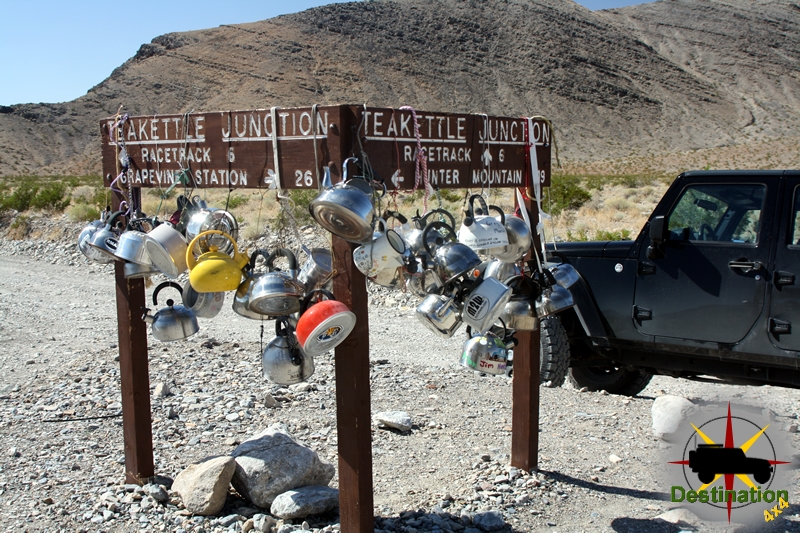
TeaKettle Junction lets you know you are starting to get close to the Racetrack.

Racetrack valley is a rough graded road which departs the Ubehebe Crater site and heads south into the desert. The road is rough, but easily passable in a regular car. However, when entering back country areas such as this it is always a good idea to have the insurance of a reliable vehicle, high clearance, four wheel drive, etc…  Do yourself a huge favor and air down your tires if you are properly equipped to air up when the trip is over.

Looking north from the Lippincott Mine towards the Racetrack off in the distance.

The racetrack valley road is a 25 miles one way trip to the playa. The road is grated, but can be heavily wash-boarded depending on the time of year, rain fall, etc…

Along the way, there are many side trips and alternate trails to help expand your visit.

As you leave Ubehebe Crater, you will be driving south and gradually gaining elevation. Take your time and enjoy the drive, if you are lucky you may see a big horn sheep herd. The road gradually gains in elevation and climbs through a Joshua Tree Forest.

Once you reach the pass, the road continues to drop in elevation all the way down to the playa. Continue straight through tea kettle junction, and bear left down the valley past the side road to the Lippincott mine, which is a great side trail.

The Racetrack Playa of Death Valley.

As you continue past the road to the Lippincott mine the road drops down to the Racetrack Playa itself. The first stop is ‘The Grandstand’ which is an outcropping of rock located in the north west corner of the racetrack. The second stop is the parking area to hike towards the stones. Don’t try to hike to the stones from the first Grandstand parking lot, or you will be hiking significantly further.

The highlight of the trip, is a short hike to the sailing or racing stones. The start of the hike is the parking area at the southern end of the racetrack playa.

Jeeps and Labradors are not allowed on the playa!

To reach the stones hike east from the parking lot across the playa towards the dark stone hillside. It is short FLAT, meaning really FLAT hike towards the stones. Be sure the check the temperatures before you leave, and bring lots of water. This is true with anything you might want to do in Death Valley. Don’t walk on the playa if it is wet or muddy.

The Racing stones.
The Racing stones.

At the end of the 30 miles road there is a small primitive campground for overnight visits. Be sure to check with the National Park Service for regulations of back country camping within the park.

Every racetrack needs a grandstand.

Notoriety

On September 19th, 1969 a Michigan front end loading is found burning along the road near the playa. Apparently, Manson order the machine burned. Park Rangers were deployed to the Racetrack. The rangers followed a set of tire tracked which belonged to a Toyota Land Cruiser which was stolen by Manson. The follow up investigate lead to the arrest of Charles Manson at Barker Ranch on October 12th, 1969.

Racetrack Valley Trail Map

References

Charles Milles Maddox

Charles Milles Maddox AKA Charlie Manson was a serial killer and most of the bad parts of the Old Testament sort of criminal. He briefly lived in the Panamint Mountains on the western edge of Death Valley National Park.

The booking photo of the dimunutive Charles Milles Maddox.  Inyo County October 1969.
The booking photo of the dimunutive Charles Milles Maddox. Inyo County October 1969.

Introduction

As a preface, I would like to say that I have been extremely reluctant to include Maddox on my website. I do not wish to glorify him in anyway. Growing up in the 1970s, just a few miles from the La Bianca house, I can not remember when I first heard of Manson. Our family loved the 395 highway and knew some law enforcement officers in Lone Pine, Inyo County.

Long Story Short

Most books and movies of Manson tend correctly focas on the Tate-La Bianca murders. In summary, Manson, a career criminal, is release from prison. He meets young women and uses the girls to attack young men with sex a drugs. Over the coarse of about two years, he forms them in a cult of followers who live at Spahn movie ranch.. On August 9th and 10th, 1969, Manson orders these followers to slaughter 7 people in their homes.

After the murders, the family cult moves to Barker Ranch in Goler Wash, in Death Valley. It is here that he is captured for vandalizing some earth moving equipment and auto theft. Once captured, he is connected to the murders in Los Angles, tried and convicted by Vincent Bug

Panamint Charlie

Myers Ranch, Panamint Mountain

Mansons original destination is the Myers Ranch in the Panamint Range. In October, 1968, he started to look for a desert location to move his “brood”. He choose the desert because “Out there, things aren’t so crazy”. (Ironic) One of his followers is Cathy (Cappy) Gilles is a grand daughter of Bill and Barbara Myers. “Cappy” obtained permission from the family matriarch for her and some girls to come up and stay at the ranch. One can not help to wonder if the true purpose of moving them to the Panamint mountains is to further isolate his followers from society.

Additionally, Manson supposedly discussed operating out of Barker Ranch with the owner Arlene. He convinced her he was a musician working on a record and would maintain the property for her. He gave her a Beach Boys gold album in payment, which would undoubtably prove his claims of being a musician. Between 40 acres at Myers Ranch and 5 acres at Barker, he had control over 45 acres of property in the sparsely populated Panamint Mountains.

The family stayed in Goler Wash from October 1968 to about January 1969. The family of nineteen people travelled using a school bus to the mouth of Goler wash, and would hike in with supplies up the ranch house. During this time, they made regular trips back down to Los Angeles or over to Las Vegas. The family would regularly shop for supplies in Ballarat which still had a small population and general store.

In the winter months of 1969, Manson and his followers returned to Los Angeles. They stayed at several other locations beside the infamous Spahn movie ranch. During this time, they continued to steal cars, deal drugs, probably prostitution and all in all anything to make money and “acquire” supplies.

Desert Deterioration

Barker Ranch - The building complex was heavily vegetated with trees, with a sparsely planted understory. Note the Charles Milles Maddox bus in the left hand side of the image. View northwest, 1969 (DEVA collection). - NPS
Barker Ranch – The building complex was heavily vegetated with trees, with a sparsely planted understory. Note the Manson bus in the left hand side of the image. View northwest, 1969 (DEVA collection). – NPS

After the Tate-La Bianca murder in August of 1969, Charles Milles Maddox and his cult travelled back up to Goler Wash. This time he setup operations around Barker Ranch. Paul Watkins was a former follower who left the family before the murders. His book is fascinating.

Prior to Charlies arrival, Watkins and some prospectors where living at Barker Ranch. Watkins received guidance from a prospector named Crockett who helped Watkins leave the family. Manson knew of Crockett’s influence over Watkins and recognize an adversary. Upon his arrival, Manson asked permission to enter the area. As Watkins et al where living in Barker Ranch, the Manson Cult moved into the Myers Ranch.

Over the next few weeks, Charlie Manson continued his mental downward spiral. At the time, the neighbors at Barker Ranch knew Charlie was dangerous, however did not know about his guilt in the Los Angeles Murders. Crockett would have philosophical conversations and push the boundaries of Manson. This prompted the unstable Manson to come visiting the occupants at Barker ranch in the middle of the night. On at least two attempts he was caught trying to sneak into the ranch house while the occupants slept. He was greeted with the muzzle of a shotgun and left into the night.

Manson is said to have driven around the area of the Panamint mountains and Death Valley looking for a hole in the earth. These excursions opened the door into the capture of the psychopath. During this time he continued to prepare for a racial war he thought was coming.

Investigation

Jim Pursell at the Manson Trial, L.A. Superior Courthouse, 1970

The beginning of the end for Manson started with a report of a fire on a Michigan front loader out at Racetrack valley. The front loader was moved to the playa in Race Track Valley to repair damage to the playa surface by off-roaders. On September 19th, 1969, Manson ordered the some family members to burn the machine because he construed it to be the device of environmental damage. Oddly enough, it was there to repair environmental damage…. This decision by Manson set in place a series of events which led to his capture and a life time in jail.

Inyo County officials were extremely upset about the loss of their newly acquired $35,000 earth moving equipment. They quickly dispatch officers and launched an investigation.

Park Rangers arrived at the scene of the fire sometime later. They noted several tire tracks leading away from the fire. One set of tire tracks belonged to a Toyota Land Cruiser. Follow up investigation included reports of a Red Toyota Land Cruiser driving around in the area. It was reported this Red Land Cruiser is driven by some hippies who lived up at Barker Ranch.

October 9th, 1969

On October 9th, CHP Officer Jim Pursell and Park Ranger Dick Powell drove up to Barker Ranch approaching from Mengel Pass. They ran into two of Mason’s girls and lacking evidence moved on down Goler Wash. In doing so, the came across Brooks Poston and Paul Crocket. When questioned why he was hauling supplies for the groupd Crocket replied, ‘‘I think my life might depend on it.’

The two men are instructed to return to Barker Ranch. On questioning about Manson, Brooks and Crocket told the two men about the families activity. According to Paul Watkins, Crocket left the ranch for fear of Manson was going to attract law enforcement. This event s probably because Crockett told law enforcement. Pursell noted that a VW was hidden beneath a purple nylon parachute beneath a trash heap. nd recorded the VIN number.

The two men left the ranch again and travelled down Goler Wash they stopped at a draw. Dick Powell started up the draw and was soon within a group of naked young women, one of who is Squeaky Fromme. Fromme claimed to be part of a girl scout troup from San Francisco and with no other evidence, the two officers continued down the valley.

A Series of Raids

Enroute to Trona, the two law enforcement officers found out over the radio that the car was stolen and a predawn raid is slated for the following morning. Looking forward to a long night, the two men hand dinner in Ballarat before parking at the mouth of Goler Wash.

October 10th

The first raid took place on October 10th, 1969. Just before dawn, a small task force made up of officers from the California Highway Patrol, Inyo County Sheriff’s Department, and the National Parks Service maneuvered into position around Barker Ranch. The cult members had pilled rocks up along the road, which necessitated the officers travel on foot.

At first, it seemed the operation was a success. The task forced found several stolen cars and dune buggies. Weapons suchs a pistol, knives, food, gasoline, and other survivalist supplies confirmed that the cult was building a stronghold in the desert for the long haul. They arrested three men, ten girls, and two babies, one of them just a few weeks old. A count of the number of sleeping bags informed the task force they had not captured everyone involved.

October 12th

On the evening of October 12, the small force of park rangers headed back to Barker Ranch. From an observation point, the witnessed four people walking towards the cabin and entering the building. One of the people is covered head to tow in a buck skin outfit and obviously the leader.

The task forced stormed the ranch with guns drawn. The ordered the occupants inside to raise their hands. They met no resistance. The man dressed buckskin is nowhere to be found.

Charles Milles Maddox Capture

Barker Ranch, CCharles Milles Maddox’s hiding place  Vernon Merritt III Time & Life Pictures/Shutterstock
Barker Ranch, Charles Manson’s hiding place Vernon Merritt III Time & Life Pictures/Shutterstock

Following the raid, Jim Pursell search for the buckskin man. He enters the bathroom where is sees a very small cabinet. The door is slightly open and he notices a few long hairs sticking out. In the failing evening light, armed with a candle and a .357 revolver, Pursell noticed some fingers wiggling inside.

Pursell later recounted “I put the candle way down, and this figure starts unwinding and coming out. How he got into that cupboard, I’ll never know. He’s not big. I’ve had a lot of people ask me, ‘Why didn’t you shoot the son of a bitch?’ But again, we really didn’t know what we had, and you can’t just shoot somebody that climbs out of a little cupboard, and says [cheerily], ‘Hi! I was pointing the gun at him and told him exactly what I wanted him to do, and what not to do. ‘Make one wrong move and I’ll blow your head off.’ I ask his name, and he said, simply, ‘Charlie Manson.’ Right off. I led him out to the guys outside”

The raid of October 12th lead to arrest of six males and three more females. All in all the bravery of the CHP, INYO Sheriffs and Park Rangers led to the apprehension, conviction and sentencing of one of the worlds most notorious people, Charles Milles Maddox. The cult or family that Manson started literally killed many and ruined the lives of hundreds of people. The story of Mansons life in the Panamint Mountains of Death Valley is more fascinating that the typical most people will understand and his activities in Death Valley are far larger than “Barker Ranch.”

Manson’s Locations in and around Death Valley

Ballarat, California - Marriedtofilm at English Wikipedia - Transferred from en.wikipedia to Commons by Malafaya using CommonsHelper.

Ballarat California – Inyo County Ghost Town

Ballarat, California Located in Inyo County, Ballarat California is a ghost town which supposedly has a few residents living their dream within the town. Ballarat…
This image, taken circa 1940, shows the main residence, workshop, retaining walls, and ornamental vegetation. Note the windmill located behind the workshop. View north (DEVA collection) - NPS

Barker Ranch

Thomason/Barker Ranch is a five-acre property within Death Valley National Park. This historic site is located off of Goler Wash in the southern Panamint Range…
Myers Ranch, Panamint Mountain

Myers Ranch

Myers Ranch is a privately owned ranch located in Goler Wash in the Panamint Mountains of Death Valley National Park, California. The forty acre ranch…
The Racing stones.

Racetrack Valley

TeaKettle Junction lets you know you are starting to get close to the Racetrack. Racetrack valley is a rough graded road which departs the Ubehebe…
Looking down at the Lippencott Mine Road from the Lippencott Mine, with Saline Valley in the distance.

Warm Springs Road

A short side trip from the Saline Valley Road to the Saline Valley Warm Springs in Death Valley National Park, California. The road is used…

References