Hole in the Rock
Recognized on the National Register of Historic Places, the Hole in the Rock trail is an old Mormon trail in Utah that was used to establish colonies on the east side of the Colorado River in 1879. The Hole in the Rock from which the trail is named, is a narrow canyon from the rim of the canyon down into the Colorado River Valley. This canyon provided access to the Colorado River and the much needed water require to survive in these remote locations. Months were spent widening the narrow canyon to allow “safe” passage of all the wagons and cattle.

The original trail was bisected when the Glen Canyon damn bottled the Colorado River and started to fill up Lake Powell in 1966. However, thE road continues to exist and allows access to the Escalante Canyon system, along with access to the Devils Garden, numerous slot canyons and lots of back country hiking and camping opportunities.

The road passes between the Kaiparowits Plateau and the Escalante River. This area is a labyrinth of roads and trails. The trail leaves the small town of Escalante and travels 44 miles south along a sandy road.

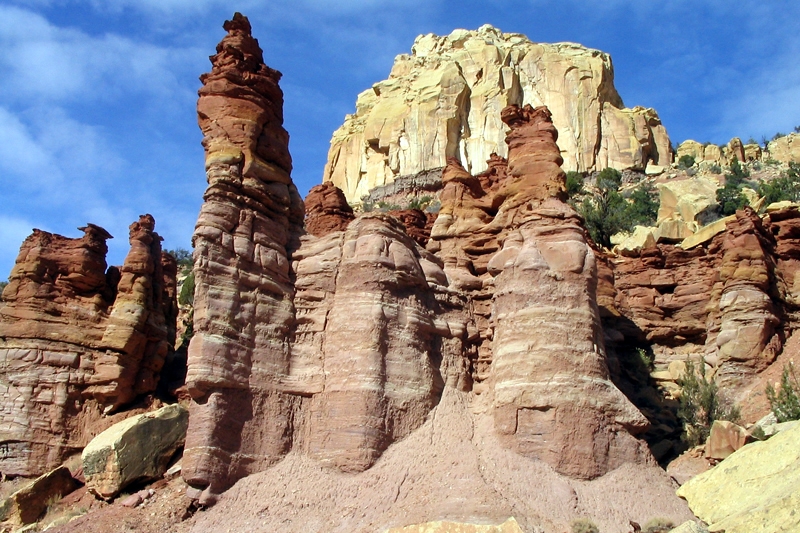
Do not underestimate how cool this area is to visit. The rock formations, remote locations and sunsets are beyond comprehension. One can get the feeling of isolation on just a short visit.

Hole in the Rock Trail Map
Shafer Trail
The Shafer Trail, located in the Island in the Sky district of Canyonlands National Park near Moab, Utah, is a renowned backcountry road celebrated for its dramatic scenery and challenging terrain. Spanning approximately 19 miles, the trail descends 1,500 feet through a massive sandstone cliff via a series of tight switchbacks, connecting the mesa top to the canyon floor and linking with the White Rim Road and Potash Road. Its history reflects a rich tapestry of human activity, evolving from ancient pathways to a modern recreational route.

Early Use by Native Americans
Long before modern roads, the Shafer Trail began as a route used by Native Americans to access resources on the mesa top and travel to the Colorado River below. These early inhabitants of the region navigated the rugged terrain to gather materials and move between seasonal locations, establishing a path that would later be adapted for other purposes. The trail’s origins as a Native American route highlight its significance as a corridor through the challenging canyon landscape.
Ranching Era and the Shafer Family
In the early 20th century, the trail was adapted by Mormon pioneer settlers, particularly the Shafer family, for whom it is named. Starting in 1916, John “Sog” Shafer used the trail to move cattle between summer pastures on the mesa top and winter grazing grounds on the White Rim sandstone below. Shafer and other ranchers improved the trail, widening and stabilizing it to make it safer for livestock, though it remained narrow and perilous, with animals occasionally slipping to their deaths. These improvements laid the groundwork for later developments, and many trails in the Island in the Sky district bear the names of families who worked them.
Uranium Boom and Road Expansion
The 1950s marked a significant transformation for the Shafer Trail during the uranium boom in the American Southwest. The Atomic Energy Commission widened and extended the trail to accommodate trucks transporting uranium-bearing ore from mines in the Triassic Chinle Formation to processing facilities in Moab. This period saw many backcountry roads in the Moab area, including the Shafer Trail, upgraded to support the mining industry, leaving visible scars across the desert landscape. The trail’s role in uranium transport underscores its importance to the region’s industrial history.
Transition to Recreation
With the establishment of Canyonlands National Park in 1964, the Shafer Trail’s function shifted from ranching and mining to recreation. Ranchers were granted a ten-year extension to continue operations, but by the mid-1970s, the trail was primarily used by visitors seeking adventure. The National Park Service improved the road to make it safer for recreational use, though it remains unpaved and challenging, requiring high-clearance 4WD vehicles with low-range gear (4LO). Today, the trail attracts hundreds of visitors annually for its thrilling switchbacks and breathtaking views of Canyonlands’ sculpted pinnacles, buttes, and the Colorado River.
Modern-Day Significance
The Shafer Trail is now an iconic backcountry drive, celebrated for its scenic beauty and historical significance. It offers access to notable sites like the Shafer Canyon Overlook, where visitors can view the trail’s switchbacks and the surrounding canyon landscape, and Thelma and Louise Point, famous for its appearance in the 1991 film’s final scene. The trail also connects to other recreational routes like the White Rim Road and is popular among hikers, mountain bikers, and photographers for its wildflowers, petroglyphs, and dinosaur tracks. Its challenging conditions, including steep drops and sharp rocks, require careful preparation, and it can become impassable during wet or snowy weather.
Conclusion
From a Native American pathway to a cattle trail, a uranium transport route, and now a premier recreational destination, the Shafer Trail encapsulates the evolving human relationship with Canyonlands’ rugged landscape. Named after the Shafer family and shaped by centuries of use, it remains a testament to the region’s cultural, industrial, and natural history, offering visitors an unforgettable journey through one of America’s most striking national parks.
Shafer Trail map
Valley of the Gods
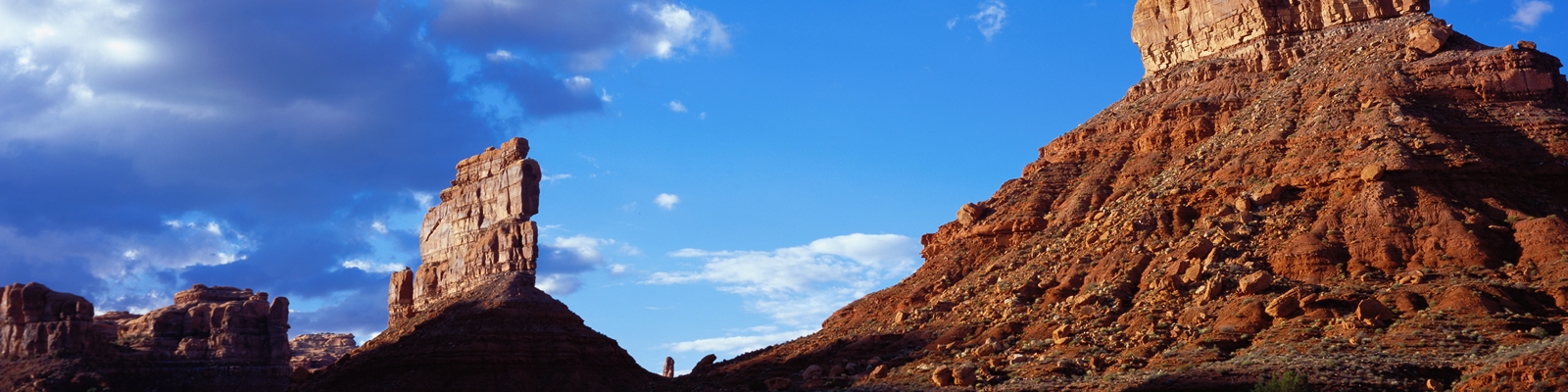
Valley of the Gods is a beautiful sandstone valley and located in the South East corner of Utah near Mexican Hat. alley of the Gods is the lesser known northern extension of Monument Valley and is frequently confused with Monument Valley. The valley is carved out from a layer of eroded sandstone, and features two large table top mesa with are long and narrow in shape. These mesas appear like ship sails again a sea of clear blue skies.
The seventeen mile trail loops north from highway 163 and then travels back the the south west to connect to highway 261 and recommended for high clearance vehicles.

Down towards to the of the valley, two beautiful spires reminded me of sailing ships in the desert. The road winds between them to provide for an amazing drive.
Unlike Monument Valley which is controlled by the Navajo Nation, the valley is managed by the Bureau of Land Management and does not contain any services or campgrounds, or tribal restrictions. There are several small camping spots on the loop and when I visited in October the number of people seems to be quite low.
Valley of the Gods trail map
Geological Report on Formation
The striking landscape of Valley of the Gods is the result of sedimentary deposition, tectonic uplift, and prolonged differential erosion over hundreds of millions of years. The primary rock unit is the Cedar Mesa Sandstone, part of the Permian-age Cutler Group (approximately 250–270 million years old). This formation reaches thicknesses of up to 1,200 feet and was deposited in a coastal environment near the shores of an ancient shallow sea that once covered much of the region during the Permian Period.
- Depositional environment: The Cedar Mesa Sandstone originated as huge sand dunes and beach deposits along a fluctuating shoreline. It consists of cross-bedded sandstone cemented by calcium carbonate, with interspersed lenses of red siltstone. Underlying it is the older Halgaito Shale (also Permian), which formed in coastal deltas and shallow marine settings. These layers represent a transition from marine to more terrestrial conditions in western Pangea.
- Coloration: After the ancient sea retreated, iron minerals within the sediments oxidized (reacted with oxygen), producing the characteristic rich red, orange, and purple hues visible today. Horizontal striations in the rock record millions of years of layered deposition.
- Erosional sculpting: The Colorado Plateau’s gradual uplift (beginning tens of millions of years ago) exposed these rocks to the forces of wind, water, and ice. Differential erosion is key: the softer Halgaito Shale erodes more quickly than the resistant Cedar Mesa Sandstone above it, causing undercutting and cliff retreat. This process isolates massive buttes, spires, and pinnacles, creating the “sentinels” and mushroom-like forms seen throughout the valley. Over eons, these same forces have carved the 17-mile valley floor and surrounding features.
The valley’s geology also preserves Late Paleozoic fossils (vertebrates, plants, and invertebrates) in the Halgaito Shale and related units, offering a window into ancient coastal plain and riparian environments.
In essence, Valley of the Gods is a textbook example of Colorado Plateau geology: ancient Permian coastal sediments uplifted and exquisitely sculpted by arid-climate erosion into one of the American Southwest’s most iconic badlands.
Human History and Cultural Significance
While the rocks themselves predate humanity by hundreds of millions of years, the valley holds deep cultural meaning for Native American tribes and has seen limited Euro-American activity.
- Indigenous connections: The Valley of the Gods is sacred to the Navajo (Diné) people. According to Navajo tradition, the towering monoliths are ancient Navajo warriors frozen in stone and time—spirits that reside in these places of power and can be appealed to for protection and strength (especially for young servicemen). The broader Bears Ears region, which once included the valley, contains over 100,000 cultural sites significant to multiple tribes, including the Navajo, Ute, and others. It features prominently in creation mythologies and is sometimes described as a “Garden of Eden” for these peoples. The area also preserves Ancestral Puebloan (Anasazi) artifacts, rock art, and ruins in the surrounding Cedar Mesa landscape.
- Euro-American exploration and naming: The valley remained largely undeveloped and unnamed until the mid-20th century. In the 1940s, prospector Albert Christensen gave it its evocative name, comparing the dramatic sandstone formations to the gods of mythology. Early 20th-century ranchers and prospectors may have passed through the area, but it never supported major settlement.
- Filming and recreation: Its classic “western” look made it a popular backdrop for commercials, movies, and promotions (including Marlboro ads and even video game backgrounds). The 17-mile loop road, accessible from U.S. Highway 163 or Utah State Route 261 (near the dramatic Moki Dugway switchbacks), has long drawn photographers, hikers, and off-road enthusiasts.
- Modern protection and controversies: In 2008, the Bureau of Land Management (BLM) designated Valley of the Gods an Area of Critical Environmental Concern (ACEC) to protect its scenic values. In 2016, President Obama included it in the 1.35-million-acre Bears Ears National Monument, citing its cultural, paleontological, and natural importance. In 2017, President Trump reduced the monument by about 85%, removing the Valley of the Gods (and other areas) from monument status; it reverted to ACEC protection under BLM management. The valley remains open to the public with no entrance fees, though it prohibits campfires and limits camping to previously disturbed sites. It continues to face debates over balancing recreation, grazing, and resource protection.
Today, Valley of the Gods stands as a pristine, uncrowded gem of the Colorado Plateau—offering solitude, stunning geology, and a living connection to Native American heritage. Its formations continue to erode slowly, ensuring that future generations will witness an ever-changing landscape shaped by the same forces that created it over 250 million years ago. For visitors, a drive or hike through the valley provides both geological wonder and cultural reverence in one of Utah’s most underrated desert treasures.
Achy-Breaky
Achy-Breaky is a very difficult, trail which circumnavigates Watkins Peak in San Bernardino County, California. This trail is one of many on the Stoddard Wells OHV. The trail requires a well built 4×4 and a GPS to even stay on the trail which a network of difficult to navigate trails.

Located south of Barstow, in the Stoddard Wells OHV Area. The trail is quite a popular destination for people who are looking to test their 4×4, and not suitable for stock vehicles. Skid plates, differential lockers, high ground clearance and a capable truck are required to navigate the desert terrain with numerous steep, rocky climbs. Tire damage is a real possibility from the large, sharp rocks. Although technically challenging, the trail does not offer much in the scenery department, unless you hike up towards to top of the peak.
The trail is best run from November to March each year due to the high heat of the Mohave Desert. More information on Stoddard Wells OHV Area can be found at the Barstow Field office of the Bureau of Land Management at 760-252-6000.
Arcy-Breaky Trail Map
References
White Mountain Road
Locathed in Inyo County, the White Mountain Road is a high altitude road that travels north from Highway 168 out of Big Pine and into the Bristle Cone Pine Forest of the White Mountains. The road is partial paved as far as the Schulman Grove visitors center and beyond the road is graded dirt.

As the White Mountain roads winds north, it follows the ridge line of the White Mountains climbing higher in elevation and offers up amazing vistas of Owens Valley to the west.

The bristlecone pine tree is found in this mountain range, and is the oldest living thing on the planet and are known to live 5,000 years. The bristlecone pine trees live in groves in arid sub alpine mountain tops in the western United States, including the White Mountains in California and around Mount Charleston just north of Las Vegas. The harsh environment, high elevations over 12,000 above sea level, dry conditions, high winds twist a bend the trees and they slowly grow across the millennium.

The very high elevation takes its toll on car and driver a like. While climbing the route, the power of the jeep was quite noticeable. I did not notice the elevation until I got out for a bit of a hike among the Bristle Cones. Once must be careful to catch their breathe, and the suns intensity was rather noticable.