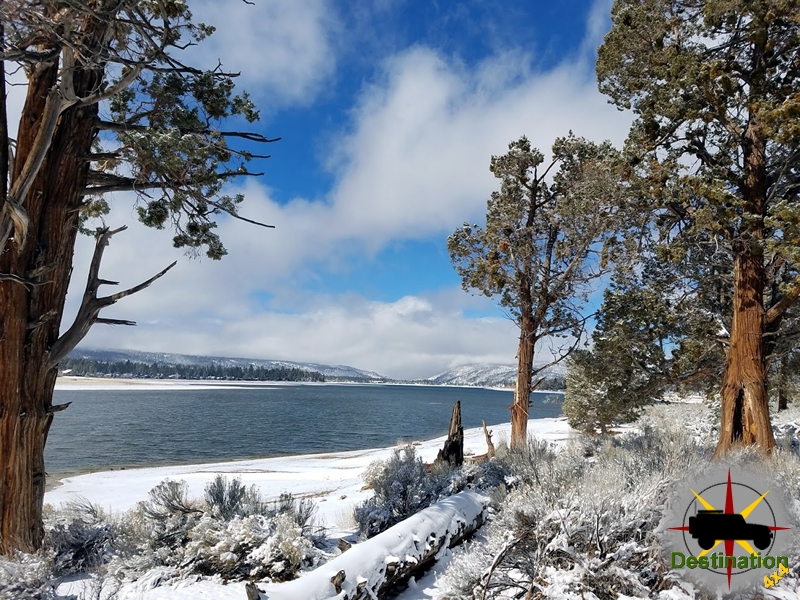
Big Bear, CA
I quiet mountain community full of back country adventure.
The Journey is the destination
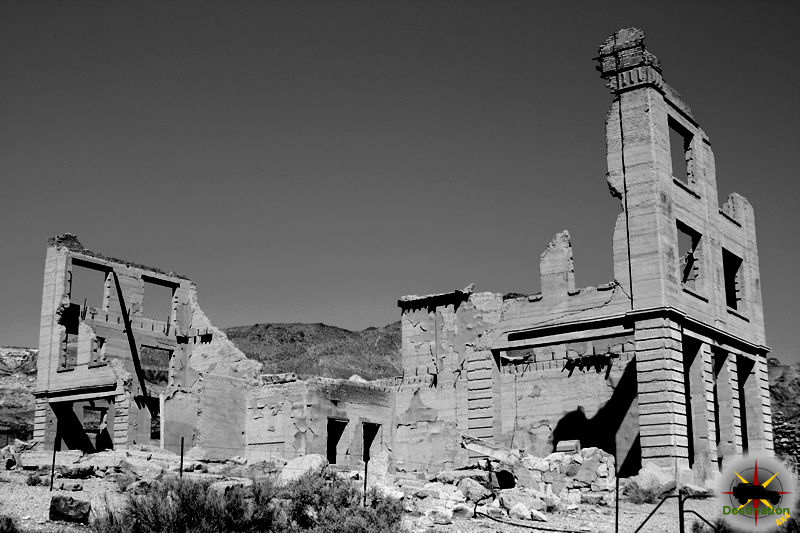

Spanning an awe-inspiring 6.3 million acres, Humboldt–Toiyabe National Forest is the largest national forest in the contiguous United States. This vast landscape stretches across most of Nevada and into a portion of eastern California. Unlike traditional forests, it consists of numerous large, non-contiguous sections scattered across dozens of mountain ranges, creating a mosaic of extraordinary natural beauty.
From rugged desert valleys and sagebrush steppes to lush alpine meadows, glacial canyons, and snow-capped peaks rising over 12,000 feet, Humboldt–Toiyabe offers classic Western scenery and unparalleled solitude.
The forest encompasses over 60 mountain ranges, including iconic areas like:
Elevations range from about 4,000 feet in arid basins to over 12,000 feet at summits like Dunderberg Peak. This variation supports an incredible range of ecosystems — from ancient bristlecone pines and aspen groves to volcanic formations and limestone canyons.
The forest is home to over 350 species of wildlife, including:
Crystal-clear rivers and alpine lakes teem with trout, while the dark night skies — some of the best in the Lower 48 — offer spectacular stargazing. Visitors often encounter historic mining remnants, ancient petroglyphs, and ghost towns that tell the story of the Old West.
Summer & Fall:
Winter & Spring:
Popular trails include the Hunter Creek Trail (with its refreshing waterfall), Mount Rose Summit, and sections of the Tahoe Rim Trail and Pacific Crest Trail.
The forest also features 18–24 designated Wilderness Areas, offering pristine, roadless experiences for those seeking true solitude.
Whether you’re chasing alpine adventure in the Rubies, seeking desert mountain solitude near Las Vegas, or exploring historic trails, Humboldt–Toiyabe National Forest delivers unforgettable experiences in one of the American West’s most expansive and diverse wild places.
“Adventure Awaits in Nevada’s Majestic Backyard”
For more information, visit the official U.S. Forest Service website: fs.usda.gov/htnf
Protecting and sharing this land for future generations.
 Trumbull Lake CampgroundHumboldt–Toiyabe National Forest Campgrounds Trumbull Lake Campground, nestled in the Humboldt-Toiyabe National Forest near Bridgeport, California, is a serene high-altitude camping destination at 9,980 feet… |
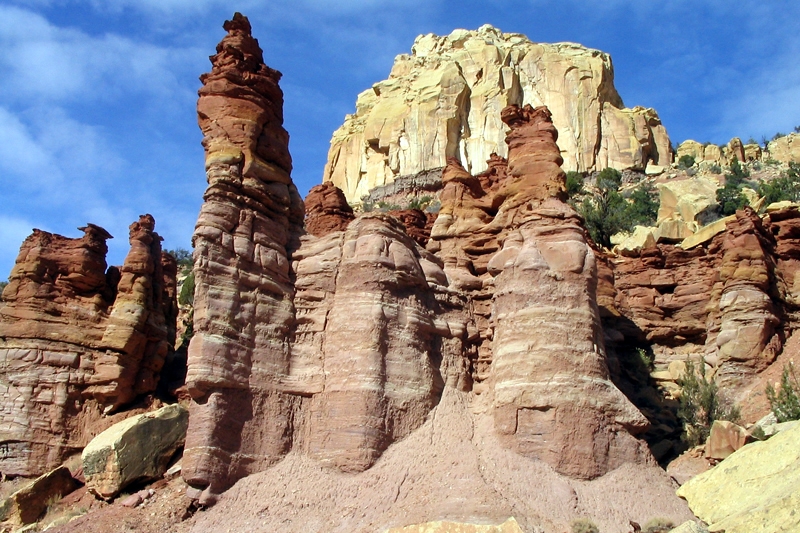
In the sun-scorched heart of Utah’s Grand Staircase-Escalante National Monument, where the Hole-in-the-Rock Trail claws its way through a labyrinth of crimson canyons like the desperate fingers of Mormon pioneers hacking at stone in 1879, lies Devil’s Garden—a surreal tableau of the earth’s defiant artistry, a gallery where time’s patient chisel has mocked gravity and whispered secrets of ancient winds. This is no mere badlands, but a fever dream etched in sandstone, where the land rises in defiant spires and dissolves into whispering hoodoos, as if the desert itself, weary of flat horizons, conspired with the sky to birth a menagerie of stone beasts frozen mid-roar.

Geologically, Devil’s Garden unfurls from the Jurassic Entrada Sandstone, a 180-million-year-old relic of vast eolian dunes that once undulated across a sun-blasted supercontinent like the breath of forgotten leviathans. These cross-bedded layers, fine-grained and ochre-hued, were laid down in arid coastal sabkhas and wind-swept ergs, their quartzose grains—subrounded, frosted relics of primordial beaches—cemented loosely enough to yield to erosion’s subtle tyranny. Above and below, the Navajo Sandstone’s pale monoliths loom like bleached bones of colossal whales, while the underlying Kayenta Formation’s red fluvial silts speak of meandering rivers that quenched Triassic thirsts long before the dinosaurs’ dominion. But it is the Entrada’s capricious members—the silty Gunsight Butte and the interbedded Cannonville—that ignite the garden’s whimsy: differential weathering gnaws at softer lenses, toppling slabs into balanced rocks that teeter on invisible threads, while harder caps shield slender pedestals, birthing hoodoos that squat like mischievous imps, their fluted skirts etched by flash floods and the ceaseless sigh of wind.
Wander its maze off the trail’s dusty vein, and Metate Arch spans like a portal to petrified skies, a 20-foot crescent of Slickrock hewn from the Escalante Member’s “stonepecker” pockmarks—hollows bored by ancient burrowing winds or the ghosts of Cretaceous tides. Nearby, Mano Arch frames the horizon in delicate filigree, a testament to joint-controlled fracturing where the Circle Cliffs uplift tilted these strata northward, exposing them to the Colorado Plateau’s relentless sculpting. Petrified logs from the Chinle Formation’s volcanic-ash mudstones peek through like fossilized lightning, reminders that this paradise was once a floodplain choked with conifers and the clamor of unseen beasts, before the Laramide Orogeny’s slow heave and Pleistocene downcuts exhumed it all.
Yet Devil’s Garden is no static relic; it breathes with the pulse of erosion, a slow-motion ballet where rain’s rare kisses dissolve calcium bonds, and thermal fractures invite collapse. In the golden hour, shadows pool in goblin hollows, turning the palette from burnt sienna to bruised plum, inviting the soul to trace the earth’s autobiography in every fractured finial. Here, off the Hole-in-the-Rock’s historic scar—a trail born of faith and folly, blasted through basalt to ford the Escalante River—nature’s geology becomes poetry: a devilish delight where stone defies the fall, and the desert, in its infinite patience, dreams of flight.

Grand Staircase-Escalante National Monument in southern Utah represents a profound intersection of geological time and human endeavor. Spanning approximately 1.87 million acres, the monument preserves over 270 million years of Earth’s history through its iconic “Grand Staircase”—a series of stepped cliffs and plateaus that reveal ancient environments from deserts and shallow seas to lush floodplains. Geologically, it is renowned for its continuous stratigraphic record and abundant fossils, including dinosaur remains and petrified forests. Historically, the area has been inhabited by Indigenous peoples for millennia and later traversed by Mormon pioneers, culminating in its controversial establishment as a national monument in 1996. Managed by the Bureau of Land Management (BLM), GSENM faces ongoing debates over resource use and preservation.
Established on September 18, 1996, by President Bill Clinton under the Antiquities Act, GSENM initially encompassed 1.7 million acres to protect its unparalleled scientific and cultural resources. The monument’s name derives from the Escalante River, named after Spanish explorer Silvestre Vélez de Escalante, and the Grand Staircase, a geological feature conceptualized by Clarence Dutton in 1880. Divided into three sections—the rugged Grand Staircase in the west, the high Kaiparowits Plateau in the center, and the dissected Escalante Canyons in the east—GSENM spans diverse landscapes of slot canyons, buttes, and badlands. Its boundaries were reduced by nearly 47% in 2017 under President Donald Trump but restored to their original extent in 2021 by President Joe Biden, a decision upheld by federal courts in 2023 with appeals ongoing as of late 2024. Today, it serves as a critical site for paleontological research, cultural heritage, and recreation, attracting over 1 million visitors annually while balancing conservation with traditional uses like grazing and off-road access.
The geology of GSENM is a testament to the dynamic forces that have shaped the Colorado Plateau, recording environmental shifts from arid deserts to marine incursions over nearly 300 million years. The monument’s strata, gently dipping northward, form the “Grand Staircase”—a 100-mile-long, 6,000-foot-high sequence of cliffs (risers) and plateaus (treads) that ascends from the Grand Canyon northward to Bryce Canyon National Park. This staircase, first described by geologist Clarence Dutton in 1870, preserves a near-continuous record from the Permian Period (about 275 million years ago) to the Eocene (about 50 million years ago), with only minor unconformities representing erosion gaps.
The stratigraphic column is divided among the monument’s three sections, with thicknesses varying due to local tectonics. From oldest to youngest:
Unconformities, such as a 20-million-year gap between Permian and Triassic rocks, indicate erosion during tectonic quiescence.
Tectonic events shaped the monument’s architecture. The Sevier Orogeny (Late Jurassic–Early Cretaceous) folded strata into north-south anticlines, synclines, and monoclines, including the dramatic East Kaibab Monocline (Cockscomb thrust, with 5,000 feet of displacement) and Escalante Monocline. The Laramide Orogeny (Late Cretaceous–Eocene) uplifted the Colorado Plateau by up to two miles, while Miocene Basin-and-Range extension created normal faults like the Paunsaugunt and Johnson Canyon faults, forming grabens and tilted blocks. Quaternary erosion by the Escalante and Paria Rivers, exacerbated by monsoons and flash floods, incised deep canyons and exposed the staircase. Volcanic activity in the middle Tertiary added ash flows in the Aquarius Plateau, but the dominant process remains differential erosion: resistant sandstones cap cliffs, while softer shales form slopes.
GSENM is a global hotspot for Mesozoic fossils, offering insights into ancient ecosystems. Triassic Chinle layers yield petrified wood (up to 90 feet long), dinosaur tracks, and reptiles. Jurassic Navajo and Morrison formations preserve theropod and sauropod tracks, plus rare bones. The Cretaceous Kaiparowits Formation is exceptionally rich, with hadrosaurs, ankylosaurs, crocodiles, turtles, and plants from a subtropical floodplain—over 1,000 specimens collected since 1996. Marine fossils in Tropic Shale include ammonites and mosasaurs. These finds, protected under the Paleontological Resources Preservation Act, underscore the monument’s role in understanding the dinosaur era’s end.
Human presence dates to the Paleo-Indian period (ca. 10,000 BCE), but permanent settlements emerged during the Basketmaker III Era (ca. AD 500). Ancestral Puebloans (Anasazi) and Fremont peoples farmed corn, beans, and squash in canyons, constructing pithouses, granaries, and rock art panels depicting hunters and abstract symbols. Ruins like those in the Escalante Canyons reveal a sophisticated adaptation to arid environments, with trade networks extending to Mesoamerica. By AD 1300, climate change and overuse led to abandonment, leaving over 5,000 archaeological sites—20% of Utah’s total.
Spanish explorers, including the 1776 Domínguez–Escalante expedition, first mapped the region but did not settle. Mormon pioneers arrived in 1866, with Captain James Andrus leading the first recorded Euro-American party to the Escalante River headwaters. In 1871, Jacob Hamblin traversed the river, aiding John Wesley Powell’s surveys. The 1879 Hole-in-the-Rock Expedition, involving 250 Mormons, blasted a perilous trail through Glen Canyon to establish a southeastern Utah colony, taking six weeks and symbolizing pioneer resilience. By the early 20th century, ranching and mining boomed, with uranium and coal prospects on the Kaiparowits Plateau threatening resources.
Conservation efforts began in the 1930s, but momentum built in the 1990s amid coal mining threats. Clinton’s 1996 proclamation, announced during his reelection campaign, bypassed Utah’s congressional delegation, sparking lawsuits and accusations of federal overreach. The 1998 Utah Schools and Lands Exchange Act swapped state inholdings for $50 million and alternative lands. Trump’s 2017 reduction enabled coal and logging leases, reversed by Biden in 2021 amid lawsuits from counties and states. As of 2025, the monument remains intact, though disputes over Revised Statute 2477 “right-of-way” roads persist, with BLM closing some routes while locals maintain others. Culturally, GSENM honors Indigenous heritage through co-management discussions with tribes like the Kaibab Paiute and Navajo Nation.
GSENM embodies the interplay of geological grandeur and human legacy, from Permian seas to Mormon trails. Its preservation safeguards irreplaceable fossils and sites, but challenges like climate-driven erosion and visitation impacts loom. Recommendations include enhanced paleontological monitoring, Indigenous-led interpretation programs, and sustainable tourism policies. As a cornerstone of the National Conservation Lands, GSENM continues to inspire scientific inquiry and reflection on our shared past. For further reading, consult BLM visitor centers in Escalante or Kanab.
 Devils GardenIn the sun-scorched heart of Utah's Grand Staircase-Escalante National Monument, where the Hole-in-the-Rock Trail claws its way through a labyrinth of crimson canyons like the… |
 Hole in the RockRecognized on the National Register of Historic Places, the Hole in the Rock trail is an old Mormon trail in Utah that was used to establish colonies… |
 Calf Creek Recreation Area CampgroundBureau of Land Management Campground Calf Creek Recreation Area Campground is a serene desert oasis nestled along Calf Creek in the Grand Staircase-Escalante National Monument… |
White House CampgroundNestled in the rugged southwestern expanse of Utah's Grand Staircase-Escalante National Monument (GSENM), White House Campground offers a serene, primitive escape for adventurers seeking solitude… |
Wide Hollow CampgroundNestled within the stunning Escalante Petrified Forest State Park in southern Utah, Wide Hollow Campground beckons adventurers, families, and nature enthusiasts to an idyllic retreat… |
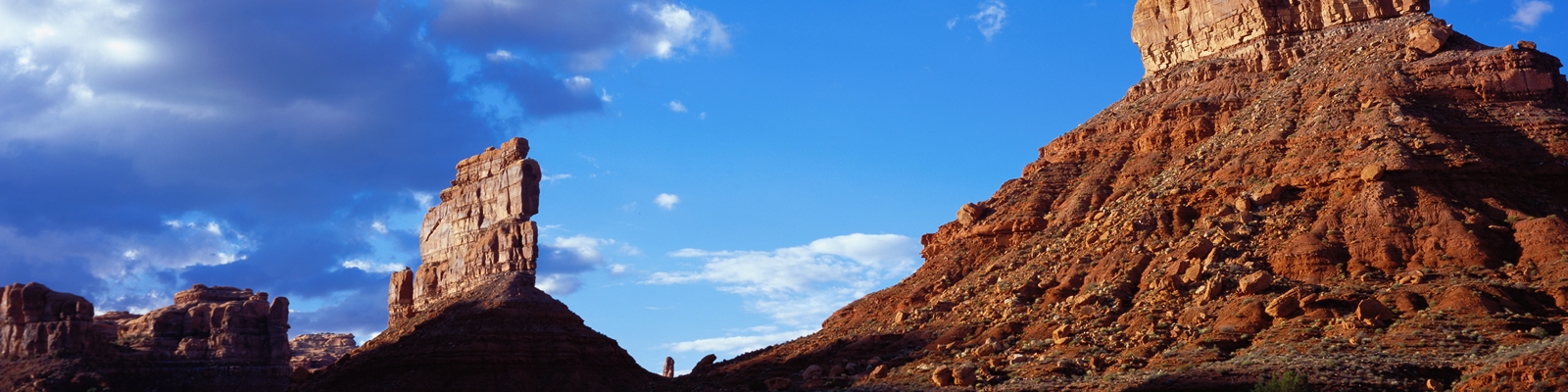
Monument Valley, known in Navajo as Tsé Biiʼ Ndzisgaii (meaning “valley of the rocks”), is a striking region of the Colorado Plateau located along the Arizona-Utah border within the Navajo Nation Reservation. This iconic landscape features clusters of towering sandstone buttes, mesas, and spires that rise dramatically from the valley floor, with the tallest formations reaching up to 1,000 feet (300 meters) in height. Spanning approximately 91,696 acres, it is not a national park but a Navajo Tribal Park, managed by the Navajo Nation since its establishment in 1958.

The area’s red-hued rock formations have become synonymous with the American Southwest, largely due to their appearances in films, but its significance extends far beyond Hollywood, encompassing deep geological history and profound cultural heritage for Indigenous peoples.
Monument Valley’s unique geology is a product of millions of years of sedimentary deposition, uplift, and erosion on the Colorado Plateau. The formations primarily consist of sedimentary rocks dating from the Permian to the Jurassic periods, representing about 192 million years of Earth’s history. The process began during the Permian Period when the area was part of a vast inland sea and desert environments, leading to the accumulation of sediments from eroding ancestral Rocky Mountains.
The valley’s prominent features are built from three main stratigraphic layers:
Regional uplift of the Colorado Plateau, driven by tectonic forces, elevated these layers thousands of feet above sea level. Subsequent erosion by wind, water, and ice carved the landscape. Differential erosion played a key role: harder sandstones resisted weathering, while softer shales eroded faster, creating the isolated pillars, buttes, and arches seen today. Notable formations include the East and West Mitten Buttes (resembling hands in mittens), the Totem Pole (a slender sandstone spire), and Merrick Butte. The valley floor, at elevations of 5,000 to 6,000 feet, is composed of sand and siltstone, with its vivid red tones from oxidized iron.
Geological studies, including those by the U.S. Geological Survey and the New Mexico Geological Society, highlight Monument Valley as a classic example of plateau dissection. Similar landscapes on Mars have even been nicknamed “Monument Valley” by researchers due to visual parallels. Ongoing erosion continues to shape the area, though at a slow pace in this arid environment.
Human history in Monument Valley dates back millennia, intertwined with its geological features. The earliest known inhabitants were the Ancestral Puebloans (also called Anasazi), who occupied the region around 1300 CE or earlier, building cliff dwellings and leaving petroglyphs in nearby areas like Mystery Valley. These ancient peoples used the valley’s resources for hunting, gathering, and agriculture before mysteriously abandoning the sites around the 14th century, possibly due to drought or resource depletion.
By the 1300s, San Juan Band Paiutes frequented the area as nomadic hunters and gatherers, naming it “Valley or Treeless Area Amid the Rocks” and imbuing it with spiritual significance, such as viewing certain formations as gods or hogans (traditional Navajo dwellings). The Navajo (Diné) people arrived later, establishing a more permanent presence by the 18th century. They consider the valley sacred, with mythological stories tied to the landforms.
European contact began with Spanish and Mexican explorers in the 18th and 19th centuries, often in punitive expeditions against Navajo raiders. In the 1860s, during the U.S. government’s campaigns against the Navajo, Kit Carson led forces into the region, forcing many Navajo into the “Long Walk” to internment at Bosque Redondo. After their return in 1868, the Navajo faced miners seeking silver and uranium, with notable incidents like the 1880 killings of prospectors Ernest Mitchell and James Merrick near the monoliths. Uranium mining boomed in the mid-20th century west of U.S. Highway 163, leaving a legacy of environmental contamination that persists today.
The modern era began in the early 20th century with traders like Harry and Leone “Mike” Goulding, who established a trading post in 1923 (now Goulding’s Lodge). They promoted the area to Hollywood, leading to director John Ford’s discovery of the valley in the 1930s. Ford’s films, starting with “Stagecoach” (1939) starring John Wayne, immortalized Monument Valley as the archetype of the American West. Subsequent movies like “The Searchers” (1956), “Forrest Gump” (1994), and “2001: A Space Odyssey” (1968) further cemented its fame.
In 1958, the Navajo Nation established Monument Valley as its first tribal park, a pioneering move in Indigenous self-governance that influenced other tribes. This designation preserved Navajo control over tourism, which includes guided tours emphasizing cultural history.
For the Navajo, Monument Valley is not just a geological wonder but a spiritual homeland. Legends describe buttes as defeated monsters or sky-supporters, and the land is integral to ceremonies and storytelling. Tourism, managed through Navajo-guided jeep, horseback, and hiking tours, provides economic benefits while sharing cultural insights. Visitors can explore the 17-mile scenic drive or off-road sites like Hunt’s Mesa, but unguided access is limited to respect sacred areas.
Today, Monument Valley attracts over 500,000 visitors annually, boosting the local economy through lodges, artisan sales, and film productions. Environmental challenges include erosion, climate change impacts, and legacy mining pollution, prompting ongoing conservation efforts by the Navajo Nation.
Nestled on a sagebrush-covered ridge overlooking the remnants of Bodie State Historic Park in Mono County, California, the Bodie Cemetery stands as a poignant testament to the fleeting fortunes of the American Wild West. Bodie itself emerged in 1859 when prospector W.S. Bodey discovered gold in the surrounding hills, leading to the establishment of a modest mining camp. Tragically, Bodey perished in a blizzard just months later, his body temporarily buried near the site of his death. By spring 1860, his remains were recovered and interred, though not reburied in the formal cemetery until nearly two decades later, around 1879, when the town had swelled into a bustling hub.
The cemetery’s development coincided with Bodie’s explosive growth in the late 1870s. What began as a small settlement ballooned to a population of nearly 10,000 by 1880, fueled by the promise of gold from the Standard Mine and other veins. This boomtown, notorious for its lawlessness—earning the moniker “the worst place in the West” from a minister’s young daughter—saw saloons, brothels, and gunfights outnumber churches and schools. Amid this chaos, the Bodie Miners’ Union, formed on December 22, 1877, played a pivotal role in the cemetery’s history. The union’s constitution included a “death benefits clause,” providing financial support for funerals, grave plots, and stone markers for its members, ensuring dignified burials in an era of perilous labor.
The cemetery comprises three primary sections: the Miners’ Union area (with 38 marked graves), the Wards Cemetery (29 marked graves for general citizens), and the Masonic section (9 marked graves). Beyond these, an informal “Boot Hill” extension housed the outcasts—prostitutes, Chinese immigrants, and those deemed socially unacceptable—buried without ceremony outside the fenced perimeter. The Chinese section, in particular, reflects the town’s multicultural underbelly; hundreds of railroad workers and laborers who sought gold met untimely ends, their unmarked graves a somber reminder of prejudice and unfulfilled dreams of repatriation to their homeland.

Life in Bodie was as harsh as its high-desert climate, with epidemics, mining accidents, and violence claiming lives at an alarming rate. By the 1880s, over 200 burials had occurred, though only about 150 markers remain legible today, scarred by vandalism, erosion, and relentless winters. Notable among the interred is Rosa May, a prostitute legendarily said to have nursed the afflicted during a smallpox outbreak in the 1870s, only to succumb herself and be denied a plot inside the fence. The cemetery also holds a cenotaph to President James A. Garfield, symbolizing the town’s fleeting ties to national events.
As Bodie’s mines played out in the 1890s, the population dwindled to a few hundred by 1915, transforming the site into a ghost town. Designated a National Historic Landmark in 1961 and part of Bodie State Historic Park since 1962, the cemetery endures in “arrested decay,” its weathered headstones whispering tales of ambition, hardship, and transience. Restoration efforts by groups like the Bodie Foundation continue to preserve this legacy, offering visitors a stark contrast to the preserved buildings below—a place where the gold rush’s human cost lies eternally etched in stone.
The following is a curated list of notable or representative burials, drawn from historical records. Dates indicate year of death where known; sections are noted for context. This is not exhaustive, as many markers are faded or lost.
| Name | Death Year | Section/Area | Notes |
|---|---|---|---|
| W.S. Bodey | 1859 | Miners’ Union | Namesake of Bodie; prospector who discovered gold; remains relocated c. 1879. |
| Rosa May (Ding) | 1879? | Outside Fence (Boot Hill) | Prostitute who allegedly nursed smallpox victims; denied formal burial due to profession. |
| Michael Cody | 1880s | Miners’ Union | Union member; burial documented via multiple obituaries. |
| Lester L. Bell | 1955 | Wards Cemetery | Late burial in family plot; reflects ongoing ties to the site. |
| James W. Daly | 1881 | Miners’ Union | Irish miner killed in accident; headstone notes “Erected by his fellow workmen.” |
| Nellie Cashman | 1880s? | Masonic? | Adventurer and restaurateur; disputed burial, but associated with Bodie lore. |
| Chinese Immigrants (various) | 1870s-1880s | Chinese Section (Outside) | Unmarked graves of laborers; hundreds remain, unrestful per local legend. |
| President James A. Garfield (cenotaph) | N/A | Main Cemetery | Symbolic monument; not a burial, honors the assassinated president. |
For a comprehensive inventory of all legible markers, historical surveys list over 150, including children lost to illness, miners crushed in cave-ins, and families who briefly called Bodie home.